French National Dishes

Pastis quercynois

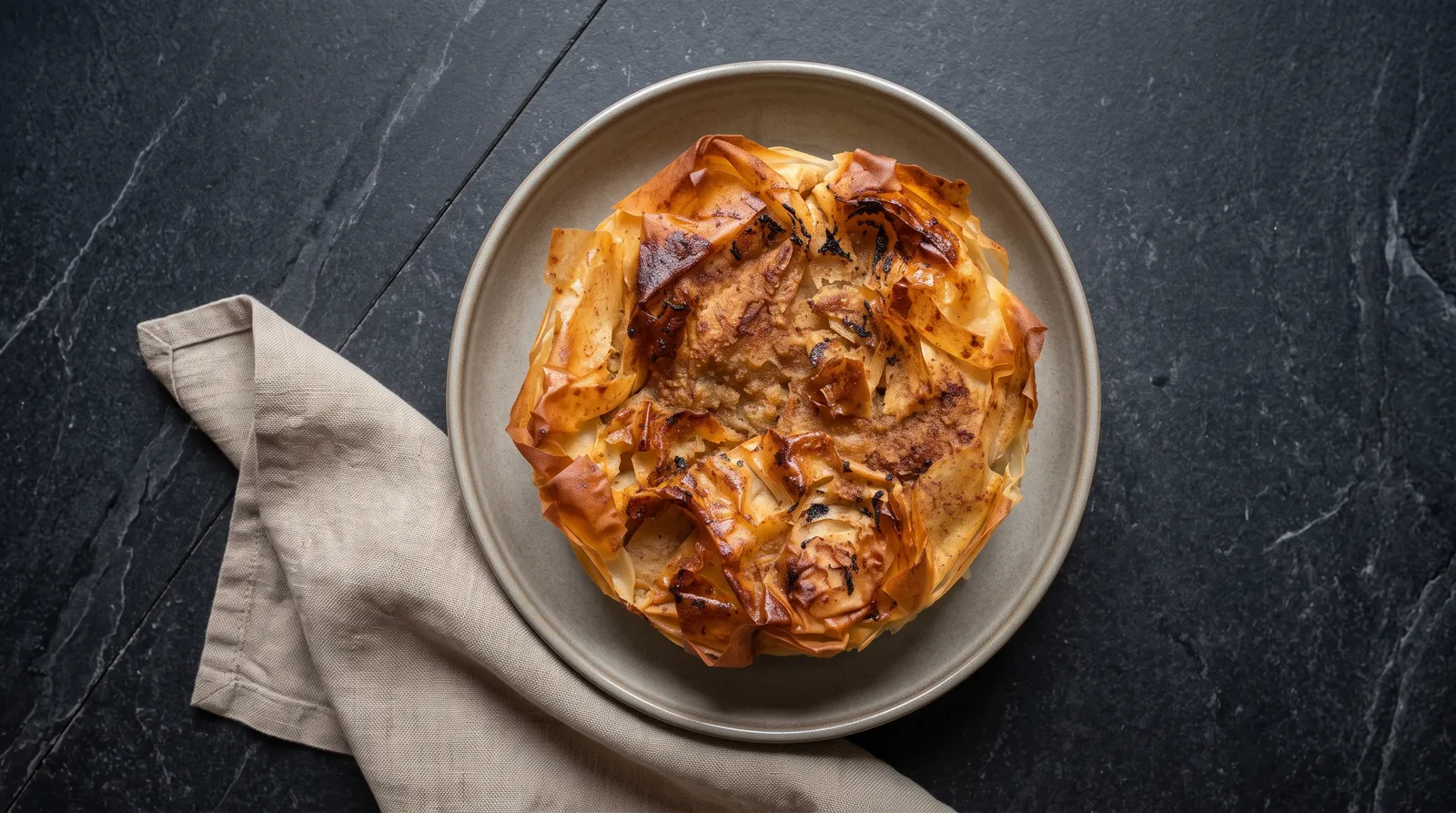
A Lot and Quercy apple pastry made from a table-size translucent dough sheet that is briefly dried, dressed with fruit, sugar, oil and eau-de-vie, then rolled and coiled like a snail.

French National Dishes
Share
Pastis quercynois — shown whole after baking
Prep 100 minutes
Cook 60 minutes
Total 265 minutes
Yield 1 coiled 28 cm pastis, 8 portions
Introduction and overview

Pastis quercynois: rolled Quercy apple pastry

Pastis quercynois in the Lot is a hand-stretched apple pastry, not a raised festive cake. The local preparation is built from a flour-and-egg dough that rests, stretches across a large cloth until nearly transparent, dries briefly, receives apple, sugar, sunflower oil and eau-de-vie, and is then rolled lengthwise before being curled into a loose spiral. That rolled construction gives it a different architecture from a ruffled Gascon croustade.

The dough receives a full one-hour rest before stretching. A heavy clean cloth supports the sheet while flat hands work from underneath, preferably with two people sharing the perimeter. Once translucent, the surface is left just long enough to become less tacky; it must stay flexible enough to roll. The thick outer rim is trimmed because it would otherwise remain doughy inside the coil.

Shaping is done with the cloth rather than by squeezing the filled sheet by hand. The long roll should contain an even distribution of apples and sugar, and the final snail should be loose enough for heat to reach the inner turns. The pastry bakes at 210 °C for one hour until the exterior is deep golden and the centre is fully baked. Eau-de-vie contributes to the characteristic aroma, and some alcohol may remain after baking.
Success points

Success points

  • A relaxed dough, a translucent but still flexible sheet and a loose final coil are the three structural controls. Tight rolling creates a dark exterior before the inner layers have time to crisp.
Ingredients

Ingredients

Dough

  • 500 g plain wheat flour
  • 50 g whole egg, 1 large egg, without shell
  • 250 ml water, added gradually
  • 60 ml sunflower oil, for the dough
  • 2 g fine salt

Apple, sugar and finishing

  • 600 g apples, peeled, cored edible weight; thin wedges
  • 200 g caster sugar
  • 16 g vanilla sugar, 2 small sachets
  • 120 ml sunflower oil, measured for sprinkling the sheet
  • 60 ml fruit eau-de-vie, measured; prune eau-de-vie is regionally documented
Method

Method

Directions

  1. Mix the dough. Make a well in the flour and add egg, salt and 60 ml sunflower oil. Draw in flour while adding the 250 ml water gradually until the dough is smooth and extensible; avoid aggressive tearing motions once it comes together. The dough is smooth and supple enough to stretch without ragged cracks. Keep the work surface stable and dry.

  2. Rest the dough. Cover the dough and rest it for 60 minutes. The dough relaxes and can be pulled thin without snapping back strongly. Keep covered to prevent a dry skin.

  3. Stretch over the cloth. Flour a clean heavy cloth on a large table. With two people if possible, stretch the dough gently from underneath with flat hands until the sheet is thin and translucent over most of its area. The cloth can be seen through most of the dough sheet and only the perimeter remains noticeably thicker. Remove rings and bracelets, keep fingertips flat and keep children away from the working perimeter.

  4. Dry briefly. Leave the stretched sheet exposed for 15 minutes so its surface becomes slightly less tacky, then trim the thick rolled rim. The surface feels dry enough to lift and roll without sticking to the cloth, while the sheet remains flexible. Do not let the sheet become brittle.

  5. Fill, roll and coil. Scatter the measured 120 ml sunflower oil and 60 ml eau-de-vie over the sheet, distribute the apples and both sugars evenly, then use the cloth to roll the sheet lengthwise into one long coil. Curl the roll into a loose snail and transfer it to a 28 cm round tin. The long roll is evenly filled and forms a loose spiral without crushed apple pockets. Eau-de-vie is flammable; keep it away from open flame and hot burners.

  6. Bake the spiral. Bake at 210 °C for 60 minutes; shield the top loosely with foil only late in baking if it darkens before the centre is crisp. The outer coil is crisp and deep golden, the inner turns are fully baked, and apple pieces are tender. Use oven gloves and beware of hot sugar syrup.

  7. Cool before slicing. Cool for 30 minutes before cutting into 8 portions. The spiral holds together when cut and the apple juices no longer run freely. Alcohol may remain after baking and is not assumed to disappear completely.

Serving and planning

Practical

Serving and planning

Serve warm or at room temperature in wedges that show the rolled spiral.

Serving and planning

The dough can be mixed earlier the same day and kept covered; the stretched sheet should be filled, rolled and baked during the same session.

Storage and reheating

Cover and refrigerate cooled leftovers for up to 2 days. Re-crisp at 160 °C for 8–10 minutes before serving; microwave reheating softens the thin layers.

Substitutions

Rum appears in some modern regional descriptions, but this version keeps fruit eau-de-vie. Substituting rum changes the aroma but not the stretched-and-coiled technique.

Substitutions

Ready-made filo is not treated as the same preparation because it removes the defining Quercy hand-stretching and rolling process.

Nutrition per serving

Nutrition per serving

  • Serving size1 of 8 portions
  • Calories568 kcal
  • Carbohydrate84.9 g
  • Protein7.3 g
  • Fat22.2 g
  • Fibre3.5 g
  • Sodium305 mg
Allergens and food safety

Allergens and food safety

Use two people for the table-size stretch when possible and work on a stable surface.

Keep eau-de-vie away from flames.

Fully bake the thin dough and handle hot sugar and steam cautiously.

Alcohol can remain after baking.

Allergens: egg, gluten, sulphites if present in the eau-de-vie product.

FAQ

FAQ

Is pastis quercynois a yeasted cake?

Not in the Lot form used here. The Quercy preparation is a thin hand-stretched apple pastry that is rolled and coiled.

How is it different from pastis gascon?

Both use very thin dough and apples, but this Quercy preparation is rolled lengthwise and formed into a snail rather than built as loose ruffled sheets.

Closing

Closing

  • Result: A Lot and Quercy apple pastry made from a table-size translucent dough sheet that is briefly dried, dressed with fruit, sugar, oil and eau-de-vie, then rolled and coiled like a snail.
  • Decisive technique: A relaxed dough, a translucent but still flexible sheet and a loose final coil are the three structural controls. Tight rolling creates a dark exterior before the inner layers have time to crisp.