French National Dishes

Paris-Brest

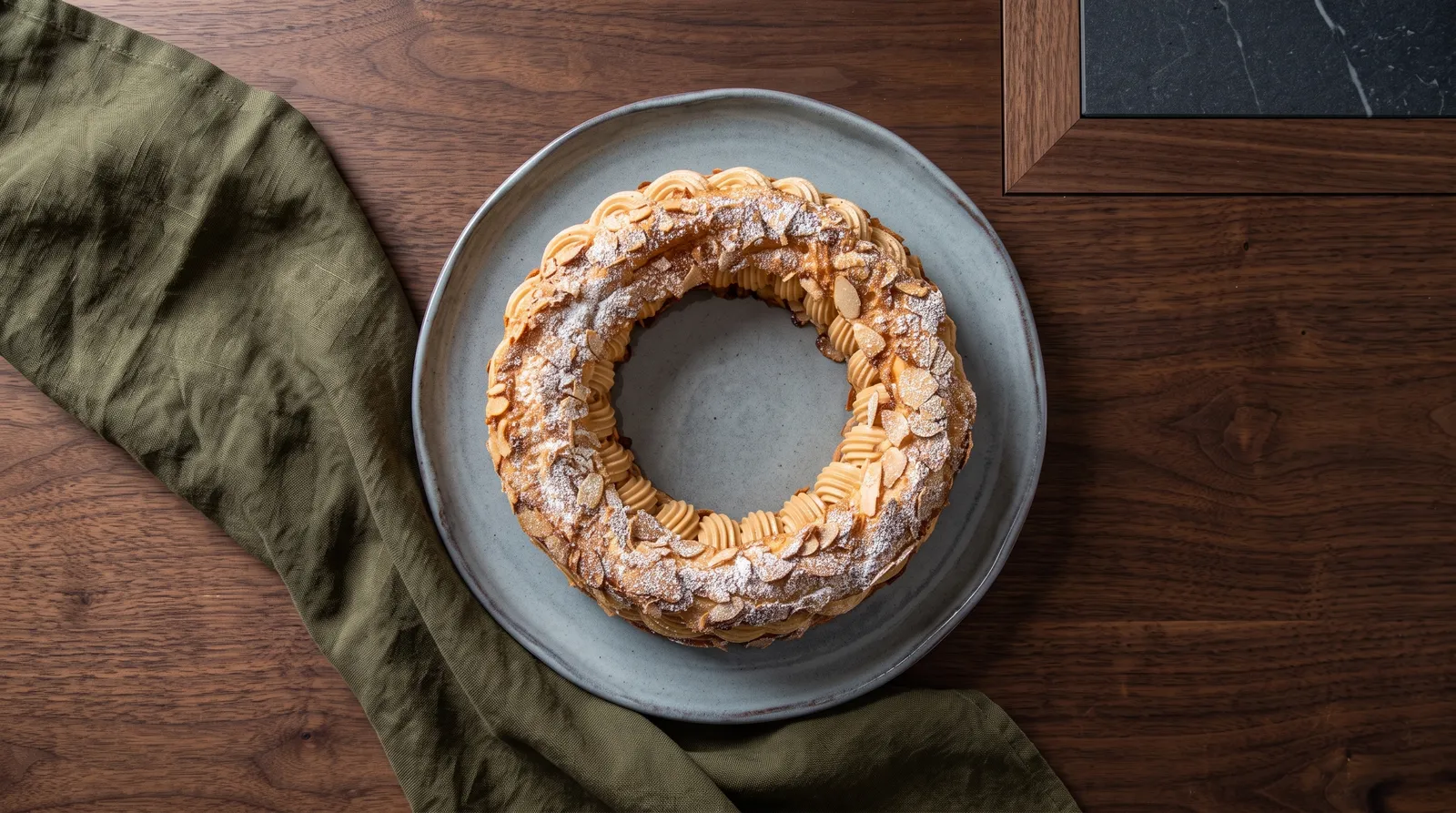
A 22 cm wheel-shaped choux ring, baked until deeply dry and golden, then split and filled with hazelnut-almond praline mousseline and finished with almonds and icing sugar.

French National Dishes
Share
Paris-Brest — shown whole after baking
Prep 55 minutes
Cook 66 minutes
Total 336 minutes
Yield 1 ring, 22 cm, cut into 8 wedges
Introduction and overview

Paris-Brest with praline mousseline

Paris-Brest is built around two demanding but complementary pastry techniques: a dry, well-risen choux ring and a butter-rich praline mousseline. The bicycle-wheel form is part of the dessert’s identity, so this recipe makes one 22 cm ring rather than individual choux buns. Flaked almonds bake onto the surface, while icing sugar is added only after the filled ring has been assembled.

The choux depends on moisture control. The panade is cooked until it forms a smooth ball, then dried for two further minutes before the beaten egg is incorporated gradually. The finished paste must fall from the paddle in a thick V rather than running like batter. Once piped as two concentric rings with a third ring on top, it bakes without the oven door being opened during the first 30 minutes, then dries at a lower temperature so the interior is not gummy.

The mousseline is equally sensitive to temperature. A cooked pastry-cream base is chilled rapidly, then both that base and the finishing butter are brought to the same 18–20 °C working range before whipping. When those temperatures match, the cream can take the butter and praline paste without turning grainy or greasy. A final one-hour chill gives enough structure for eight clean wedges while keeping the choux recognisable rather than compressing it into a soft cream sandwich.
Success points

Success points

  • Dry the choux thoroughly and treat 18–20 °C as a real working range for both mousseline components. Those two controls determine whether the ring stays crisp enough and the filling stays smooth.
Ingredients

Ingredients

Choux ring

  • 125 ml water
  • 125 ml whole milk
  • 100 g unsalted butter, cubed
  • 4 g fine salt
  • 8 g caster sugar
  • 150 g plain wheat flour, sifted
  • 250 g whole egg, beaten, weighed without shell; about 5 large eggs
  • 35 g flaked almonds, for topping
  • 15 g icing sugar, for finishing

Praline mousseline

  • 500 ml whole milk
  • 100 g egg yolk, about 5 large yolks
  • 100 g caster sugar
  • 45 g cornstarch
  • 250 g unsalted butter, 125 g into hot pastry cream, 125 g softened separately
  • 180 g hazelnut-almond praline paste, smooth commercial or prepared praline paste with traceable ingredients
Method

Method

Directions

  1. Cook the pastry cream. Heat the 500 ml milk until steaming. Whisk yolks, sugar and cornstarch smooth; temper with some hot milk, return everything to the saucepan and boil while whisking for 1 minute. The pastry cream is thick, glossy and bubbles steadily for the full final minute. Working temperature: 85 °C. Avoid tasting raw yolk mixture; use clean utensils.

  2. Chill the pastry cream. Remove from the heat and emulsify 125 g butter into the hot pastry cream, then spread in a shallow tray, cover the surface and refrigerate until cold. The pastry cream is fully cold and set, with no warm centre. Working temperature: 4 °C. Refrigerate promptly and keep at 4 °C or below.

  3. Cook the panade. Bring 125 ml water, 125 ml milk, 100 g butter, salt and 8 g sugar to a full boil. Add all the flour at once and stir vigorously until a smooth panade forms. The panade forms one smooth ball and leaves a thin film on the base of the pan. Working temperature: 100 °C. Take care around steam.

  4. Dry the panade. Continue stirring the panade over medium heat for 2 minutes to dry it, then transfer it to a mixing bowl. The panade looks satiny rather than greasy and no longer emits heavy steam. Working temperature: 75 °C. Take care around the hot pan and steam.

  5. Cool before adding egg. Leave the panade in the bowl for 5 minutes before adding egg. The panade is still warm but no longer hot enough to scramble egg on contact. Do not add the egg while the panade is hot enough to cook it.

  6. Add the weighed egg. Beat in the 250 g weighed egg gradually until the paste is smooth and falls from the paddle in a thick V shape. The paste is glossy and drops in a thick V from the paddle without flowing like batter. Use the full 250 g only once the V-shaped consistency is reached.

  7. Pipe and bake the wheel. Pipe two touching 22 cm rings and a third ring centred on top, brush very lightly with any trace of egg left on the bowl, scatter with almonds and bake without opening the oven for the first 30 minutes. The ring is deeply golden, expanded and firm enough that the sides do not buckle when lightly pressed. Working temperature: 190 °C. Do not open the oven early; escaping steam can collapse underbaked choux.

  8. Dry the choux. Lower the oven to 150 °C and dry the fully set ring for another 10 minutes with the door briefly cracked only after it is structurally firm. The ring feels light for its size and the interior is dry rather than gummy when split. Keep hands clear of escaping oven steam.

  9. Cool the choux shell. Transfer the ring to a rack and leave it for 30 minutes until completely cool. The ring is completely cool and dry before it is split for filling. Keep the shell dry and uncovered while it cools.

  10. Equalise the cream and butter. Bring the cold pastry-cream base and the remaining 125 g butter separately to 18–20 °C and hold them in that range before mixing. Both the pastry cream and butter are in the same 18–20 °C working range. Keep cumulative room-temperature time for the dairy-and-egg components under 2 hours.

  11. Whip the praline mousseline. Beat the softened butter smooth, beat in the pastry cream gradually, then beat in the praline paste until aerated and homogeneous. The mousseline is smooth, fluffy and holds a clean ridge from the whisk with no visible butter grains. Working temperature: 18–20 °C. If the mixture begins to look grainy, stop and correct its temperature before further whipping.

  12. Fill and chill. Split the cold choux ring horizontally, pipe the mousseline evenly into the base, replace the top, dust with icing sugar and refrigerate before cutting into 8 wedges. The filling is firm enough to slice cleanly and the ring keeps its wheel shape. Working temperature: 4 °C. Keep refrigerated until serving.

Serving and planning

Practical

Serving and planning

Serve chilled but let each slice stand 10 minutes before eating so the praline mousseline is supple.

Serving and planning

The pastry cream can be cooked the day before. The baked unfilled ring can be kept airtight for one day and refreshed briefly in a low oven before cooling; fill on the day of service.

Storage and reheating

Keep the filled Paris-Brest refrigerated at 4 °C or below and eat within 48 hours. Do not freeze the finished mousseline if clean texture is the priority.

Substitutions

Commercial hazelnut-almond praline paste is acceptable when its nut/sugar composition is clear; a pure hazelnut spread or chocolate spread is not an equivalent substitute.

Nutrition per serving

Nutrition per serving

  • Serving size1 of 8 wedges
  • Calories696 kcal
  • Carbohydrate44.3 g
  • Protein13.0 g
  • Fat53.1 g
  • Fibre2.2 g
  • Sodium243 mg
Allergens and food safety

Allergens and food safety

Cook pastry cream to at least 85 °C and chill rapidly.

Keep pastry cream and filled pastry at 4 °C or below.

Limit cumulative room-temperature holding of the mousseline components to 2 hours.

Allergens: egg, milk, gluten, tree nuts.

FAQ

FAQ

Why weigh the eggs?

Choux consistency depends on the amount of liquid the dried panade can absorb. Weighing the beaten egg is more reliable than counting shells of different sizes.

What causes grainy mousseline?

A temperature mismatch is the usual cause. Bring both pastry cream and butter to 18–20 °C before whipping them together.

Closing

Closing

  • Result: A 22 cm wheel-shaped choux ring, baked until deeply dry and golden, then split and filled with hazelnut-almond praline mousseline and finished with almonds and icing sugar.
  • Decisive technique: Dry the choux thoroughly and treat 18–20 °C as a real working range for both mousseline components. Those two controls determine whether the ring stays crisp enough and the filling stays smooth.