French National Dishes

Cramique

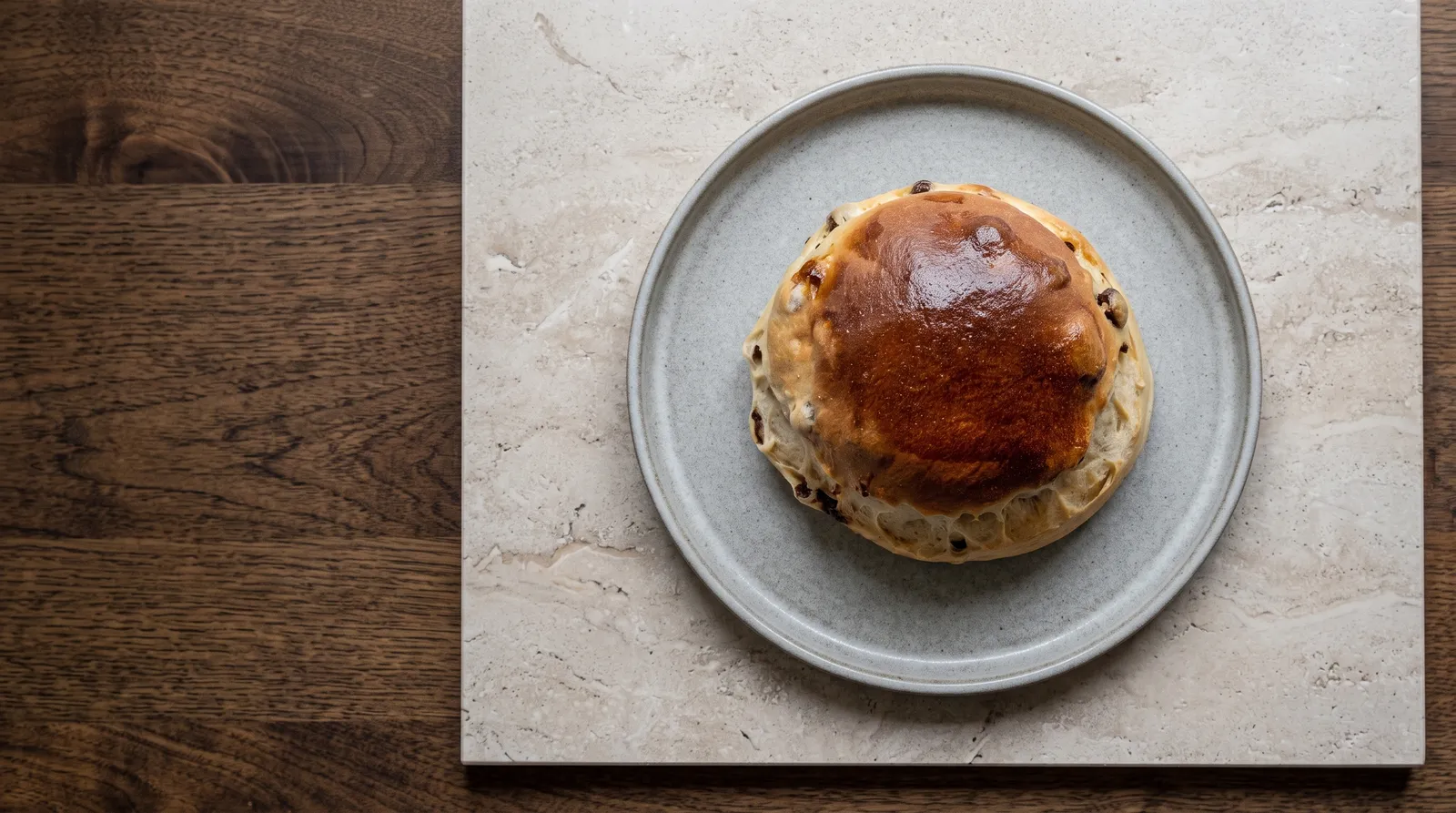
A rich northern/Flemish French yeasted loaf with butter, eggs and raisins, developed slowly through two long proofs and baked to a deep golden crumb.

French National Dishes
Share
Cramique — arranged on a board
Prep 38 minutes
Cook 30 minutes
Total 493 minutes
Yield 1 loaf, 12 slices
Introduction and overview

Cramique — northern French raisin brioche loaf

Cramique sits in the enriched bread tradition of northern France and the Flemish border region. It is closer to a brioche-style loaf than to cake, yet it should not be confused with the seasonal trilobed coquille. Here it is baked as a rectangular raisin loaf in a 20 × 10 × 10 cm tin, which fixes both shape and slice yield.

The raisins are conditioned first so they do not pull moisture from the crumb, then drained thoroughly before they enter the dough. Gluten is developed before most of the butter is worked in; adding the butter gradually helps the dough stay elastic instead of becoming greasy. A useful dough temperature is 24–26 °C, warm enough for fermentation but not so warm that the butter melts out.

Time is a structural ingredient. The first proof lasts about 150 minutes, the shaped loaf rests and relaxes, and the final proof continues until the crown rises roughly 2 cm above the tin. After a 30-minute bake at 180 °C, an internal temperature around 93 °C, deep colour and a set crumb all point to doneness. The full hour of cooling is part of the method, not an optional pause.
Success points

Success points

  • Keep raisins dry after soaking.
  • Add butter gradually only after initial gluten development.
  • Proof by volume and feel as well as time.
  • Bake until the centre is about 93 °C.
Ingredients

Ingredients

  • 200 g wheat flour, French-style T55 or equivalent plain wheat flour by specification
  • 100 g whole egg, about 2 large eggs without shell, room temperature
  • 40 ml whole milk, lukewarm, about 24 °C
  • 20 g caster sugar
  • 6 g fresh baker’s yeast, crumbled
  • 4 g fine salt
  • 80 g unsalted butter, soft but cool, about 18–20 °C
  • 100 g raisins
  • 30 ml boiling water, for conditioning raisins; drained after soak
  • 25 g beaten egg, for egg wash
Method

Method

Condition fruit and mix

  1. Plump and dry the raisins. Pour 30 ml boiling water over the raisins and leave them to soak for 30 minutes; drain very thoroughly and pat dry. Tool or vessel: small bowl + sieve. Heat: none. Temperature: water initially about 100 °C, then cooling. Readiness: The raisins are plump but their surfaces are dry enough not to smear water into the dough. Why it matters: Conditioning limits the raisins drawing moisture from the dough. Safety: Discard the soak water; do not count it as consumed.

  2. Develop the dough. Mix the flour, eggs, milk, sugar and crumbled fresh yeast for 5 minutes until no dry flour remains; add the 4 g salt and knead for 8 minutes. Tool or vessel: stand mixer with dough hook or sturdy bowl. Heat: none. Temperature: target dough about 24 °C. Readiness: The dough is cohesive and stretches into a thin translucent film before tearing. Why it matters: Initial gluten development prepares the dough to accept butter. Safety: Do not taste raw flour or egg dough.

  3. Work in the butter and raisins. Add the 80 g butter in four additions over 8 minutes, then knead 4 minutes more until glossy and elastic; fold in the drained raisins for 2 minutes. Tool or vessel: same mixer or bowl. Heat: none. Temperature: target dough 24–26 °C. Readiness: The dough is glossy, elastic and pulls cleanly from most of the bowl, with raisins evenly distributed. Why it matters: Gradual butter addition preserves gluten strength. Safety: If dough exceeds 26 °C, pause briefly in a cool place rather than adding flour.

  4. Give the dough a short rest. Cover and leave the dough to rest for 5 minutes before the first proof. Tool or vessel: covered bowl. Heat: none. Temperature: about 24 °C. Readiness: The dough relaxes and is easier to gather into a smooth mass. Why it matters: A short rest completes mixing without extra flour.

Proof and shape

  1. Complete the first proof. Cover and leave the dough to rest and proof for 150 minutes at about 24 °C. Tool or vessel: covered bowl. Heat: none. Temperature: about 24 °C. Readiness: The dough has expanded to roughly double its original volume and feels aerated rather than dense. Why it matters: A long first fermentation develops the enriched dough.

  2. Relax the pre-shape. Turn out gently, press out only the largest gas pockets, pre-shape into a log and leave it to rest uncovered for 30 minutes. Tool or vessel: work surface. Heat: none. Temperature: about 22–24 °C. Readiness: The dough relaxes enough to roll without springing back sharply. Why it matters: Bench rest prevents tearing during final shaping.

  3. Shape and complete the final proof. Shape into a tight log and place seam-side down in a greased 20 × 10 × 10 cm loaf tin; cover and leave it to rest and proof for 150 minutes. Tool or vessel: 20 × 10 × 10 cm loaf tin. Heat: none. Temperature: about 24 °C. Readiness: The dough crown rises to about 2 cm above the rim and slowly springs back when lightly pressed. Why it matters: The final proof controls crumb lightness and oven spring.

Bake and cool

  1. Bake the loaf. Brush with the 25 g beaten egg and bake in a preheated 180 °C conventional oven for 30 minutes; verify about 93 °C in the centre. Tool or vessel: loaf tin + food thermometer. Heat: 180 °C conventional oven. Temperature: 180 °C oven; about 93 °C centre. Readiness: The loaf is deep golden brown, sounds lightly hollow when tapped, and the centre is about 93 °C. Why it matters: Colour, structure and internal temperature together define the baked endpoint.

  2. Cool before slicing. Turn out after 5 minutes and cool on a rack for 60 minutes before slicing. Tool or vessel: cooling rack. Heat: none. Temperature: room temperature. Readiness: The crumb has set and slices without compressing or becoming gummy. Why it matters: Cooling lets steam redistribute through the enriched crumb.

Serving and practical guidance

Practical

Substitutions

- Fresh yeast: Use an equivalent quantity only if a verified project conversion to the exact dry-yeast type is available; otherwise retain fresh yeast. Yeast type changes proof speed.

Troubleshooting

Troubleshooting

  • Problem 1Check the cause and correction. If butter leaks from the dough, it or the dough became too warm; keep the dough in the 24–26 °C range during mixing.
  • Problem 2Check the cause and correction. If the crumb is dense, the long proofs were cut short; wait for the stated volume and finger-response cues.
Nutrition per serving

Nutrition per serving

  • Serving size1 of 12 equal slices
  • Calories160 kcal
  • Carbohydrate20.4 g
  • Protein3.2 g
  • Fat7.0 g
  • Fibre0.9 g
  • Sodium152 mg
Allergens and food safety

Allergens and food safety

Allergen: Gluten from wheat.

Allergen: Egg.

Allergen: Milk.

Safety: Do not taste raw flour or egg dough.

Safety: Bake the loaf fully before eating and cool on a clean rack.

Safety: Egg wash is fully baked with the loaf.

Closing

Closing

  • Result: A rich northern/Flemish French yeasted loaf with butter, eggs and raisins, developed slowly through two long proofs and baked to a deep golden crumb.
  • Decisive technique: Keep raisins dry after soaking.