French National Dishes

Crème catalane

A milk-based Catalan custard infused with cinnamon and citrus, thickened on the stovetop with cornstarch, chilled in shallow dishes and caramelised just before serving.

French National Dishes
Share
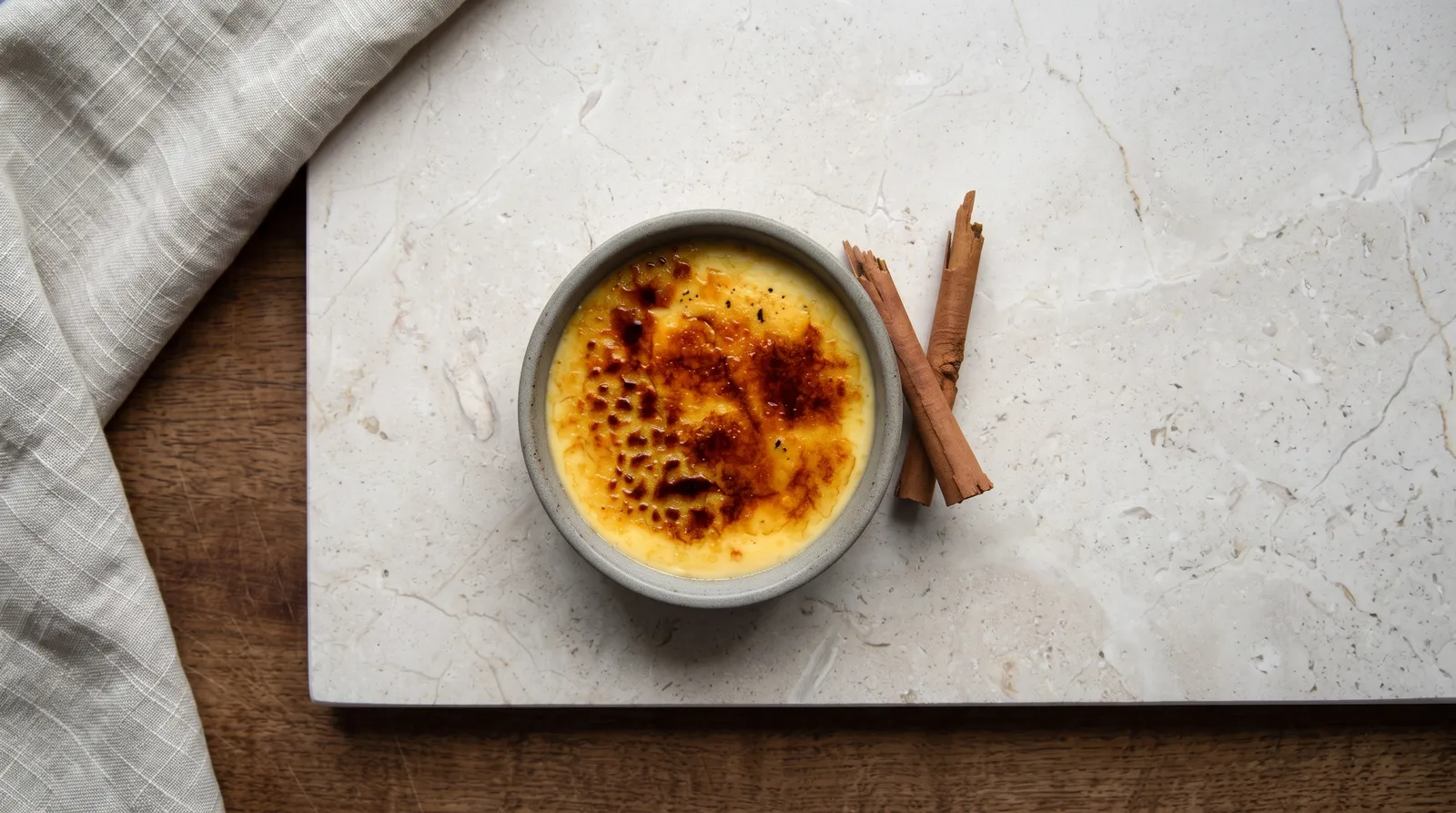
Crème catalane — served in a bowl
Prep 15 minutes
Cook 16 minutes
Total 256 minutes
Yield 6 shallow dishes
Introduction and overview

Crème catalane — Catalan milk custard with cinnamon, citrus and caramel

Crème catalane, or crema catalana, belongs to the Catalan dessert tradition on both sides of the Pyrenees. Its structure is not the same as crème brûlée: milk replaces rich cream as the main dairy ingredient, cornstarch provides part of the thickening, and the custard is cooked in a saucepan rather than baked in a water bath.

Cinnamon and wide strips of lemon and orange peel infuse 600 ml of the milk for 15 minutes. The peel contains no white pith, which keeps bitterness in check. A further 150 ml cold milk is held back specifically for the cornstarch slurry, allowing the starch to disperse before it meets the yolks and warm infused milk.

Continuous stirring governs the final cook. At about 82 °C the starch is cooked, the mixture coats the back of a spoon and the first slow bubble appears, while the temperature remains comfortably above the 71 °C egg-safety threshold. The custard then cools and chills for three hours before a 6 g sugar layer is caramelised on each shallow dish.
Success points

Success points

  • Remove citrus pith to avoid bitterness.
  • Disperse cornstarch in cold milk before heating.
  • Stir continuously on the stovetop and target about 82 °C, never stopping below 71 °C.
  • Caramelize only after a complete chill.
Ingredients

Ingredients

Custard

  • 600 ml whole milk, for infusion
  • 150 ml whole milk, cold, reserved for starch slurry
  • 108 g egg yolks, about 6 large yolks
  • 120 g caster sugar
  • 30 g cornstarch
  • 5 g lemon peel, wide strips, yellow zest only, no white pith
  • 5 g orange peel, wide strips, orange zest only, no white pith
  • 3 g cinnamon stick, about 1 small stick

Caramel top

  • 36 g caster sugar
Method

Method

Infuse milk

  1. Infuse the milk with cinnamon and citrus. Heat 600 ml milk with the cinnamon stick, lemon peel and orange peel for 5 minutes until the milk reaches about 85 °C, then remove from the heat. Tool or vessel: medium saucepan. Heat: medium-low. Temperature: about 85 °C. Readiness: The milk is steaming and aromatic with no rolling boil. Why it matters: Gentle heat extracts cinnamon and citrus without scorching the milk.

  2. Let the aromatics steep. Cover and leave the infused milk to stand for 15 minutes, then strain out the cinnamon and citrus peels. Tool or vessel: same saucepan + fine sieve. Heat: none. Temperature: warm. Readiness: The milk smells clearly of cinnamon and citrus, and no peel or cinnamon fragments remain. Why it matters: A measured infusion gives flavour without prolonged pith contact. Safety: Discard the spent peel and cinnamon; do not count them as eaten.

Cook custard

  1. Prepare the yolks and starch slurry. Whisk the 108 g yolks and 120 g sugar for 2 minutes until smooth; in a second bowl whisk the 30 g cornstarch into the reserved 150 ml cold milk until lump-free. Tool or vessel: two bowls + whisk. Heat: none. Temperature: room temperature. Readiness: The yolk mixture is smooth and the starch slurry has no visible lumps. Why it matters: Cold milk disperses the starch before heating.

  2. Temper the mixtures together. Whisk the starch slurry into the yolks, then gradually whisk in the warm infused milk for 2 minutes. Tool or vessel: large bowl + whisk. Heat: none. Temperature: warm mixture. Readiness: The combined custard is uniform and fluid with no streaks of egg or starch. Why it matters: Gradual mixing limits sudden egg coagulation.

  3. Cook until the custard coats the spoon. Return the mixture to a clean saucepan and cook over medium-low heat for 8 minutes, stirring continuously and scraping the base, until it reaches about 82 °C. Tool or vessel: clean saucepan + whisk or heatproof spatula + food thermometer. Heat: medium-low. Temperature: about 82 °C; never stop below 71 °C. Readiness: The custard reaches about 82 °C, thickens to a nappé consistency that coats the back of a spoon, and shows the first slow starch-cooked bubble without scrambled-egg flecks. Why it matters: Continuous stirring cooks the starch and yolks evenly; the higher target gives a reliable starch-thickened set while exceeding 71 °C. Safety: The custard must reach at least 71 °C.

  4. Fill the shallow dishes. Immediately divide among six shallow 12 cm dishes and smooth the surface. Tool or vessel: six shallow 12 cm dishes. Heat: off heat. Temperature: hot custard. Readiness: Each dish has a shallow even layer with a smooth surface. Why it matters: Shallow dishes cool quickly and provide the characteristic broad caramel top.

Cool and caramelize

  1. Cool and chill the custard. Cool the dishes uncovered for 30 minutes, then cover and refrigerate for 180 minutes at 4 °C or below. Tool or vessel: cooling rack + refrigerator. Heat: none. Temperature: ≤4 °C after initial cooling. Readiness: The custard is fully cold and set enough to hold a thin sugar layer. Why it matters: Prompt cooling sets the starch-thickened custard before caramelizing. Safety: keep refrigerated at 4 °C or below.

  2. Caramelise just before serving. Just before serving, spread 6 g sugar over each dish and caramelize for about 3 minutes total with a kitchen torch or approved hot caramelizing iron. Tool or vessel: torch or caramelizing iron. Heat: direct surface heat. Temperature: surface caramelization. Readiness: The top is a thin, evenly amber, brittle crust while the custard beneath stays cold. Why it matters: Caramelizing at the last moment preserves contrast between crisp top and cold custard. Safety: use heatproof dishes and keep the flame away from flammables.

Serving and practical guidance

Practical

Substitutions

- Citrus peel: Keep both lemon and orange in this version; do not replace with juice because acid and extra liquid change the custard. Changing peel to juice can alter thickening and flavour.

Troubleshooting

Troubleshooting

  • Problem 1Check the cause and correction. If the custard is floury, the starch did not cook long enough; maintain continuous stirring until the first slow bubble and about 82 °C.
  • Problem 2Check the cause and correction. If the custard scrambles, the heat was too high or stirring stopped; use medium-low heat and scrape the base continuously.
Nutrition per serving

Nutrition per serving

  • Serving size1 of 6 shallow dishes
  • Calories257 kcal
  • Carbohydrate37.2 g
  • Protein6.9 g
  • Fat8.9 g
  • Fibre0.0 g
  • Sodium63 mg
Allergens and food safety

Allergens and food safety

Allergen: Egg.

Allergen: Milk.

Safety: Cook the egg-yolk custard to at least 71 °C; this preparation targets about 82 °C.

Safety: After the initial cool, refrigerate at 4 °C or below.

Safety: Use clean shallow dishes and caramelize only immediately before serving.

Closing

Closing

  • Result: A milk-based Catalan custard infused with cinnamon and citrus, thickened on the stovetop with cornstarch, chilled in shallow dishes and caramelised just before serving.
  • Decisive technique: Remove citrus pith to avoid bitterness.