
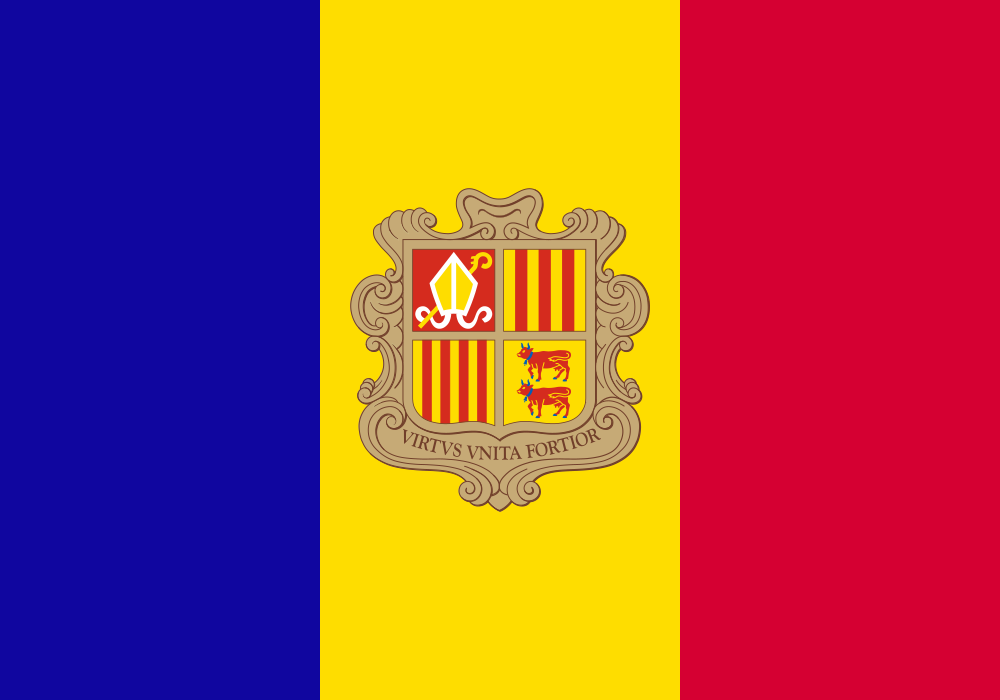

An accessible trip to Andorra is possible to plan, but it cannot be judged from a single “accessible” label. The practical question is whether the whole journey works for the person travelling: the airport or coach arrival, the vehicle and stop, the pavement to the hotel, the room and bathroom, the entrance to an attraction, and the return route when weather or fatigue changes the plan. Andorra’s official sources document meaningful inclusive services, including adaptive skiing at Grandvalira and an adapted section of the Les Fonts–Engolasters route. They do not provide enough current, vehicle-by-vehicle information to guarantee that every public bus, stop, taxi or visitor venue will meet an individual traveller’s needs.
That distinction is a reason to plan from functional details instead of broad labels. A wheelchair user may need to know doorway width, transfer space and the slope from parking to reception. A blind traveller may want tactile orientation, audio description and a guide-dog policy. Someone with hearing loss may need visual announcements; a neurodivergent visitor may benefit from predictable timings, quiet areas and clear written instructions. A person with chronic fatigue may need a realistic rest plan even where every doorway is level. “Accessible” is not one traveller profile, and one successful feature does not prove that the rest of the journey connects.
Start with the journey you need, not a general label
Before choosing a base, write a short practical profile of the trip. Which mobility aid or equipment will be used? Can the traveller transfer independently? Is a step at the vehicle entrance manageable? Is a roll-in shower necessary, or will a bath with a grab rail work? Are there sensory, communication, fatigue, medication-storage or assistance-dog requirements? Which parts of the day need to be independently accessible, and where is a companion expected to help? These details determine which questions matter.
The most useful requests are measurable. Instead of asking whether a room is accessible, ask for photographs of the actual room and bathroom, the clear width of the entrance and bathroom door, the shower threshold, the position of rails, turning space, bed height, lift dimensions, route from drop-off to reception and any steps along it. If the hotel says it has an adapted room, ask whether that exact room is available for the dates and whether the booking is guaranteed. A building may have an adapted entrance but only one accessible room, or a step-free lobby followed by an inaccessible route to the restaurant.
Describe equipment accurately when contacting a transport provider: manual or powered wheelchair, approximate width and weight, whether it folds, whether the traveller remains seated, and any companion or support-device needs. Ask how boarding works, whether a ramp or lift is available on the vehicle assigned to the booking, whether the equipment can be secured, and how much notice is required. A general operator statement about “support devices” does not establish that a specific vehicle can carry a particular wheelchair. Do not book an ordinary taxi on the assumption that all vehicles are wheelchair accessible.
For a sensory or communication need, ask what information is available before and during the visit. Is an attraction’s safety briefing spoken only, or are written instructions available? Can a guide dog enter the relevant area? Is there a low-stimulation time or place to wait? Are announcements displayed visually? Is a sign-language or text option available for customer support? A photograph or marketing description can help with orientation, but it cannot answer the operating question by itself.
Keep the answers in writing. Save the name of the person who confirmed the service, the vehicle or room details, the planned arrival time and a backup contact. If the trip depends on several providers, send the same concise description to each one rather than assuming the accommodation has passed it on. Reconfirm close to departure: vehicles can be substituted, lifts can stop, snow conditions can alter resort operations and a venue may change its entrance or timetable.
What Andorra’s accessibility law does—and does not—tell a visitor
Andorra’s Law 24/2025 on universal accessibility, dated 13 November 2025, covers physical environments, transport, information and communication, public and publicly used services, and cultural, sporting and leisure activities. Its transport provisions address public-transport infrastructure, stops and terminals, assistance dogs and provider responsibilities. The law also treats mechanical lifts at ski resorts as public-transport vehicles, subject to specific regulations. This is a national legal framework, not an inventory of which bus, stop, building or lift is currently usable by a particular person. [S01]
The law’s transitional and implementation provisions matter. While the Government develops the regulations, the earlier 1995 accessibility regulation continues to apply; the law also sets timelines for access plans and future regulatory development. A reader should not infer from the existence of the statute that every older facility has already been adapted or that each technical detail is visible in a visitor-facing booking system. This is practical travel information, not legal advice about a particular person’s entitlements or a provider’s compliance. For an unresolved legal question, consult the competent Andorran authority or a qualified adviser. [S01]
The Government’s June 2026 description of the Commission for the Promotion of Accessibility confirms that the body is tasked with advising, promoting universal accessibility, evaluating compliance and raising awareness. That supports the broader direction of public policy; it does not certify a hotel, bus or attraction. The distinction is especially important when a website uses “accessible” as a promotional adjective without supplying dimensions, route details or an operating contact. [S02]
Transport: confirm the actual vehicle and the complete connection
Public buses
Andorra’s official travel information describes an extensive national bus network and points visitors towards public transport. The Government publishes line changes and seasonal reinforcement, and the municipal authority in Andorra la Vella describes public transport as connecting the parish with other parishes and neighbouring countries. Those are useful network-level facts, but they do not confirm the boarding arrangement, accessible bay, ramp reliability, stop kerb or real-time information on the service a visitor will take. [S03][S04]
The legal framework sets requirements for accessible public-transport infrastructure and services, including access systems, reserved spaces and information. For journey planning, however, ask the operator about the specific date, line, direction, stop and vehicle. Ask whether boarding is level or ramp-assisted, whether the driver must be notified, how the wheelchair is secured, whether a companion is required, and what happens if the scheduled vehicle is replaced. Confirm the destination stop’s kerb and pavement connection as well as the bus itself. If you need visual or audio stop announcements, ask how they are delivered on that route. [S01]
Do not treat a route map as evidence of step-free access. A stop can be close to a hotel and still require a steep approach, uneven paving, a road crossing without an accessible signal, or a long uphill return. A lift or ramp on one vehicle does not establish that the next departure has the same equipment. If a missed connection would leave the traveller stranded, identify a backup taxi or a nearer destination before travelling.
Taxis and private transfers
The Andorran Taxi Drivers Association says it can provide support devices for people with reduced mobility and asks passengers to notify it in advance. This is a starting point for a request, not confirmation that every taxi is adapted for a seated wheelchair user. Ask the booking office what vehicle is being assigned, whether the traveller transfers to a seat, whether a wheelchair can be carried, and what dimensions or equipment are accommodated. The association’s published contact numbers are +376 863 000 and +376 828 000; check the current contact page before relying on them. [S05]
If a powered wheelchair or complex mobility device is involved, send its dimensions and weight and ask about lifting, tie-downs and storage. Confirm whether the person can stay in the chair during the journey or needs to transfer. A “large vehicle”, an estate car or an ordinary taxi with a boot is not necessarily wheelchair-accessible. Ask about a companion, assistance with boarding and the fare before confirming a trip. If the taxi provider cannot meet the requirement, request a referral before the vehicle arrives.
Pre-booked transfers may be more workable than trying to find a suitable vehicle after arrival, particularly for an airport or border transfer. Make the booking conditional on the exact equipment and assistance being available. Reconfirm the pick-up location in a format the traveller can use: a written address, a map pin, an accessible message or an agreed phone call. If the traveller cannot use voice calls, ask whether booking by email or text is available and whether the driver can contact the companion instead.
Arriving from abroad and handling luggage
Andorra has no rail or international airport inside the country; visitors commonly arrive via transport hubs in Spain or France and continue by road. The accessibility of the Andorran leg does not establish the accessibility of the incoming flight, railway station, coach or border transfer. Coordinate assistance with each provider separately, including luggage handling and the transition between vehicles. Allow extra time at transfer points and avoid a plan whose only accessible connection is the last departure of the day.
If travelling with a mobility device, keep essential components, chargers, batteries and repair contacts accessible. Check the external carrier’s rules for batteries and powered devices before departure; those rules belong to the airline or cross-border transport operator, not to Andorra’s local travel information. Consider carrying a concise written note about the device and any transfer assistance needed. This is not a substitute for arranging assistance with the provider, but it can reduce repeated explanations during a disruption.
Grandvalira: the clearest published adaptive-skiing information
Grandvalira publishes dedicated accessibility information for its sectors, with operational detail that is more useful than a general claim that a ski area welcomes everyone. The exact information differs across sector groups, and it should be checked again before the season: accessible spaces, building routes, lift procedures, toilets, restaurants, instructors and activity availability are not identical in every part of the resort. [S06][S07]
Canillo, El Tarter and Soldeu
For Canillo, El Tarter and Soldeu, Grandvalira lists reserved parking at named car parks: six spaces at Canillo’s Telecabina parking and two at Riu, 250 metres from the gondola; five spaces at El Tarter’s P3; and thirteen at Soldeu’s P5 Avet and eight at P6 Basers. The resort describes step-free or lift connections from those parking areas to service buildings. The details matter because “parking available” is not enough: the relevant space should connect to the ticket office, ski school, toilet or lift the traveller intends to use. [S06]
At Canillo, the resort lists an elevator route from parking to the ticket office and information point, adapted toilets on the second floor, and direct access to the gondola on the fifth floor. At El Tarter, it describes access from P3 to ticketing, the ski school, lockers, cafeteria and medical centre, with an elevator to the gondola. At Soldeu, elevators from the Avet and Basers car parks connect to ticketing, the medical centre, adapted toilets and gondola access. These are the operator’s published facilities; ask about any construction, lift outage or temporary entrance change on the travel date. [S06]
Grandvalira recommends arranging lift access with staff in advance and using the operational staff entrance with a companion. Staff may assist with boarding and reduce lift speed if needed, but carriage is conditional on prior agreement and the conditions of the lift. Certified adaptive equipment is required, and the resort gives specific seating guidance for chairlifts. A traveller should not arrive assuming that a particular chairlift will stop automatically or accept any device. Contact the resort with the equipment, skier’s position and companion needs so staff can assess the intended route. [S06]
The operator recommends green and blue slopes and beginner areas but notes that flat sections can require pushing. This is a crucial qualification for sit-ski users and others who may not be able to propel themselves on a shallow gradient. Snow conditions can change how a section skis; a trail colour alone is not an accessibility rating. Ask the adaptive-ski team about the intended route, lift combinations, snow state and whether an instructor or companion is required. A person who can ski one section may still face a difficult connection between it and the next lift. [S06]
Grandvalira says its ski school has specialised instructors for physical and visual disabilities and can coordinate equipment such as mono-skis, dual-skis and outriggers. Availability and fit need to be confirmed directly. Provide the skier’s experience, support needs, equipment dimensions and preferred dates. Clarify whether the lesson price includes adaptive equipment, lift pass, companion access and any transfer between the meeting point and the slope. The page describes the service but does not promise that every configuration is available on every date. [S07]
The same page lists adapted restaurants and toilets by sector. Examples include Xiri Forn and Espress’oh in Canillo; Pi de Migdia, Riba Escorxada and other named facilities in El Tarter; and Gall de Bosc plus the Basers and Avet car parks in Soldeu. These listings can help plan a rest break, but a restaurant’s adapted entrance does not answer every interior question. Ask about the route from the lift, table layout, toilet access, snow equipment storage and whether the venue is operating that day. [S06]
Encamp, Grau Roig and Pas de la Casa
For Encamp, Grau Roig and Pas de la Casa, Grandvalira identifies the Funicamp cable car as an authorised access point for adaptive use. It recommends detachable and fixed chairlifts because boarding and disembarking can be more controlled, says staff can assist and slow the system when needed, and advises coordination in advance. Drag lifts are not recommended, especially for sit-ski users. These sector-specific notes should not be assumed to apply identically to Canillo, El Tarter or Soldeu; use the right page for the intended lift. [S08]
Grandvalira recommends easier green and blue runs and beginner zones for adaptive skiing in these sectors too, while warning that some flat areas require extra momentum. It strongly recommends skiing with a companion and states that a companion is mandatory for blind users or sit-skiers in its published guidance. Adaptive instructors and equipment are offered, but the school asks users to contact it ahead of time to confirm availability. These are important details to settle before purchasing a pass or arriving at a lift. [S08]
Accessible dining and toilets are also described for these sectors, including facilities at main lift terminals, information points and selected restaurants. A visitor with a specific bathroom-transfer requirement should request confirmation about dimensions, grab rails, transfer side, emergency pull cord and access route; the phrase “adapted restroom” does not provide those measurements. If the needs involve evacuation from a high-altitude building, ask the resort how assistance is handled and whether the planned activity has a suitable contingency. [S08]
What a ski pass does not answer
An adaptive-ski discount, where offered, is a ticket condition and not proof of access to every slope or lift. Grandvalira’s general adaptive-ski page describes discounts and the documents to present at the ticket office; eligibility and proof requirements should be checked against the current offer. A companion’s ticket, equipment rental, instructor, parking and transport may be treated separately. Ask for the total cost of the actual setup; the skier’s pass price alone will not show it. [S07]
Weather and operations affect accessibility as much as the built environment. A path from a car park may be level when clear but obstructed by snow or ice. A lift may stop for wind. A staff member may need to slow boarding, which can depend on queue and operating conditions. Arrange a backup plan at a lower elevation or in town, and confirm how to leave the resort if the intended lift is unavailable. The official pages provide service descriptions, not a real-time guarantee of conditions.
An adapted nature route: Les Fonts–Engolasters
Visitandorra describes the Circuit de les Fonts d’Engolasters as the Principality’s first universally accessible hiking itinerary, developed with technical advice from Spain’s ONCE organisation. The route uses specialised surfaces, contrasting colours and techniques, and a handrail to help blind and partially sighted visitors anticipate obstacles. The authority states that the itinerary is adapted for people with visual disabilities and reduced mobility. This is a rare example where the source explains the adaptation; an “inclusive” label on its own says little. [S09]
The route information says the full circuit from the Engolasters road car park to the Corralets picnic point measures 2.8 kilometres and takes a little over an hour and a half; 1,200 metres form the specifically adapted section. The distinction should stay visible in planning. A visitor who needs the adapted surface should ask which segment is included, what the surface and gradients are like today, how to reach the start, and whether the return route is the same. Do not describe all 2.8 kilometres as a continuous purpose-built accessible path when the tourism authority identifies only 1.2 kilometres as the adapted section. [S09]
The route is in a mountain environment, so “adapted” does not mean weather-proof or suitable for every chair, walker, visual profile or stamina level. Ask the relevant local tourism office or parish about current maintenance, snow, ice, works, parking and the exact start point. The page names natural springs along the route—Les Ordigues, Les Molleres, Corralets and La Closa—but does not give measurements for every gradient, passing width or rest point. Travellers should request the specific information their equipment and support needs require. [S09]
Sensory information in other places
Visitandorra’s Parl’App page reports QR-linked information at 105 tourist sites, including monuments, sculptures, viewpoints and interpretation panels. It says the information includes sign-language descriptions and commentaries in Catalan, Spanish, French and English; nature interpretation panels also provide accessible information on landscapes, animals and plants. This can improve the way a visitor receives information at a site, but it does not establish that the physical approach, viewpoint or surrounding path is step-free. Check the site itself as well as the format of its interpretation. [S10]
This distinction is useful for blind and low-vision travellers, Deaf and hard-of-hearing visitors, and anyone who benefits from more than one way to receive information. Before relying on a QR code, confirm that the phone can connect, the page works with the traveller’s assistive technology and the content is available in the needed language. Bring headphones if audio would help, but also identify a person or office to contact if the code, network or device fails. A digital alternative should add to, not replace, practical orientation and human assistance where required.
Choosing a hotel, restaurant or cultural venue
The sources consulted do not provide a current, complete database of accessible hotels, restaurants, public toilets or museums across Andorra. No property is therefore presented as suitable for every disabled visitor. Search filters can identify possible candidates; contact the property directly about the exact room and route. A few details are especially easy to miss: a step at the entrance, a heavy manual door, a shower lip, a lift too small for a power chair, a steep ramp, a dining room reached by stairs, or a toilet used as storage.
Ask an accommodation to describe the path from street to bed in order: drop-off, entrance, reception, lift, room door, bed, bathroom and breakfast area. Request photos or a video of the route and the actual room. If an emergency evacuation is a concern, ask how the building handles it and whether the room is near a step-free exit. For a visual, hearing or cognitive support need, ask what staff communication and alert systems are available. Treat each answer as applying to the named room and dates only.
For restaurants and attractions, confirm the entrance, internal level changes, toilet, seating, booking requirements, service-animal policy and whether a companion is admitted or charged. A restaurant listed by Grandvalira as adapted for resort visitors is a useful lead for that resort, not a guarantee about every table or route from the snow. For a cultural site, ask whether the historic building has steps or restricted rooms and whether a virtual, audio or tactile alternative exists. An alternative can be valuable, but should not be described as equivalent to physical access unless the venue says so.
If staff cannot answer a question, ask for someone who can inspect the relevant area. “We have had wheelchair users before” does not answer whether the current bathroom fits a particular chair. “There is a lift” does not give its door width or whether it reaches the required floor. “The path is easy” is not a measurement of surface, cross-slope or maximum gradient. Polite, specific questions reduce the risk of discovering a barrier after arrival.
Moving around town and dealing with Andorra’s terrain
The central valley is more urban than the high mountain, but that does not mean every route is flat. A hotel may sit above the street; two places close together on a map can be separated by a slope, stairs or a busy road. Ask for a route that avoids steps if needed, and check its surface and gradient. In winter, snow, meltwater and ice can change the usability of a pavement or kerb ramp. A route that worked in summer may not work in January.
When planning an outing, think about the return journey as carefully as the outward one. Downhill slopes can be difficult for a manual chair, while an uphill return can consume substantial energy. A taxi drop-off near a venue may not be available at the exit if the street is restricted or busy. Identify a resting place, accessible toilet and indoor fallback before leaving. If the traveller uses a power chair, confirm charging arrangements and avoid relying on a single untested charging point.
Parking is another link in the chain. Grandvalira lists reserved spaces at several access points in three sectors, but availability at arrival is not guaranteed. Check the current parking operator’s rules, badge recognition and whether a reservation is possible. If using a recognised disability permit issued abroad, do not infer its local treatment from the vehicle markings alone; confirm recognition with the relevant Andorran authority or parking operator before travel. The law’s provisions on a national permit do not by themselves establish the treatment of every foreign permit.
Build an itinerary with a fallback
For a short visit, reduce the number of transitions. Choose accommodation with a confirmed route from drop-off to room, then plan one major activity per day. A central base may simplify access to services and allow a shorter indoor alternative; a resort base may reduce transfers for adaptive skiing but place more weight on lift operation and weather. Neither choice is universally better. Compare the actual room, transport and activity route; a general location label will not settle the details.
For a ski day, confirm the adaptive instructor or companion, equipment, lift entry, toilets, lunch venue, pass rules and return transport in one chain. Ask what happens if a lift closes after the skier has gone up. Clarify who makes the decision about a particular lift and how the group is informed. Keep the confirmation details accessible on the day, and do not treat a previous year’s adaptive plan as proof that the same arrangement is available this season.
For Les Fonts–Engolasters, confirm the start, the adapted 1.2-kilometre section, current surface and road access; then plan a shorter return if the person’s energy changes. For a town visit, choose one venue with a verified entrance and toilet instead of stringing together several unverified stops. For a sensory outing, identify where to obtain written or audio information and a quiet place to pause. A good fallback can be as simple as returning to the hotel or moving to a venue whose access details have already been confirmed.
Travel insurance, medical care, medication and emergency planning depend on a traveller’s own circumstances and policy. The guidance here does not determine coverage, eligibility for services or medical fitness for altitude or skiing. Ask the insurer and relevant healthcare professional about individual needs, and check current emergency information from competent authorities. If a device is essential for mobility, breathing, communication or medication, include its power, repair and replacement needs in that conversation.
A concise confirmation checklist
Before paying for accommodation, transport or an activity, obtain answers to the questions that would change the decision:
- Is the exact room, vehicle, lift or activity confirmed for the booked date?
- What are the relevant dimensions, surfaces, gradients, thresholds and transfer arrangements?
- What support is supplied by staff, and what must the traveller or companion provide?
- Are assistance dogs permitted in the vehicle, venue and activity area?
- Which accessible toilets, rest areas and exits are available along the actual route?
- What happens if a vehicle, lift or entrance becomes unavailable?
- Can the provider communicate changes in the traveller’s required format?
- Are charges, companion access, equipment hire, insurance and cancellation terms clear?
Keep confirmations, maps and telephone or messaging contacts together. Recheck weather, road conditions, lift status and transport equipment shortly before each outing. If an answer is vague, treat the feature as unverified and choose a plan that does not depend on it.
Andorra’s strongest documented accessible offers are specific rather than universal: Grandvalira’s adaptive ski services and the adapted Les Fonts–Engolasters section show what is possible when facilities are described in practical terms. The most dependable trip plan carries that same precision through transport, accommodation and each venue. Confirm the whole chain, preserve a fallback and let the traveller’s own requirements—not a general label—decide what counts as accessible.
Sources
- [S01] Portal Jurídic del Principat d’Andorra, Law 24/2025 of 13 November on universal accessibility, especially Articles 22–25, transitional provision one and final provision eleven: https://www.portaljuridicandorra.ad/L2025024 (accessed 24 September 2026).
- [S02] Government of Andorra, “Regulation approved for the Commission for the Promotion of Accessibility”, 3 June 2026: https://www.govern.ad/ca/w/s-aprova-el-reglament-de-la-comissio-per-al-foment-de-l-accessibilitat (accessed 24 September 2026).
- [S03] Visitandorra, “Visitor information”, mobility and public-transport overview: https://visitandorra.com/en/visitor-information/ (accessed 24 September 2026).
- [S04] Comú d’Andorra la Vella, “Mobility”, municipal transport links: https://www.andorralavella.ad/comu/mobilitat (accessed 24 September 2026).
- [S05] Associació de Taxistes d’Andorra, taxi services and reduced-mobility assistance: https://www.taxis.ad/en/ (accessed 24 September 2026).
- [S06] Grandvalira, “Accessibility in Canillo, El Tarter and Soldeu”: https://www.grandvalira.com/en/ski-adapte (accessed 24 September 2026).
- [S07] Grandvalira, “Adaptive skiing for people with disabilities”: https://www.grandvalira.com/en/services/adapted-skiing (accessed 24 September 2026).
- [S08] Grandvalira, “Accessibility in Encamp, Grau Roig and Pas de la Casa”: https://www.grandvalira.com/en/Accessibility-encamp-grauroig-pasdelacasa (accessed 24 September 2026).
- [S09] Visitandorra, “Circuit de les Fonts d’Engolasters”, Catalan route page: https://visitandorra.com/ca/natura/circuit-de-les-fonts-a-engolasters/ (accessed 24 September 2026).
- [S10] Visitandorra, “Parl’App”: https://visitandorra.com/en/nature--sports/parl-app.html (accessed 24 September 2026).