
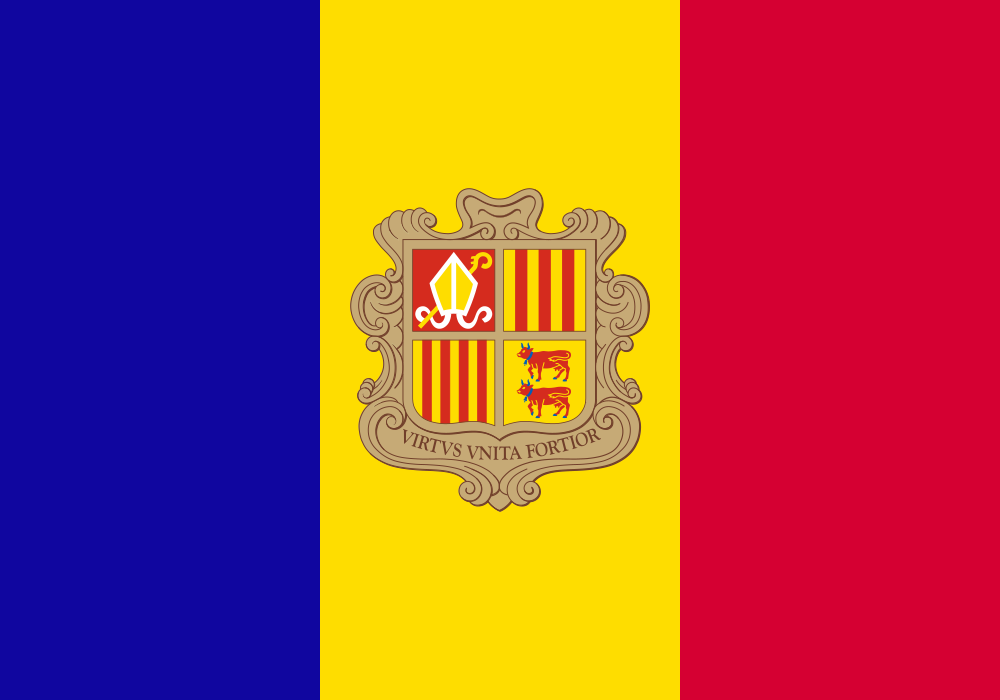
Andorra is not part of the European Union or its customs territory, so a shopping trip has a border step on the way home. The amount you can bring without customs duties and taxes depends on the goods, their value, your age and the country where you cross into the EU. Spain and France publish Andorra-specific traveller rules; the ordinary allowances for many other non-EU destinations are not a safe substitute. Before buying, identify your route and check the relevant customs table for the goods you plan to carry.S001S002S004
For most ordinary non-food purchases, the headline value allowance is €900 per traveller aged fifteen or over, and €450 for a traveller under fifteen. Food has a separate lower value ceiling—€300 or €150 for a traveller under fifteen—and some foods have additional quantity limits. Tobacco, alcohol, perfume, coffee and tea have their own quantity rules, often independent of the general value allowance. Those figures are not a single pot that can be freely combined across a family or applied to every product in the same way.S002S004
The safest mental model has three checks: first, is the item permitted and free of a special control; second, does it fit the value or quantity allowance for the relevant category and traveller; and third, is the purchase genuinely a non-commercial personal import? If any answer is uncertain, ask the customs authority before crossing. This guide summarises official information available on 24 September 2026, but it is not legal advice for an unidentified traveller, and rules or temporary health controls can change.S002S003S004S005
First identify the border you will cross
Andorra can be entered and left by road through France or Spain. It is not itself in the EU or Schengen area, and the border into either neighbour is an external customs entry into the EU. If you drive from Andorra into France, the French customs instructions are the relevant starting point for that crossing. If you leave through Spain, use the Spanish Tax Agency’s page specifically for travellers arriving from Andorra. Do not substitute a general “returning from the EU” rule: the Andorra-specific tables exist because the Principality has a distinct customs arrangement.S001S002S004
Some travellers cross into one country and continue to the other. In that situation, make the declaration or ask for guidance at the first customs border you actually reach; do not assume that a later border makes the earlier crossing disappear. If the planned route, vehicle or onward movement creates a special situation, contact the customs office for the route before travel. France and Spain may describe the same broad value thresholds but publish some category details differently, so a traveller should use the authority responsible for the actual crossing rather than combine the most generous-looking figures from separate pages.S002S003S004
Residence or nationality does not, by itself, remove the customs step. Spain’s Tax Agency says customs controls are made when goods cross a border regardless of the traveller’s residence or nationality. The relevant test is what is being carried, its purpose, value and category, and which traveller is carrying it. A resident returning with personal effects and a visitor carrying new purchases should both keep evidence that helps distinguish existing belongings from goods newly bought during the trip.S003
Keep the purchase receipt, especially for a high-value item. A receipt helps establish the price and date; it is not an exemption, and it does not override a quantity limit or a restriction. France also offers a free movement card through customs for registering some personal belongings such as cameras or phones already owned before a trip, so a returning traveller can document pre-existing equipment rather than rely only on memory or an old invoice. Check the issuing customs office and current procedure before relying on the card.S004
The general value allowance
For goods other than food and goods with a separate quantity allowance, the published value allowance is broadly aligned for Andorra-to-France and Andorra-to-Spain traveller baggage:
| Traveller | General value allowance | Important qualification |
|---|---|---|
| Aged 15 or over | €900 | For qualifying personal, non-commercial goods; some categories have separate rules. |
| Under 15 | €450 | The lower age-based value threshold applies to this traveller. |
Spain’s official Andorra section states a €900 global value for goods in personal baggage, reduced to €450 for children under fifteen. France’s Andorra page publishes the same age/value split for goods other than food. The Spanish page also specifies that phones, radio transmitters and bicycles must bear the required homologation indication to benefit under its listed allowance. If buying one of those products, confirm that condition with the seller and customs before assuming that the normal value ceiling is the only test.S002S004
The allowance is about goods carried in personal baggage for a traveller’s own non-commercial use. It is not a promise that every visitor may import up to €900 of any goods in any circumstances. Customs can treat a quantity, pattern or type of goods as commercial rather than a personal travel purchase. Resale stock, repeated consignments, goods carried for someone else as part of a business, or a shipment sent separately can follow other procedures. The Spain guidance explicitly directs commercial goods away from the ordinary traveller channel.S003
Do not treat a family’s allowances as a shared discount on one expensive item. France explicitly says allowances cannot be accumulated by several people travelling together for the same object or purchase: two adults cannot simply add their individual ceilings to bring one item over the individual threshold duty-free. The allowance is personal, not a group credit balance. Where several separate purchases are carried by several travellers, keep a clear record of who owns and carries each item, and ask the relevant authority how it applies the rule to the actual facts.S004
For example, imagine two adults and a thirteen-year-old returning with a single camera worth €1,500. It is not safe to add €900 + €900 + €450 and treat the camera as automatically exempt. The French guidance expressly rules out pooling for one purchase, and the Spanish rules still require the traveller to meet the applicable personal-baggage conditions. Declare or obtain customs advice for a high-value shared item rather than assigning an artificial fraction of its price to each passenger.S002S003S004
Likewise, an allowance is not necessarily a deductible that can be subtracted from every object’s price. France says an item above the applicable value allowance must be declared and that duties and taxes are calculated on the total value, without an allowance reduction. When there are several goods or a set made of connected parts, the authority may need to determine how they are valued and classified. Do not calculate a tax bill by subtracting €900 from a product’s price or assume the same calculation applies in both countries; customs determines the treatment under its current procedure.S004
Food has a separate value ceiling
Food is not simply added to the general €900/€450 allowance. Both the French and Spanish Andorra-specific pages show a distinct food value threshold: €300 for a traveller aged fifteen or over and €150 for a traveller under fifteen. Certain products also have quantity limits. A shopper carrying artisan cheese, cured meat, sweets or other food should therefore check the product’s category, total food value and quantity rather than looking only at the receipt total for all purchases.S002S004
The official tables list the following food amounts. Treat these as customs duty/tax allowance limits for the listed categories, not as a universal statement about every food or every current animal-health measure:
| Listed food | Published maximum quantity | Additional value condition |
|---|---|---|
| Milk powder | 2.5 kg | Food value must remain within the separate €300/€150 threshold. |
| Condensed milk | 3 kg | Same separate food-value condition. |
| Fresh/liquid milk | 6 litres | Same separate food-value condition. |
| Butter | 1 kg | Same separate food-value condition. |
| Cheese | 4 kg | Same separate food-value condition. |
| Sugar and sweets | 5 kg | Same separate food-value condition. |
| Meat | 5 kg | Same separate food-value condition. |
The lists on the two authorities’ current Andorra pages are materially aligned for these categories. Spain writes liquid milk in litres and the French page lists fresh milk with a quantity of six kilograms; follow the destination authority’s live wording and ask customs if the package, density or product form makes the unit unclear. The tables do not mean that any product omitted from them automatically has no restriction: food can also be subject to sanitary, agricultural, protected-species or other controls.S002S004
There are two distinct questions for food: whether it may be carried under animal- or plant-health rules, and whether it falls within the value/quantity limits for a duty- and tax-free traveller import. The European Commission explains that the ordinary EU restrictions on personal consignments of meat and dairy from many non-EU countries do not apply to products coming from Andorra, while warning that controls and exceptional restrictions may still matter. That sanitary exception does not turn a purchase into an unlimited customs-free allowance: the French and Spanish customs tables still set value and quantity thresholds for their listed food categories.S005S002S004
This distinction is useful for local cheese, meat products, honey or other regional food. “The food is permitted to travel” and “the food is within the fiscal allowance” are not identical claims. A veterinary disease outbreak or a temporary restriction may also alter the first answer. Check the current official health guidance for the product, then apply the relevant customs-value and quantity rules. Do not rely on a shopkeeper’s reassurance about customs or on a general EU page that does not discuss the Andorra-specific fiscal allowance.S005S002S004
Tobacco and alcohol
Tobacco and alcohol are governed by quantity allowances rather than only the general merchandise-value ceiling. The age cut-off is important: both Spain and France say travellers under seventeen receive no tax/duty-free allowance for tobacco or alcoholic drinks. A seventeen-year-old may therefore qualify for those specific allowances, even though the general value threshold remains based on the separate under-fifteen age band.S002S004
For a traveller aged seventeen or over, the Andorra-specific tobacco limits published by both countries are:
| Tobacco category | Maximum duty/tax-free quantity per eligible traveller |
|---|---|
| Cigarettes | 300 |
| Cigarillos, each no more than 3 g | 150 |
| Cigars | 75 |
| Smoking tobacco | 400 g |
These are alternatives or proportionally combinable categories, not four full allowances to stack. France says tobacco products may be assorted within the category; Spain also allows combinations without exceeding the overall permitted limit. If a traveller carries a mix, do not assume that one full limit of each product is allowed. Use the customs authority’s current calculation or seek confirmation for the exact combination.S002S004
For alcoholic drinks, Spain’s Andorra-specific page lists 1.5 litres of drinks over 22% alcohol by volume, or 3 litres of drinks at 22% or below, fortified wine or sparkling wine, plus 5 litres of still wine and 16 litres of beer. The high- and lower-strength categories are combined proportionally rather than treated as separate full allowances. The page limits these allowances to travellers aged seventeen or over.S002
France’s live Andorra-specific page lists 1.5 litres for drinks above 22% (and undenatured ethyl alcohol at 80% or above), or 3 litres for drinks at 22% or below, alongside 5 litres of still wine. Its table does not list a separate beer line on the current page. That presentation is not a reason to import Spain’s 16-litre beer entry into the French calculation: if beer is part of a French-bound purchase, confirm its treatment with French Customs using the current Andorra regime. The same page says the allowance applies from age seventeen and permits proportional assortment within its category.S004
In both countries, the key is to classify a drink accurately. A spirit over 22%, a liqueur at or below 22%, sparkling wine and still wine may not fall under the same row. A mixed basket cannot be calculated by simply adding every row’s printed maximum. Keep the labels and volumes visible, and check the current table for the country of entry. If the product is an unusual aperitif, high-strength spirit or alcohol sold in a format not described by the table, ask customs before purchase.S002S004
Where proportional assortment is allowed, think in fractions of the relevant allowance rather than full rows. Under Spain’s Andorra table, for example, 0.75 litres of a drink above 22% is half of the 1.5-litre allowance; 1.5 litres of a drink at or below 22% is half of the 3-litre allowance. Together they use the full proportional allowance for those two alternatives, not two full allowances. Likewise, 150 cigarettes are half of the 300-cigarette limit, while 75 cigarillos are half of the 150-cigarillo limit. A traveller can use this kind of arithmetic to check a proposed mix, but must apply the rules of the actual border authority and must not multiply the result by the number of people for one shared purchase.S002S004
Age affects different parts of the calculation differently. A sixteen-year-old is not in the under-fifteen band for the general value allowance, but is still under seventeen and therefore has no duty/tax-free allowance for tobacco or alcohol. A fourteen-year-old is in the lower value band and also has no tobacco or alcohol allowance. For food, the lower value ceiling applies to travellers under fifteen. This is why the age of each passenger matters by category; a household should not assign an adult’s alcohol allowance to a teenager or assume all age thresholds are the same.S002S004
Perfume, coffee and tea
Small specialist categories can catch out shoppers because their allowances are expressed in units of weight or volume rather than price. Spain’s Andorra table lists 75 grams of perfume and 37.5 centilitres of eau de cologne; France’s current page lists 75 millilitres of perfume and 37.5 centilitres of eau de toilette. Do not silently convert the Spanish perfume figure from grams into millilitres or assume that “perfume”, “eau de parfum” and “eau de toilette” are interchangeable customs classifications. Preserve the product label and use the wording of the customs authority for the route.S002S004
Both authorities list coffee and tea limits for eligible travellers aged seventeen or over. The published amounts are one kilogram of coffee or 400 grams of coffee extracts/essences, and 200 grams of tea or 80 grams of tea extracts/essences. The wording is “or” within each product group; it should not be read as permission to carry each full amount of both the raw product and its extract. Ask customs how a mixed quantity is calculated if both are in the baggage.S002S004
These quantity allowances are separate from the general value ceiling in the Andorra-specific tables. That does not mean they can be multiplied by every passenger in a group for a single shared purchase, or that a commercial quantity becomes a traveller import. France expressly prohibits pooling allowances for the same object or purchase; both countries condition the traveller rules on personal baggage and non-commercial character. A large number of identical bottles or boxes deserves a customs check even if the arithmetic appears to fit separate individual limits.S002S003S004
Declare, rather than guessing
Spain describes a green channel for goods that do not need to be declared and a red channel when the traveller has goods to declare—for example, because the amount or quantity exceeds a traveller allowance or an item is restricted. Passing through the green channel is itself a customs declaration that nothing reportable is being carried; the authority can still select baggage for inspection. Spain says the red channel is required for goods above the allowance and for commercial goods, and explains that the traveller may be asked to provide a receipt or other evidence of value.S003
If a purchase exceeds an allowance, do not hide it, split its price across companions, remove packaging to make it look used, or assume that a receipt is unnecessary. Declare it and ask what procedure applies. Spain’s information explains that customs may allow a non-commercial item over the allowance to be declared, with payment of the corresponding import charges, or give other formal options; the traveller may in some circumstances abandon or re-export goods rather than import them. The correct option and cost depend on the product and the customs decision.S003
The French customs page likewise says goods over the allowance must be declared and gives the value treatment for goods above the threshold. Its calculation should not be improvised from a travel blog, an old brochure or a generic non-EU calculator, because Andorra has specific allowances and products may attract different duties, VAT or excise treatment. Ask French Customs or use its current official declaration service before reaching the border if the purchase is high-value, unusual, or in a regulated category.S004
Keep receipts together with the goods and do not rely on a bank statement as the only evidence. If the receipt is not in a language understood by the officer, product identity and price should still be clear. If the item was bought for another person, say so honestly; an allowance belongs to the traveller who meets the conditions, and an item intended for commercial resale is not converted into personal luggage by putting it in a passenger’s suitcase.S003S004
Common shopping scenarios
A camera or phone bought for personal use
Add the value of ordinary goods carried by the same traveller, identify whether a separate quantity category applies, and compare the result with the traveller’s individual value allowance. In Spain, check the homologation condition stated for phones and other specified equipment. In France, the customs authority describes a free movement card for registering some existing personal devices before a trip. If the new item pushes the traveller above the applicable threshold, declare it rather than assuming the threshold is a tax-free deduction.S002S003S004
A bottle of spirits, perfume and chocolate
Do not treat the total basket as one number. The spirit may use an alcohol quantity allowance; perfume has a separate volume or weight allowance depending on the authority’s table; chocolate may fall under food limits and a lower food-value ceiling. The ticket total may be below €900 while one special-category limit is exceeded, or it may be above the food ceiling even though the main non-food purchases remain within their allowance. Classify each item and apply each relevant rule.S002S004
A family buying one expensive item
Keep the item assigned to its actual owner and do not add the allowances of a parent, partner and child to make one item appear under threshold. France expressly says several travellers cannot pool their allowances for the same object or purchase. Spain’s personal-baggage rules also do not create an automatic family exemption for a shared item. If one camera, watch, bicycle or computer is above the relevant individual value allowance, ask customs how to declare it.S002S003S004
A food basket from a local producer
Keep food receipts separate from other purchases. Check the food’s combined value against the €300/€150 ceiling and check any listed quantity limit for meat, cheese, dairy, sugar or sweets. Then verify any animal- or plant-health condition that applies at the time. The Andorra exception in EU animal-health guidance does not cancel customs duties or the Andorra-specific food value/quantity allowances.S002S004S005
Several cartons or a mixed tobacco purchase
Use the traveller’s age first: under-seventeens have no tobacco allowance in either country. For older travellers, compare the combination with the country’s proportional mix rule; do not multiply every alternative to its full maximum. If you are unsure whether a cigarillo’s weight meets the definition or how a combination is calculated, keep the packaging and ask customs before buying a large quantity.S002S004
Special goods and goods you already owned
Some goods need attention beyond the standard traveller allowance. Weapons, medicines, protected wildlife or plant products, products subject to health controls, professional equipment and goods carried for resale may be restricted, prohibited or subject to permits or declaration regardless of ordinary price thresholds. An item being sold openly in a shop does not mean that it can automatically be taken into another country. Check the relevant official product-specific rules before purchase, especially for controlled medicines, animal products during a disease outbreak, plants, weapons, antiques or products made from protected species.S003S005
For electronics or equipment you brought from home, a customs officer may need to distinguish the existing item from a new purchase. Bring a prior invoice, serial-number record, registration card or other proof if you expect a question. France’s free movement card is an official option for registering certain personal belongings at customs; the French page describes it as free and valid for ten years. Verify availability and the issuing process at a customs office. A photograph of a device may help identify it, but it is not guaranteed proof of prior importation.S004
If goods are being shipped, mailed or delivered separately, do not apply the personal-baggage tables automatically. The sources discussed here concern travellers and goods in personal luggage. Parcels, commercial consignments and distance purchases can use different customs declarations, tax treatment and carrier processes. A retailer’s promise to ship an item home does not establish which party handles import declarations or who will pay charges on arrival. Confirm the shipping and customs terms before agreeing to delivery.S003S004
What to check before you pay
Make a short list of intended purchases and assign each item to a category: ordinary goods, food, tobacco, alcohol, perfume/cologne, coffee/tea, fuel, or a controlled/special item. Record the current price and quantity. For a family group, note each traveller’s age, but do not pool allowances for a shared item. Compare the list with the specific customs page for the country through which you will leave Andorra, and check the date the page was last updated.S002S004
Ask the seller for a clear receipt with the product description and price, and check any conformity marking that the customs authority requires for the product. For a high-value item, confirm warranty and return terms as well as customs; a price advantage is less useful if the device cannot be serviced or the buyer has misunderstood the border bill. Customs can assess value and classification independently of the retailer’s marketing description.S002S004
If you may exceed an allowance, contact customs before the return journey. Ask what declaration lane or office to use, which documents to carry, how a mixed basket is calculated and whether the product requires another permit or inspection. A question asked before purchase leaves time to reduce the quantity, choose a different product or budget for the tax. At the border, give accurate answers and follow directions; customs can inspect baggage even when a traveller believes the allowance is satisfied.S003S004
Check the authorities again shortly before departure. France’s live page says the Andorra arrangement is distinct from the ordinary EU/third-country tobacco thresholds and gives the current category values and quantities. Spain’s page separately identifies goods from Andorra and notes the homologation condition for certain products. Official pages can be amended, and a temporary safeguard measure can affect food, plants or animal products. A saved screenshot from last season may not reflect the current legal position.S002S004S005
The practical rule
For an uncomplicated trip, keep purchases within the correct individual allowance, retain receipts, and declare anything that exceeds a limit or falls under a separate restriction. Remember the age bands: the main value threshold changes below fifteen, while tobacco and alcohol exemptions begin at seventeen. Treat food separately from other goods. Do not pool family allowances for one item, and do not mistake a sanitary exception for a tax-free threshold. If anything about the route, value, product category or personal use is uncertain, ask the customs office at the border you will actually cross.S002S003S004S005
Andorra’s shopping offer is easy to enjoy when the return journey is planned alongside the purchase. The useful preparation is modest: know whether you are heading into France or Spain, keep a short itemised list, check the up-to-date authority tables, and leave room in the budget for a declaration if necessary. No general travel summary can replace the customs decision on a particular item, but a careful check before paying is far less stressful than trying to solve an unclear allowance at the border.
Sources
Visitandorra, Passports, visas and customs, Andorra’s status and border context, accessed 24 September 2026. ↩
Spanish Tax Agency, Allowances: tobacco, alcohol and other goods, section “Travellers from the Principality of Andorra”, accessed 24 September 2026. ↩
Spanish Tax Agency, General information for travellers, green/red channels, personal baggage, controls and goods above allowances, accessed 24 September 2026. ↩
French Directorate-General of Customs and Indirect Taxes, Passing customs in Andorra: taxes and exemptions, current Andorra-specific tables, non-aggregation and free movement card, accessed 24 September 2026. The page states that its English version is automatically translated. ↩
European Commission, Personal imports of animal products, current personal-consignment rules and Andorra exception, accessed 24 September 2026. ↩