French Recipes

Tourte de blettes sucrée

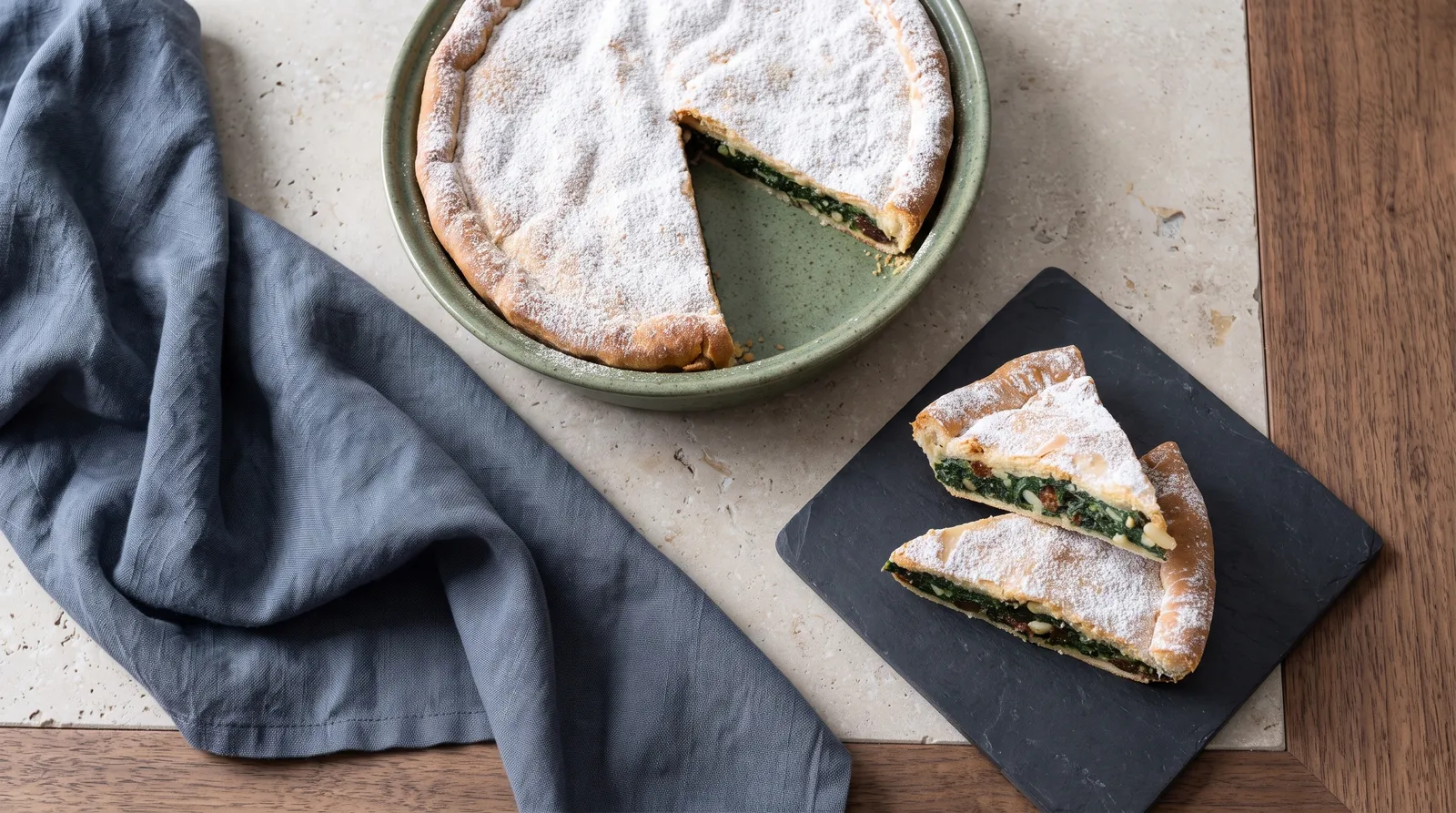
A covered 32 cm Niçois tart with carefully drained chard leaves, apples, raisins, pine nuts, hard cheese, eggs, marc and a crisp sweet pastry.

French Recipes
Share
Tourte de blettes sucrée — shown with a cut section visible
Prep 70 minutes
Cook 40 minutes
Total 320 minutes
Yield 1 x 32 cm covered tart, 8 slices
About this dish

Tourte de blettes sucrée — Niçois sweet chard tart

Niçois tourte de blettes can be savoury or sweet; this recipe is firmly the dessert form. The filling combines green chard leaves with apples, raisins, pine nuts, a little hard cheese and anise, all enclosed between two sheets of sweet pastry. The result is not a quiche and should not read like one: sugar, fruit and the pastry are structural, while the cheese provides savoury depth rather than turning the filling salty.

Water management matters more than any decorative finish. The leaves are washed repeatedly, then spun or drained until no free water remains. That protects the lower pastry from becoming gummy and keeps the filling set enough to slice after cooling. The raisins are soaked, the pastry is rested, and those waiting periods are counted rather than hidden.

The tart is fully baked when the top is golden, the edges begin to release slightly and the egg-bound centre reaches 71 °C. It then needs a complete cooling period before the icing sugar goes on and before it is cut. That rest lets the fruit and greens settle into a cohesive layer instead of leaking into the pastry.
Success points

Success points

  • Use the chard leaves and remove the thick stalks.
  • Dry the washed leaves aggressively before mixing the filling.
  • Do not cut the tart warm; complete cooling is part of the method.
Ingredients

Ingredients

Sweet pastry

  • 500 g plain wheat flour
  • 250 g unsalted butter — cold, diced
  • 150 g caster sugar
  • 100 g whole egg, net weight — 2 large eggs
  • 15 ml olive oil
  • 3 g fine salt

Filling and finish

  • 1500 g Swiss chard — purchased weight; use leaves only; about 650 g washed and thoroughly spun/drained leaves
  • 100 g whole egg, net weight — 2 large eggs
  • 50 g Parmigiano Reggiano — finely grated
  • 400 g reinette apples — peeled, cored and thinly sliced; prepared edible weight
  • 100 g pine nuts
  • 60 g raisins — 30 g dark + 30 g golden
  • 30 ml dark rum — for soaking raisins; sulphites possible by product label
  • 50 ml grape marc brandy
  • 150 g light brown sugar
  • 30 ml olive oil
  • 10 g anise seeds — lightly crushed
  • 100 g icing sugar — for the cooled tart
Method

Method

Rest pastry and prepare fruit

  1. Make the pastry. Mix the flour, sugar and salt, rub in the butter, then add the eggs and 15 ml olive oil just until a cohesive pastry forms. Allow 20 minutes. The pastry is cohesive and smooth enough to roll, without visible dry flour.

  2. Rest the pastry. Rest the wrapped pastry in the refrigerator. Allow 60 minutes passive resting. The pastry is firm and cool but still pliable when pressed. Keep chilled.

  3. Plump the raisins in rum. Soak the raisins in the rum. Allow 30 minutes passive soaking. The raisins are visibly plumper and the rum is mostly absorbed.

  4. Prepare the chard. Remove the chard stalks, slice the leaves, wash in three changes of cold water and spin or drain very thoroughly. Allow 25 minutes. The leaf strips are clean and no free water collects when they are squeezed lightly.

Fill and bake

  1. Mix the filling. Beat the filling eggs with brown sugar, marc, soaked raisins, 30 ml olive oil, grated cheese, anise and pine nuts; fold in the drained chard and one third of the apple slices. Allow 15 minutes. The leaves are evenly coated and the bottom of the bowl holds no pool of watery liquid.

  2. Line and fill the tart. Roll two thirds of the pastry to 3–4 mm, line a 32 cm tart tin, add the filling to about 2 cm depth, arrange the remaining apple slices, then cover with the remaining pastry and seal the edges. Allow 10 minutes. The base and lid are intact, the edge is tightly sealed and the top has several small steam vents.

  3. Bake the tart. Bake until the pastry is fully cooked and golden and the egg-bound filling reaches 71 °C in the centre. Use oven. Allow 40 minutes. Temperature: 180 °C. The top is evenly golden and the baked edges begin to pull slightly from the tin. Verify the centre reaches 71 °C.

  4. Cool and finish. Cool the tart completely before dusting with icing sugar and slicing. Allow 120 minutes passive cooling. The tart is fully cool, the filling is set and the base can be cut cleanly without weeping. Do not leave the egg-and-cheese tart unrefrigerated beyond 2 hours after it has cooled to serving temperature.

Serving, storage and make-ahead

Practical

Serving, storage and make-ahead

Serve at room temperature after the tart has cooled completely and been dusted with icing sugar. For make-ahead planning, bake it earlier the same day, cool it uncovered on a rack, then cover once no warmth remains. Refrigerate within 2 hours and use within 3 days. A short temper toward room temperature improves the pastry texture; reheating is not necessary. Sbrinz can stand in for Parmigiano Reggiano because both are documented in this style, but the flavour changes. Rum and grape marc are not assumed to disappear during baking, so the tart should still be treated as containing alcohol.

Troubleshooting

Troubleshooting

  • Soggy baseThe chard carried too much water. Spin or drain until no liquid collects when the leaves are squeezed lightly.
  • Filling leaks when cutThe tart was sliced before it cooled and set. Give it the full cooling time before dusting and portioning.
Nutrition per serving

Nutrition per serving

  • Serving size1 of 8 slices
  • Calories780 kcal
  • Carbohydrate90 g
  • Protein15 g
  • Fat40 g
  • Fibre6 g
  • Sodium420 mg
Allergens and food safety

Allergens and food safety

Allergens: egg, milk, gluten, tree nuts, sulphites.

Wash the chard thoroughly. Bake until the egg-bound centre reaches 71 °C. Refrigerate the finished tart within 2 hours; alcohol from rum and marc may remain after baking.

FAQ

FAQ

Is this a savoury chard pie?

No. This is the Niçois sweet covered tart with sugar, fruit, pine nuts and pastry.

Why is there cheese in a dessert?

A small amount of hard cheese is part of documented Niçois formulas and gives the sweet filling a savoury counterpoint without changing it into a quiche.

Closing

Closing

  • Result — crisp pastry enclosing a set sweet chard, apple, raisin and pine-nut filling.
  • Decisive technique — remove excess water from the chard and cool the baked tart completely before slicing.