French Recipes

Tartiflette

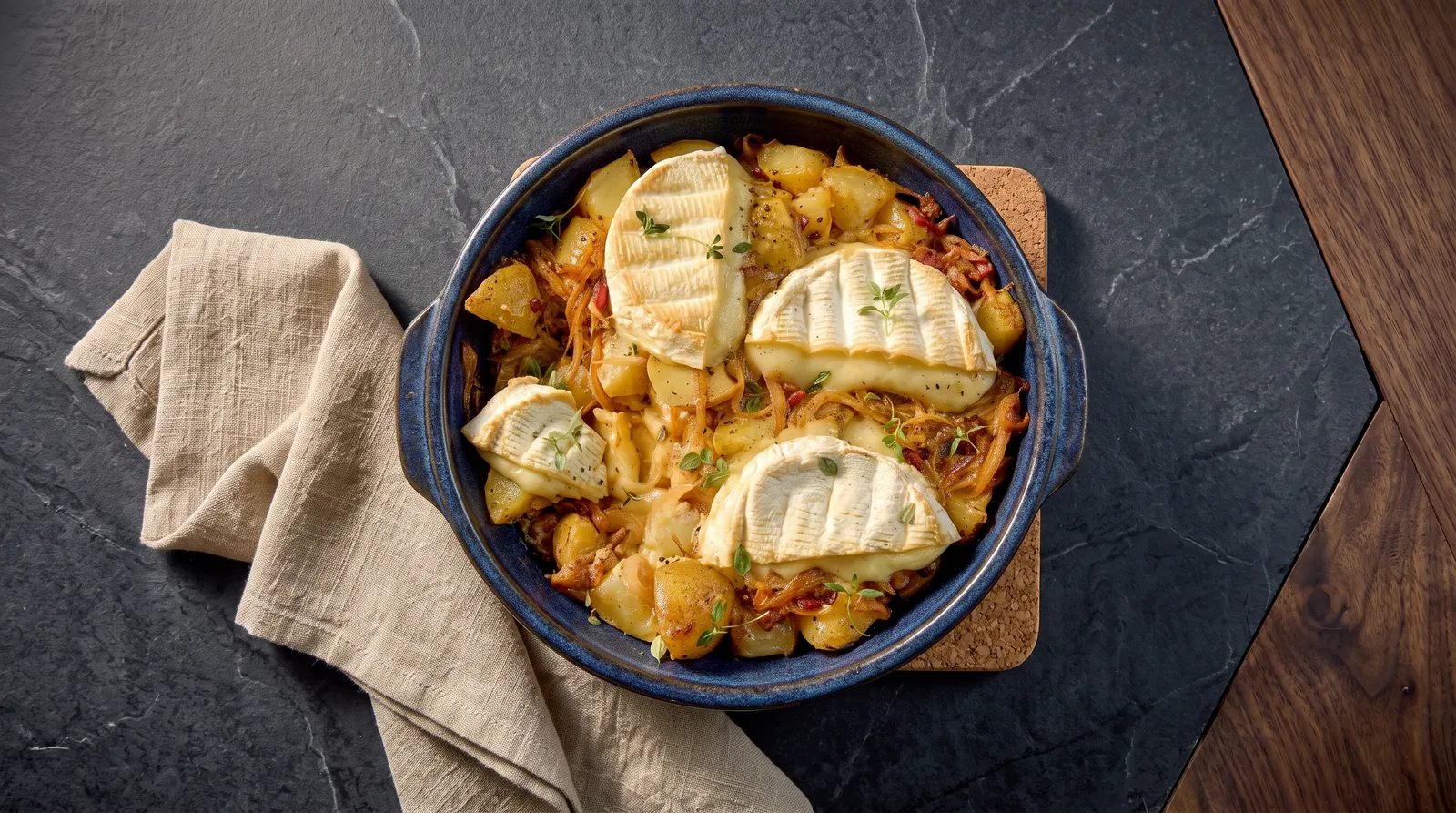
A Savoyard potato dish with onions, smoked lardons, reduced white wine and a whole Reblochon baked rind-side up until molten and bubbling.

French Recipes
Share
Tartiflette — shown in a pan
Prep 30 minutes
Cook 47 minutes
Total 77 minutes
Yield 1 baking dish, about 6 main-course portions
Introduction and overview

Tartiflette — potatoes, lardons and Reblochon

Tartiflette is built around Reblochon, not an interchangeable layer of anonymous melting cheese. Waxy potatoes are partly cooked first so they can absorb the rendered lardon fat and reduced onion-wine mixture without falling apart. A whole 450 g Reblochon is split horizontally and laid over the surface rind-side up, allowing the interior to melt down through the potatoes.

Pre-cooking each component solves a different problem. Potatoes need to be tender enough to finish in a short oven bake, lardons need enough rendering to control grease and reach 71 °C, and the onion-wine mixture needs reduction so it brings flavour rather than free water. Once assembled, the dish needs only about 20 minutes at 200 °C to become bubbling and hot throughout.

Reblochon is traditionally a raw-milk cheese, so it should stay refrigerated until assembly and be handled according to its labelled storage life. The oven stage is about melting and integrating the cheese, not baking until every trace of fat is forced out. Remove the dish when the rind is browned, the cheese beneath is fully molten and the edges are bubbling.
Success points

Success points

  • Parboil waxy potatoes only until a knife meets slight resistance in the centre.
  • Reduce the wine until the pan no longer contains a watery pool.
  • Keep the Reblochon rind and set both halves rind-side up over the potatoes.
  • Stop the bake when fully molten and bubbling to avoid unnecessary greasy separation.
Ingredients

Ingredients

Tartiflette

  • 900 g waxy potatoes — peeled and cut into 2 cm cubes; prepared weight Buy about 1 kg whole potatoes.
  • 450 g Reblochon — whole cheese, rind retained, cut horizontally into two discs Use genuine Reblochon for the unqualified dish identity.
  • 200 g smoked lardons — commercially butchered/cured
  • 200 g onions — peeled and thinly sliced
  • 100 ml dry white wine — Wine commonly contains sulphites; check the label.
  • 2 g freshly ground black pepper
Method

Method

Pre-cook

  1. Parboil the potatoes. Put 900 g potato cubes in cold water, bring to a gentle boil and cook until just tender at the edges but still firm in the centre, then drain and steam-dry. Timing: 12 minutes. Heat: medium-high then gentle boil. Temperature: boiling water. Partial cooking lets the potatoes finish in the cheese without collapsing. Drain carefully to avoid steam burns. A knife meets slight resistance in the centre and the cube edges remain intact.

  2. Steam-dry the surface. Spread the drained potatoes briefly so surface steam can escape before assembly. Timing: 5 minutes active handling and steam-drying. Keep off the heat. Dry surfaces limit watery separation in the baking dish. The potato surfaces look dry rather than glossy with water.

  3. Render the lardons. Render 200 g lardons in a large frying pan until lightly browned and the thickest pieces reach 71 °C. Timing: 5 minutes. Heat: medium heat. Temperature: 71 °C internal temperature. Rendering creates the cooking fat for the onions while the thermometer confirms pork safety. Avoid cross-contamination from undercooked pork. The lardons are lightly browned, have released visible fat and the thickest piece reaches 71 °C.

  4. Soften the onions and reduce the wine. Add 200 g sliced onion to the rendered lardons and cook until soft without deep browning, then pour in 100 ml white wine and reduce until little free liquid remains. Timing: 10 minutes. Heat: medium heat. Temperature: simmering. Reducing the wine concentrates flavour and prevents a loose bake. Alcohol should not be assumed to evaporate completely. The onions are soft and translucent, and the wine has reduced so no watery pool remains in the pan.

Assemble and bake

  1. Layer the dish. Layer the potatoes with the onion-lardon mixture and 2 g pepper in a 30 × 20 cm baking dish, distributing the rendered fat and reduced wine through the potatoes. Timing: 10 minutes. Even layering gives every portion potato, pork and sauce. The potatoes and lardon-onion mixture are evenly distributed with no dry corner or visible pool of liquid.

  2. Bake under Reblochon. Set the two Reblochon halves over the potatoes with the rind facing up and bake until the cheese is fully melted, bubbling and the dish is hot throughout. Timing: 20 minutes. Heat: 200 °C conventional oven. Temperature: 200 °C. The hot bake melts the cheese into the pre-cooked potatoes without prolonged greasy separation. The cheese, dish and bubbling fat are extremely hot; use dry oven gloves. The Reblochon is fully melted beneath its browned rind, the edges bubble actively and the potatoes are tender throughout.

Serving

Practical

Serving

Serve immediately in 6 portions while the Reblochon is molten and the potatoes are hot. A sharp, acidic green salad is a suitable counterpoint if desired at the table.

Storage and reheating

Refrigerate leftovers at 4 °C or colder within 2 hours and use within 3 days. Reheat covered at 180 °C until the centre reaches 74 °C; uncover briefly at the end if the surface needs re-crisping.

Another soft washed-rind cheese

May melt well but does not retain the unqualified tartiflette identity tied to Reblochon.

Alcohol-free dry white-wine substitute

A mild unsweetened apple juice diluted with water can provide acidity but changes flavour; use only as an adaptation and reduce it in the same way.

Troubleshooting

Troubleshooting

  • Greasy split surfaceCause: The dish baked too long after the cheese had fully melted. Correction: Remove it once the Reblochon is bubbling and molten rather than extending the bake for extra colour.
  • Watery baseCause: Potatoes were not steam-dried or the wine was not sufficiently reduced. Correction: Dry the potatoes visibly and reduce the wine until no free liquid pools in the pan.
Nutrition per serving

Nutrition per serving

  • Serving size1 of 6 portions
  • Calories523 kcal
  • Carbohydrate30.6 g
  • Protein22.4 g
  • Fat33.1 g
  • Fibre3.7 g
  • Sodium961 mg
Allergens and food safety

Allergens and food safety

Allergens: Milk, Sulphites.

Use commercially butchered/cured lardons and heat the thickest piece to 71 °C before assembly.

Reblochon is a raw-milk cheese; keep it refrigerated at 4 °C or colder and use a product within its labelled date.

Refrigerate cooked tartiflette within 2 hours.

Reheat leftovers to 74 °C at the centre.

White wine commonly contains sulphites and alcohol should not be assumed to disappear completely during cooking.

Closing

Closing

  • Result: Hot waxy potatoes coated with onion, lardon juices and molten Reblochon beneath its browned edible rind.
  • Decisive technique: Pre-cook and dry the potatoes, reduce the wine, and stop the 200 °C bake once the cheese is bubbling and fully melted.