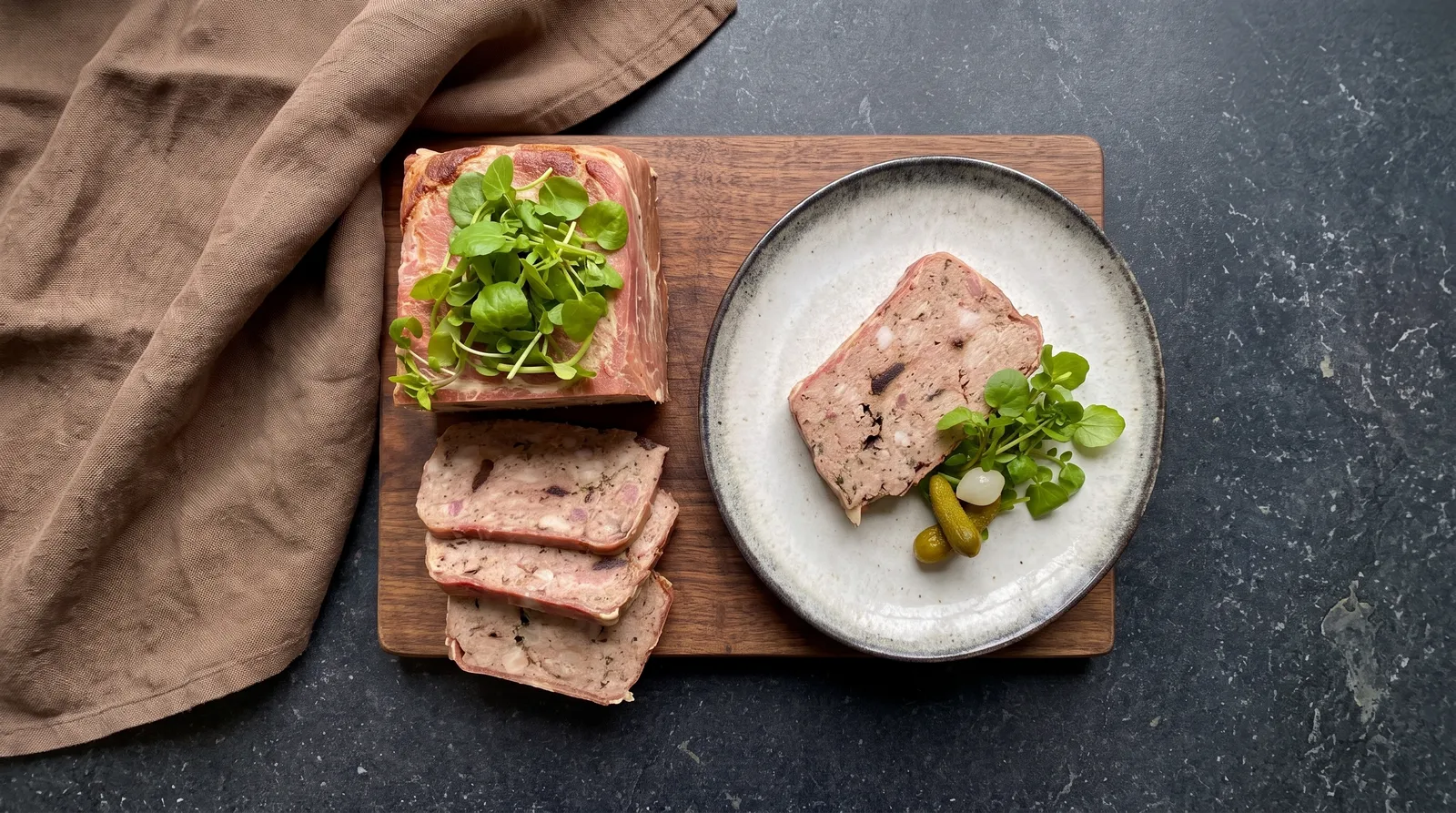
Terrine de campagne — coarse French country pork terrine
Terrine de campagne should show the structure of its meat rather than the smoothness of a fine pâté. Pork shoulder supplies lean meat, belly supplies fat and tenderness, and a measured liver portion deepens the savoury character. The chilled mixture is passed through a 6–8 mm plate, then combined with a milk-soaked bread panade and pasteurised egg so the cooked loaf slices cleanly without becoming an emulsion.
Cold handling is essential. Warm fat smears through a grinder instead of remaining as a visible coarse mosaic, producing a dense greasy slice. Keep the meat and equipment at 4 °C or colder, mix only until the mass binds and never taste raw forcemeat. The mould is packed firmly, set in a water bath and baked at 160 °C until the geometric centre reaches 71 °C.
The long set is part of the recipe rather than an optional wait. After a short 30-minute initial cool, the terrine moves into refrigeration, chills thoroughly, then rests under a clean 1 kg weight for 24 hours. That cold period firms the fat and protein matrix, improves slicing and lets the seasoning settle. The result is a refrigerated charcuterie item; it is not suitable for home-canning or shelf-stable storage.