French National Dishes

Teurgoule

A Norman rice pudding of whole milk, round rice, sugar and cinnamon, baked slowly for five hours until a thick deep-brown skin forms over tender creamy rice.

French National Dishes
Share
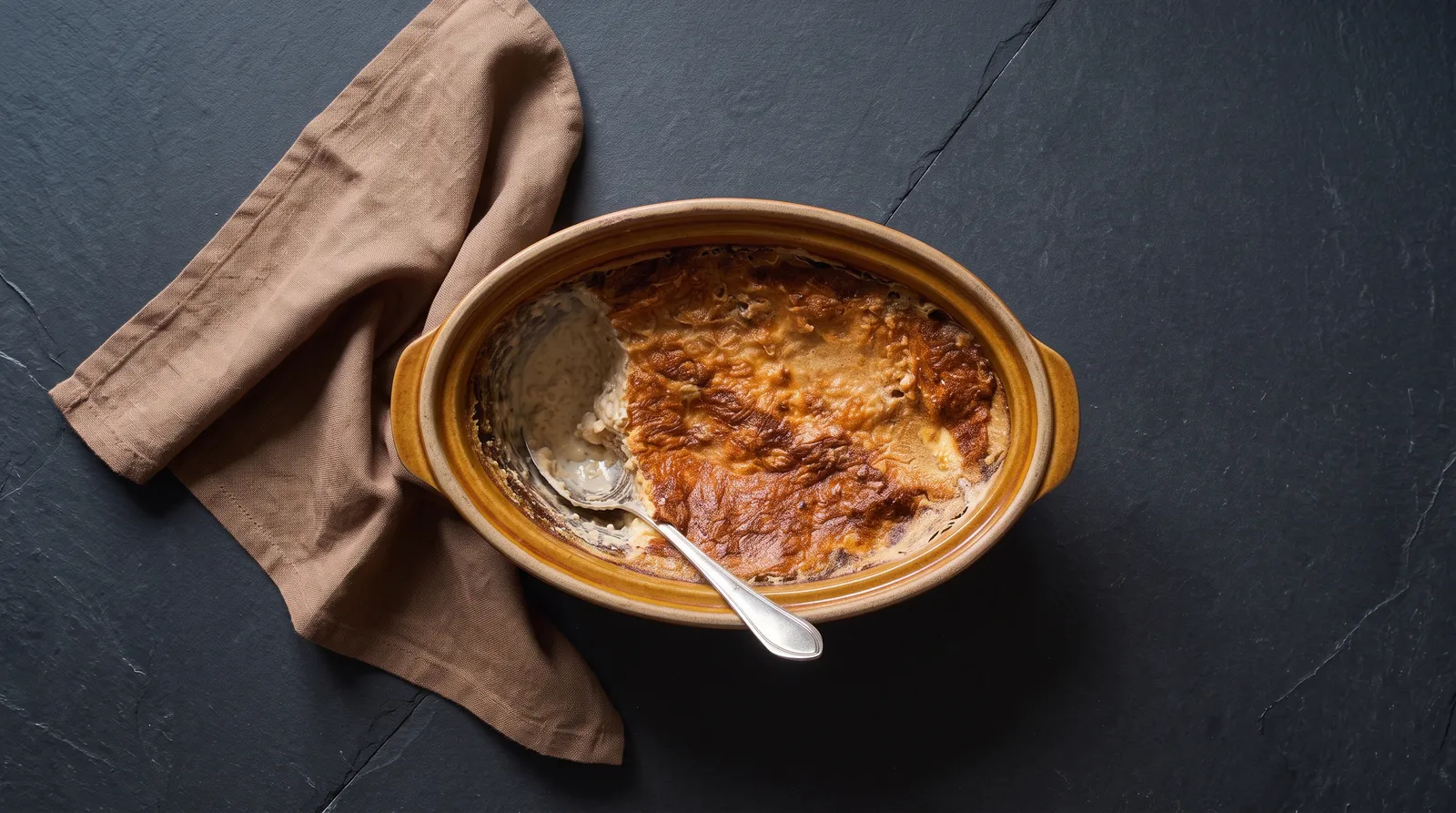
Teurgoule — presented in a serving dish
Prep 10 minutes
Cook 300 minutes
Total 340 minutes
Yield about 1.75 kg baked pudding in a 3 litre earthenware dish
Introduction and overview

Teurgoule — long-baked Norman cinnamon rice pudding

Teurgoule is the opposite of quick stovetop rice pudding. Round rice, sugar and cinnamon are mixed directly in a deep earthenware dish with whole milk, then left in a low 140 °C oven for five hours. Slow hydration and evaporation create a thick pudding underneath while the exposed milk surface develops the deeply browned, wrinkled skin that identifies the dish.

The surface should not be treated like crème brûlée. No sugar is torched at the end, and repeated stirring would destroy the skin as it forms. The goal is a continuous dark cap over rice that is completely tender and creamy rather than soupy. A deep vessel also matters because two litres of milk need ample headroom during the long bake.

Nutrition is calculated from the whole batch rather than pretending that water evaporation removes calories or macronutrients. Once baked, the pudding gets a short 30-minute cool before serving warm or moving to refrigeration. Because it is a large dairy dish, it should not sit for hours at room temperature while the centre slowly cools.
Success points

Success points

  • Use round rice and whole milk for the soft, cohesive texture.
  • Choose a deep 3 litre earthenware dish with enough headroom for two litres of milk.
  • Do not repeatedly stir during baking; the brown skin is part of the finished teurgoule.
  • Continue the low bake until the rice is fully tender and the pudding beneath the skin is thick rather than soupy.
Ingredients

Ingredients

Pudding

  • 2000 ml whole milk — pasteurised, about 3.5% fat
  • 150 g round white rice — uncooked
  • 180 g caster sugar
  • 6 g ground cinnamon
  • 1 g fine salt
Method

Method

Mix and bake

  1. Mix directly in the dish. Mix 150 g rice, 180 g sugar, 6 g cinnamon and 1 g salt directly in the 3 litre earthenware dish, then pour in 2,000 ml whole milk and stir once to distribute the rice. Timing: 10 minutes. Mixing directly in the baking vessel avoids disturbing the developing surface later. Use pasteurised milk and keep it refrigerated before use. The rice and cinnamon are evenly dispersed through the milk with no dry clumps on the base.

  2. Bake low and long. Bake uncovered without frequent stirring until the surface forms a thick deep-brown skin and the rice underneath is completely tender in a thick, creamy body. Timing: 300 minutes. Heat: 140 °C conventional oven. Temperature: 140 °C. Long low heat slowly hydrates the rice and concentrates the milk beneath the characteristic skin. The earthenware and milk are very hot; use dry oven gloves and avoid spilling the deep dish. A thick, deeply browned wrinkled skin covers the surface, the rice grains underneath are fully tender and the pudding beneath the skin is thick rather than soupy.

  3. Cool safely. Leave the dish to cool briefly before serving warm or moving it to refrigeration. Timing: 30 minutes. Keep off the heat. A short cooling period improves serving texture without prolonged room-temperature holding. Refrigerate within 2 hours of leaving the oven. After 30 minutes the pudding has stopped steaming vigorously and has thickened further while the skin remains intact.

Serving

Practical

Serving

Spoon through the browned skin into 8 portions and serve warm, tepid or chilled according to preference.

Storage and reheating

Refrigerate at 4 °C or colder within 2 hours and use within 3 days. Reheat a portion gently at 150 °C until hot, or serve chilled; avoid vigorous microwave boiling, which can toughen the skin and scorch milk solids.

Semi-skimmed milk

Produces a leaner and less creamy pudding; whole milk better matches the rich long-baked texture.

Long-grain rice

Not recommended because the starch and grain shape produce a different texture from round rice.

Troubleshooting

Troubleshooting

  • Rice remains firmCause: The dish was too shallow, oven temperature ran low or baking ended early. Correction: Continue the low bake until grains are fully tender under the skin, protecting the surface if it is already very dark.
  • Pudding is watery beneath the skinCause: It has not baked long enough for rice hydration and gentle evaporation. Correction: Continue baking until the body is thick rather than soupy.
Nutrition per serving

Nutrition per serving

  • Serving size1 of 8 portions (about 220 g)
  • Calories307 kcal
  • Carbohydrate49.3 g
  • Protein9.1 g
  • Fat8.2 g
  • Fibre0.2 g
  • Sodium157 mg
Allergens and food safety

Allergens and food safety

Allergens: Milk.

Use pasteurised milk and keep it at 4 °C or colder before use.

Refrigerate the baked dairy pudding within 2 hours and store at 4 °C or colder.

Do not leave the deep hot dish at room temperature for extended cooling.

Closing

Closing

  • Result: A thick Norman rice pudding with fully tender grains beneath a characteristic deeply browned, wrinkled milk skin.
  • Decisive technique: Bake undisturbed for five hours at 140 °C in a deep earthenware dish rather than stirring it like stovetop rice pudding.