French Recipes

Tarte flambée

An ultra-thin Alsatian dough spread with fromage blanc and crème fraîche, topped with fine onion and smoked lardons, then baked hard and fast on a fully heated stone or steel.

French Recipes
Share
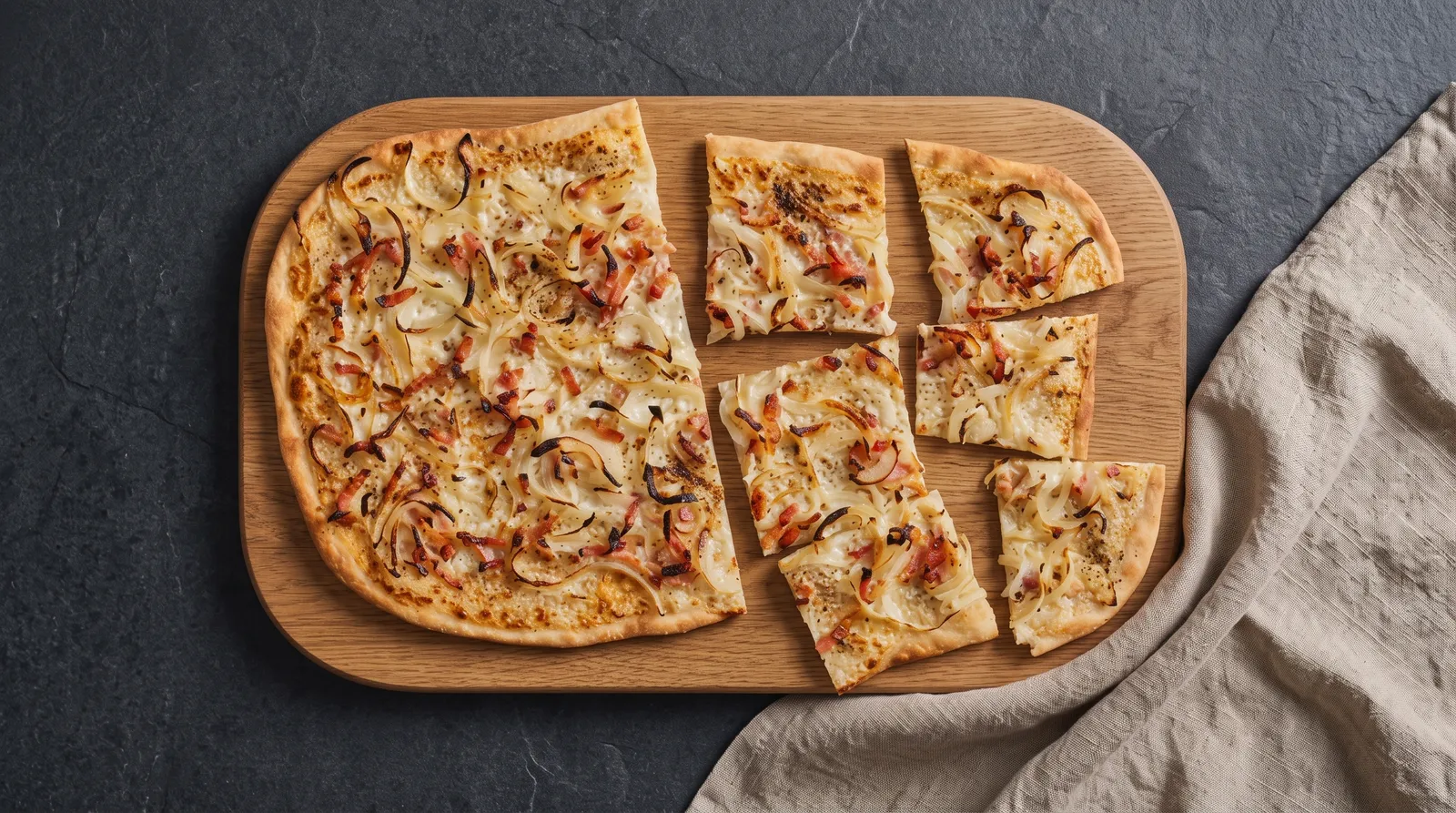
Tarte flambée — shown with a cut section visible
Prep 25 minutes
Cook 15 minutes
Total 70 minutes
Yield 1 large 30 × 40 cm tarte flambée
Introduction and overview

Tarte flambée (Flammekueche) — thin Alsatian onion and lardon tart

Tarte flambée is not pizza with a different topping. The Alsatian structure is much thinner: a supple wheat dough is rolled to about 1 mm, with no substantial bread-like rim, then covered with a restrained layer of fromage blanc and crème fraîche, fine onion and lardons. The dough receives only a short rest, enough to relax the gluten so it can be rolled almost paper-thin.

Heat is the second defining element. A baking stone or steel is held at 250 °C before the tart goes in, allowing the base to crisp before the dairy layer has time to dry out. The lardons are briefly rendered in advance so excess fat is controlled and the pork reaches 71 °C before the quick final bake. Thin onion slices soften in the same short oven window without becoming a separate sautéed topping.

The finished tart should combine three textures at once: a crisp underside, blistered browned edges and a centre that is set but still creamy. A thick base, a heavy dairy spread or a layer of grated cheese would shift the result away from the classic Flammekueche profile. Serve it at once; the contrast between crisp base and moist topping diminishes as it stands.
Success points

Success points

  • Roll the rested dough to about 1 mm and do not build a raised pizza-style rim.
  • Preheat the stone or steel fully at 250 °C during the 30-minute dough rest.
  • Spread the dairy mixture thinly and distribute onion and lardons evenly so the centre bakes in the same 10-minute window as the edges.
Ingredients

Ingredients

Dough

  • 250 g plain wheat flour
  • 125 ml water — cool
  • 30 ml rapeseed oil
  • 4 g fine salt

Topping

  • 150 g fromage blanc — pasteurised, about 7–8% fat
  • 100 g crème fraîche — pasteurised, full-fat
  • 150 g onion — peeled and sliced very thinly
  • 150 g smoked lardons — commercially cured; choose a product whose label declares sulphites for this formulation Use a commercial product whose label declares sulphites.
  • 1 g freshly ground black pepper
  • 0.5 g ground nutmeg
Method

Method

Dough and toppings

  1. Mix the dough. Mix 250 g flour, 125 ml water, 30 ml rapeseed oil and 4 g salt until no dry flour remains, then knead briefly until smooth. Timing: 8 minutes. A smooth, low-rise dough can be rolled paper-thin. The dough is smooth, supple and no longer leaves dry flour in the bowl.

  2. Rest the dough. Cover the dough and leave it to rest. Timing: 30 minutes. Resting relaxes gluten without turning the base into a thick risen bread. The rested dough rolls without springing back strongly.

  3. Heat the baking surface. Set a baking stone or steel in the oven and preheat it thoroughly. Timing: 30 minutes concurrently with the dough rest. Temperature: 250 °C. Stored heat is needed for a crisp base before the dairy topping dries out. The stone or steel is extremely hot; do not touch it and use a peel or sturdy tray to transfer the tart. The oven and stone or steel have held 250 °C for the full preheat period.

  4. Render the lardons. Render the 150 g lardons in a dry frying pan, stirring, until their fat begins to release and the pork reaches 71 °C, then transfer them to a plate. Timing: 5 minutes. Heat: medium heat. Temperature: 71 °C internal temperature. Partial rendering controls grease while the measured temperature provides the meat safety check. Keep raw or undercooked pork and its utensils away from ready-to-eat ingredients. The lardons have released some fat and are lightly coloured, and the centre of the thickest piece reaches 71 °C.

  5. Prepare the dairy and onion. Stir the fromage blanc, crème fraîche, pepper and nutmeg together; keep chilled until assembly and slice the onion very thinly. Timing: 7 minutes. Temperature: 4 °C or colder. A thin spread limits moisture on the delicate base. Return the dairy mixture to 4 °C or colder if assembly is delayed. The dairy spread is smooth and spoonable, and the onion slices are thin and flexible.

Roll and bake

  1. Roll and top. Roll the rested dough to about 30 × 40 cm and about 1 mm thick, spread the dairy mixture thinly to the edges, and distribute onion and rendered lardons evenly. Timing: 10 minutes. The characteristic crispness depends on an exceptionally thin base and restrained topping. The base is about 1 mm thick with no heavy rim, and the toppings form a thin even layer.

  2. Bake hard and fast. Slide the tart onto the hot stone or steel and bake until the edges blister and brown and the centre is set without becoming dry. Timing: 10 minutes. Heat: 250 °C conventional oven. Temperature: 250 °C. High heat crisps the base quickly while keeping the topping moist. Use oven gloves and a peel; hot fat and the baking surface can cause severe burns. The edges are blistered and browned, the underside is crisp, and the dairy centre is set but still creamy.

Serving

Practical

Serving

Cut into 4 portions and serve immediately while the edges are crisp and the centre is still creamy.

Storage and reheating

Refrigerate leftovers at 4 °C or colder within 2 hours and use within 2 days. Reheat on a hot baking sheet at 220 °C for 5–7 minutes until the topping is steaming; do not expect the same just-baked crispness.

Crème fraîche only in place of the fromage-blanc/crème-fraîche blend

Produces a richer, denser topping and shifts the classic balance; use only when fromage blanc is unavailable.

Bacon cut into short strips for lardons

Can approximate the pork element but changes smoke, salt and fat balance; it is an adaptation rather than identical lardons.

Troubleshooting

Troubleshooting

  • Soft centreCause: The dough was too thick, the stone insufficiently heated or the topping too heavy. Correction: Roll to about 1 mm, fully heat the baking surface and spread the dairy mixture thinly.
  • Dry toppingCause: The tart baked too long after the edges were already crisp. Correction: Remove it as soon as the underside is crisp, edges blister and the dairy centre is set.
Nutrition per serving

Nutrition per serving

  • Serving size1 of 4 portions
  • Calories559 kcal
  • Carbohydrate53.9 g
  • Protein14.8 g
  • Fat30.6 g
  • Fibre2.3 g
  • Sodium985 mg
Allergens and food safety

Allergens and food safety

Allergens: Gluten (wheat), Milk, Sulphites.

Use pasteurised fromage blanc and crème fraîche and keep them at 4 °C or colder before baking.

Heat the thickest lardon to 71 °C before it is placed on the tart.

Refrigerate leftovers within 2 hours; reheat leftovers until steaming hot.

Use commercial lardons whose package label declares sulphites; people sensitive to sulphites should verify the label.

Closing

Closing

  • Result: A blistered, crisp Alsatian tarte with a creamy centre, sweet onion and savoury lardons rather than a pizza-like cheese layer.
  • Decisive technique: Roll to about 1 mm and bake on a fully heated 250 °C stone or steel so the base crisps before the topping dries.