French National Dishes

Tarte tropézienne

A Saint-Tropez-style sugar-topped brioche split and filled with a chilled orange-flower cream, presented transparently as a household interpretation rather than the proprietary commercial formula.

French National Dishes
Share
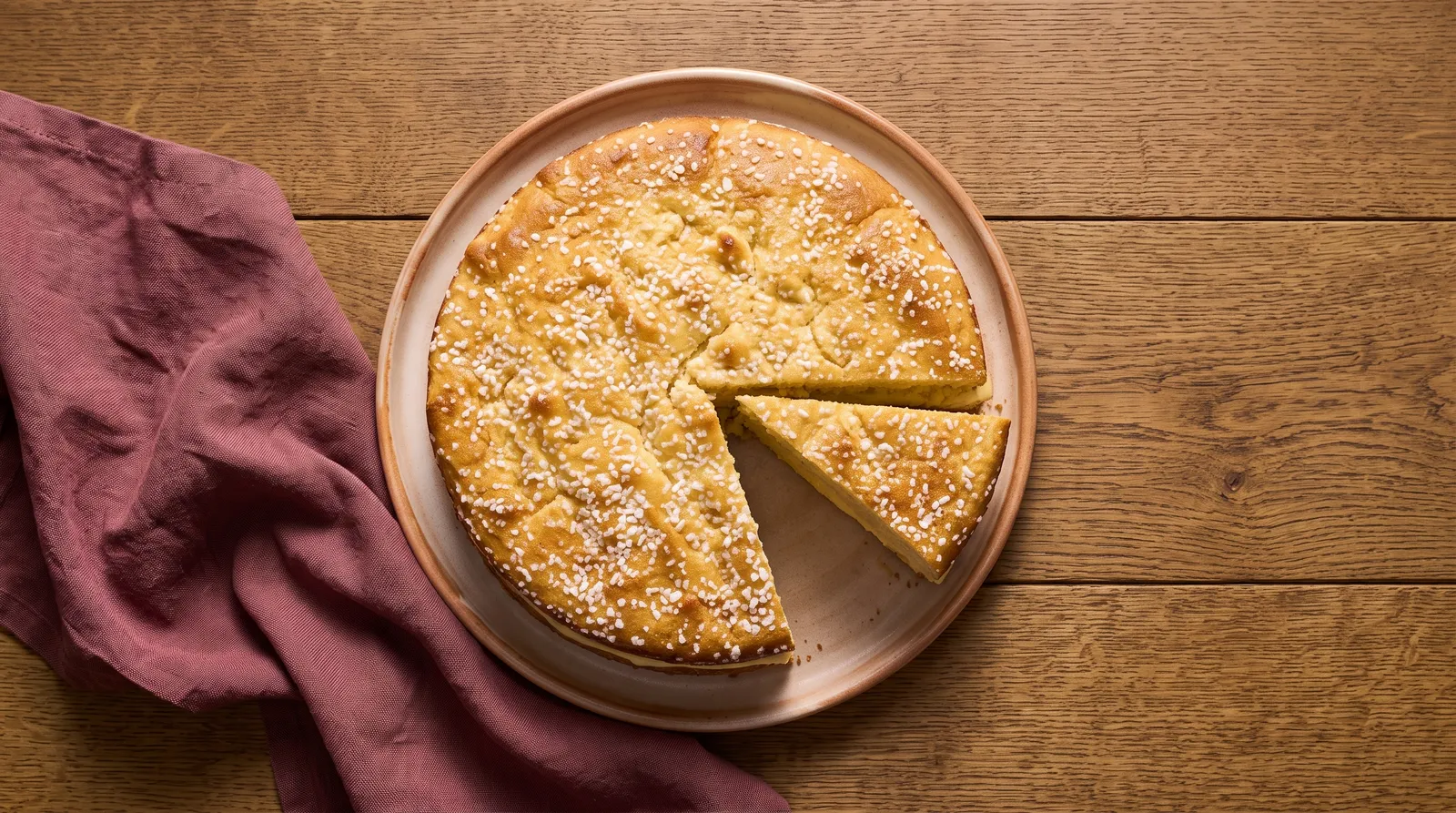
Tarte tropézienne — shown with a cut section visible
Prep 60 minutes
Cook 35 minutes
Total 350 minutes
Yield 1 filled 22 cm brioche cake
Introduction and overview

Tarte tropézienne — sugar brioche with orange-flower cream

Tarte tropézienne looks like a cake, but its foundation is enriched yeast brioche. The 22 cm round is made with egg, butter and milk, allowed a first rise, shaped, proofed again and baked under pearl sugar. The crumb needs enough gluten strength to support a generous cream layer without becoming bread-heavy or collapsing when the cake is split.

The famous Saint-Tropez commercial cream is proprietary, so a responsible home formula should not pretend to reproduce it exactly. Here the filling is a documented household-style combination: pastry cream scented with orange-flower water, enriched with butter and lightened with whipped cream. It gives the expected contrast of tender brioche and cool cream while keeping the limits of the interpretation clear.

Temperature control is central to both texture and safety. The pastry-cream base is cooked to 71 °C, spread shallow and chilled to 4 °C or colder. Before whipping, both the custard and the finishing 50 g butter are brought to the same 18–20 °C range; mismatched temperatures are a common route to a split mousseline. The filled cake then returns to 4 °C or colder for a 60-minute set before slicing.

Success points

Success points

  • Knead the enriched dough until it stretches thinly before relying on the butter-rich crumb to rise.
  • Cook the pastry cream to 71 °C and cool it rapidly in a shallow container.
  • Bring both custard and finishing butter to 18–20 °C before beating them together, keeping the cumulative room-temperature interval under 2 hours.
  • Fill only after the brioche is completely cool, then chill the assembled cake for the full 60 minutes.
Ingredients

Ingredients

Brioche

  • 300 g strong wheat flour
  • 70 ml whole milk — pasteurised, cool
  • 100 g pasteurised whole egg — beaten; net weight
  • 40 g caster sugar
  • 5 g fine salt
  • 6 g instant dry yeast
  • 100 g unsalted butter — soft but cool
  • 15 ml orange-flower water
  • 15 ml whole milk — pasteurised, for brushing
  • 35 g pearl sugar — for topping

Cream filling

  • 300 ml whole milk — pasteurised
  • 36 g pasteurised egg yolk — net weight
  • 60 g caster sugar
  • 25 g cornflour
  • 100 g unsalted butter — 50 g whisked into hot custard and 50 g held for finishing Both portions are fully counted.
  • 150 ml whipping cream — pasteurised, at least 35% fat; chilled
  • 10 ml orange-flower water
Method

Method

Brioche

  1. Develop the brioche dough. Mix 300 g flour, 70 ml milk, 100 g egg, 40 g sugar, 5 g salt, 6 g yeast and 15 ml orange-flower water, then knead until the dough becomes elastic before gradually working in 100 g soft butter. Timing: 20 minutes. Developing gluten before all the butter is absorbed gives the enriched dough enough strength. Use pasteurised egg and milk. The dough is glossy, elastic and stretches to a thin membrane without tearing immediately.

  2. Give the dough its first rise. Rest the covered dough for its first rise. Timing: 90 minutes. Heat: warm room temperature. Temperature: about 24–26 °C room. The first rise builds gas and flavour in the enriched dough. The dough has roughly doubled in volume and holds a clear fingertip indentation that relaxes slowly.

  3. Shape the round. Press out large gas pockets, shape a 22 cm round on a lined tray and allow 10 minutes of active shaping. Timing: 10 minutes. Even shape makes the finished split cake level enough to fill. The round is an even 22 cm with a level surface and no tight torn skin.

  4. Complete the final proof. Rest the shaped brioche for its final rise. Timing: 45 minutes passive proofing. Heat: warm room temperature. Temperature: about 24–26 °C room. The final rise keeps the crumb light enough to sandwich the cream. The brioche is visibly puffy and a light fingertip press springs back slowly.

  5. Bake with pearl sugar. Brush with 15 ml milk, scatter 35 g pearl sugar and bake until evenly golden and cooked through. Timing: 25 minutes. Heat: 175 °C conventional oven. Temperature: 175 °C. Moderate oven heat cooks the enriched crumb without scorching the sugar. Use oven gloves around the hot tray. The brioche is evenly deep golden, feels light for its size and the centre is set rather than gummy.

  6. Cool the brioche completely. Transfer the brioche to a rack and cool completely before splitting. Timing: 60 minutes. Keep off the heat. Warm brioche would melt the filling. Do not fill while the brioche is warm. The brioche is completely cool through the centre and no warm steam escapes when it is cut.

Cream and assembly

  1. Cook the pastry cream. Heat 300 ml milk; whisk 36 g yolk, 60 g sugar and 25 g cornflour separately, temper with the hot milk, return to the saucepan and cook while whisking until the custard reaches 71 °C and thickens. Whisk in 50 g butter and 10 ml orange-flower water. Timing: 10 minutes. Heat: medium heat. Temperature: 71 °C custard centre. Cornflour thickens the custard while 71 °C provides the egg safety endpoint. Keep the custard moving to prevent scorching and verify 71 °C with a clean thermometer. The custard is thick enough to hold whisk trails and reaches 71 °C throughout.

  2. Chill the custard rapidly. Spread the custard in a shallow clean container, cover the surface and cool it rapidly in the refrigerator. Timing: 120 minutes concurrently with proofing, baking and brioche cooling. Temperature: 4 °C or colder. Rapid shallow cooling limits time in the temperature danger zone. Refrigerate promptly at 4 °C or colder. The custard is cold throughout and no warmer than 4 °C before finishing.

  3. Finish the lightened cream. Bring the cold custard and the remaining 50 g butter separately to 18–20 °C for 20–30 minutes, beat the butter smooth, then whip it into the custard; whip 150 ml cold cream to soft peaks and fold it in. Timing: 20 minutes active within a 20–30 minute tempering interval. Temperature: 18–20 °C for custard and finishing butter; cream kept cold. Matching the custard and butter temperatures reduces the risk of a split mousseline. The combined room-temperature tempering for custard and butter stays within the 2-hour cumulative limit; return the cream to refrigeration immediately after mixing. The custard and finishing butter are both 18–20 °C before beating, and the finished cream is smooth, aerated and holds soft ridges.

  4. Fill and set the cake. Split the cooled brioche horizontally, spread all the cream evenly over the lower half, replace the top and refrigerate before slicing. Timing: 60 minutes. Temperature: 4 °C or colder. A chilled set stabilises the generous filling. Keep the filled cake at 4 °C or colder. The cream has set enough to hold a clean slice after 60 minutes of refrigeration.

Serving

Practical

Serving

Serve chilled but not ice-cold, cut into 8 slices. Keep the cake refrigerated between servings because the filling contains cooked egg, dairy and whipped cream.

Storage and reheating

Store filled cake covered at 4 °C or colder for up to 2 days. Do not reheat the filled cake: heat destabilises the cream. The unfilled brioche can be refreshed briefly in a low oven before it is cooled again for filling.

Omit orange-flower water

The brioche and cream still function, but the floral Provençal-style aroma is lost.

Do not replace butter with a soft spread

A high-water spread can weaken both brioche structure and cream stability; no equal substitution is offered.

Troubleshooting

Troubleshooting

  • Cream looks splitCause: The custard and finishing butter were at different temperatures. Correction: Bring both to the same 18–20 °C range before beating and stop if the mixture becomes oily.
  • Filling squeezes out when cutCause: The brioche was warm or the assembled cake was not chilled for the full set. Correction: Cool the brioche completely and refrigerate the filled cake for 60 minutes before slicing.
Nutrition per serving

Nutrition per serving

  • Serving size1 of 8 slices
  • Calories513 kcal
  • Carbohydrate51.6 g
  • Protein8.4 g
  • Fat30.6 g
  • Fibre1.2 g
  • Sodium302 mg
Allergens and food safety

Allergens and food safety

Allergens: Gluten (wheat), Egg, Milk.

Use pasteurised eggs and dairy; cook the pastry cream to 71 °C.

Cool the custard rapidly to 4 °C or colder in a shallow container.

Keep both custard and finishing butter within the 18–20 °C working range and keep total room-temperature tempering under 2 hours.

Refrigerate the filled cake at 4 °C or colder and return it to refrigeration within 2 hours of service.

Closing

Closing

  • Result: A tender pearl-sugar brioche filled with a stable, chilled orange-flower cream that cuts cleanly after setting.
  • Decisive technique: Cool the custard rapidly, match custard and finishing butter at 18–20 °C, and fill only a completely cool brioche.