French Recipes

Soupe au pistou

Provençal beans, summer vegetables and pasta finished off the boil with fresh basil, garlic, olive oil and Parmesan pistou.

French Recipes
Share
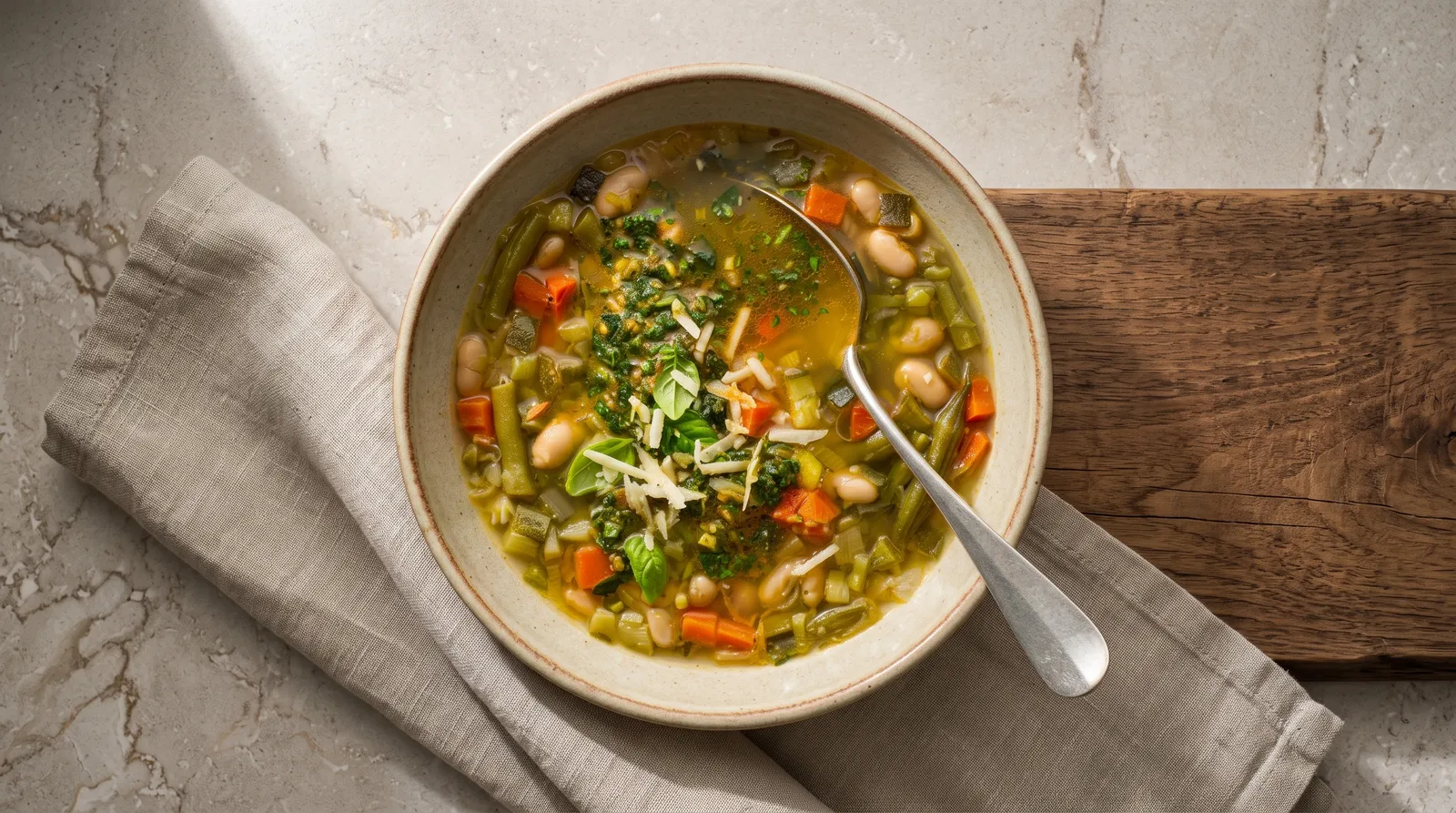
Soupe au pistou — served in a bowl
Prep 45 minutes
Cook 115 minutes
Total 880 minutes
Yield 1 large pot, about 8 generous bowls
Introduction and overview

Soupe au pistou — Provençal bean and pistou soup

Soupe au pistou is a Provençal vegetable-and-bean soup whose defining finish is pistou: basil, garlic and olive oil worked into a fresh paste, here completed with Parmesan. It is not simply minestrone with a spoonful of commercial pesto. The beans, seasonal vegetables and pasta form the body of the soup; the pistou changes its aroma at the very end.

The long schedule belongs to the beans, not to every vegetable. Dried white coco beans soak under refrigeration, then simmer until nearly tender before the firm vegetables go in. Green beans and potatoes follow, while courgettes and tomatoes are held back until the last part of cooking. This order keeps the pot substantial without reducing every vegetable to the same texture.

Pistou should never be boiled hard after it enters the pot. Basil and garlic are crushed with olive oil, the cheese is incorporated, and the paste is stirred into the soup off the heat. The final bowl should smell clearly of fresh basil and show beans, vegetables and pasta in a thick but still spoonable broth.
How to protect the pistou

How to protect the pistou

  • Soak the beans under refrigeration, not on the counter.
  • Add vegetables in stages so they finish together.
  • Stir the pistou in off the heat and do not boil it afterwards.
Ingredients

Ingredients

Soup

  • 250 g dried white coco beans — picked over
  • 3000 ml cold water — for soaking and cooking; replace soaking water with fresh measured cooking water
  • 200 g yellow onion — diced
  • 200 g leek — sliced
  • 250 g carrots — 1 cm dice
  • 120 g celery stalk — 1 cm dice
  • 250 g green beans — cut into 2 cm pieces
  • 500 g potatoes — 1.5 cm dice
  • 400 g courgettes — 1.5 cm dice
  • 400 g ripe tomatoes — peeled, seeded and chopped
  • 200 g small dried pasta — coquillettes or short macaroni
  • 10 g fine salt
  • 2 g black pepper

Pistou

  • 80 g fresh basil leaves
  • 30 g garlic — peeled
  • 160 g extra-virgin olive oil
  • 100 g Parmesan — finely grated
Method

Method

Directions

  1. Cold-soak the beans. Cover the beans with cold water and refrigerate for 12 hours at 4 °C or below; drain and discard the soaking water. The beans are visibly plumper and evenly hydrated before cooking.

  2. Cook the beans first. Put the soaked beans in the stockpot with the remaining fresh measured water and simmer for about 60 minutes. The beans are creamy inside when bitten but still hold their shape.

  3. Add the firm vegetables. Add onion, leek, carrots and celery and simmer for 20 minutes. The carrots are beginning to soften but still offer slight resistance.

  4. Add green beans and potatoes. Add the green beans and potatoes and simmer for 15 minutes. The potato cubes are almost tender and the green beans remain intact.

  5. Add the delicate vegetables. Add the courgettes and tomatoes and cook for 10 minutes. The courgettes are tender but keep distinct edges and the tomatoes have softened into the broth.

  6. Cook the pasta. Add the pasta and cook for 10 minutes, stirring from the base. The pasta is tender with a slight bite and the soup remains thick but spoonable.

  7. Make fresh pistou. Crush the garlic and basil, work in the olive oil, then mix in the Parmesan. The pistou is a thick, bright green paste with visible basil flecks and no whole garlic chunks.

  8. Finish off the heat. Take the soup off the heat, stir in the pistou, salt and pepper and serve without boiling again. The pistou is evenly dispersed and the soup smells strongly of fresh basil rather than cooked pesto.

Serving

Practical

Serving

Serve hot or warm in deep bowls. The soup should be substantial, with visible beans, vegetables and pasta suspended in a basil-scented broth.

Make-ahead

Cook the beans and vegetable soup one day ahead, cool promptly and refrigerate. Prepare the pistou fresh and stir it into reheated soup just before serving.

Storage and reheating

Refrigerate within 2 hours and use within 3–4 days. Reheat the soup base to 74 °C, remove from the heat, then add any reserved pistou. Pasta will continue to absorb liquid during storage.

Substitutions

Fresh shelled coco beans can replace dried beans when available, but they do not need the 12-hour soak and their cooking time is shorter; the timing would need adjustment. A similar hard aged cheese can replace Parmesan, changing the final flavour but not the pistou technique.

Troubleshooting

Troubleshooting

  • Vegetables collapseToo many vegetables were added at once and cooked for the full bean time. Keep the staged additions so delicate courgette and tomato go in late.
  • Flat basil aromaThe pistou was boiled after addition. Take the pot off the heat first and stir it in only at the end.
Nutrition per serving

Nutrition per serving

  • Serving size1 large bowl, one eighth of the pot
  • Calories552 kcal
  • Carbohydrate65.6 g
  • Protein19.7 g
  • Fat25.0 g
  • Fibre11.3 g
  • Sodium741 mg
Allergens and food safety

Allergens and food safety

Allergens: Milk, Gluten (wheat), Celery.

Soak beans at 4 °C or below and cook them fully. Pistou and cooked beans are perishable; refrigerate leftovers within 2 hours. Reheat stored soup to 74 °C.

FAQ

FAQ

Does pistou contain nuts?

Not in this version. The pistou is basil, garlic, olive oil and Parmesan.

Why not boil after adding pistou?

Strong boiling dulls the fresh basil aroma and can make the cheese finish harsher.

Closing

Closing

  • Result: A thick Provençal bean-and-vegetable soup lifted by fresh basil-garlic pistou.
  • Decisive technique: Stagger the vegetables and stir fresh pistou in only after the pot leaves the heat.