French National Dishes

Soupe corse

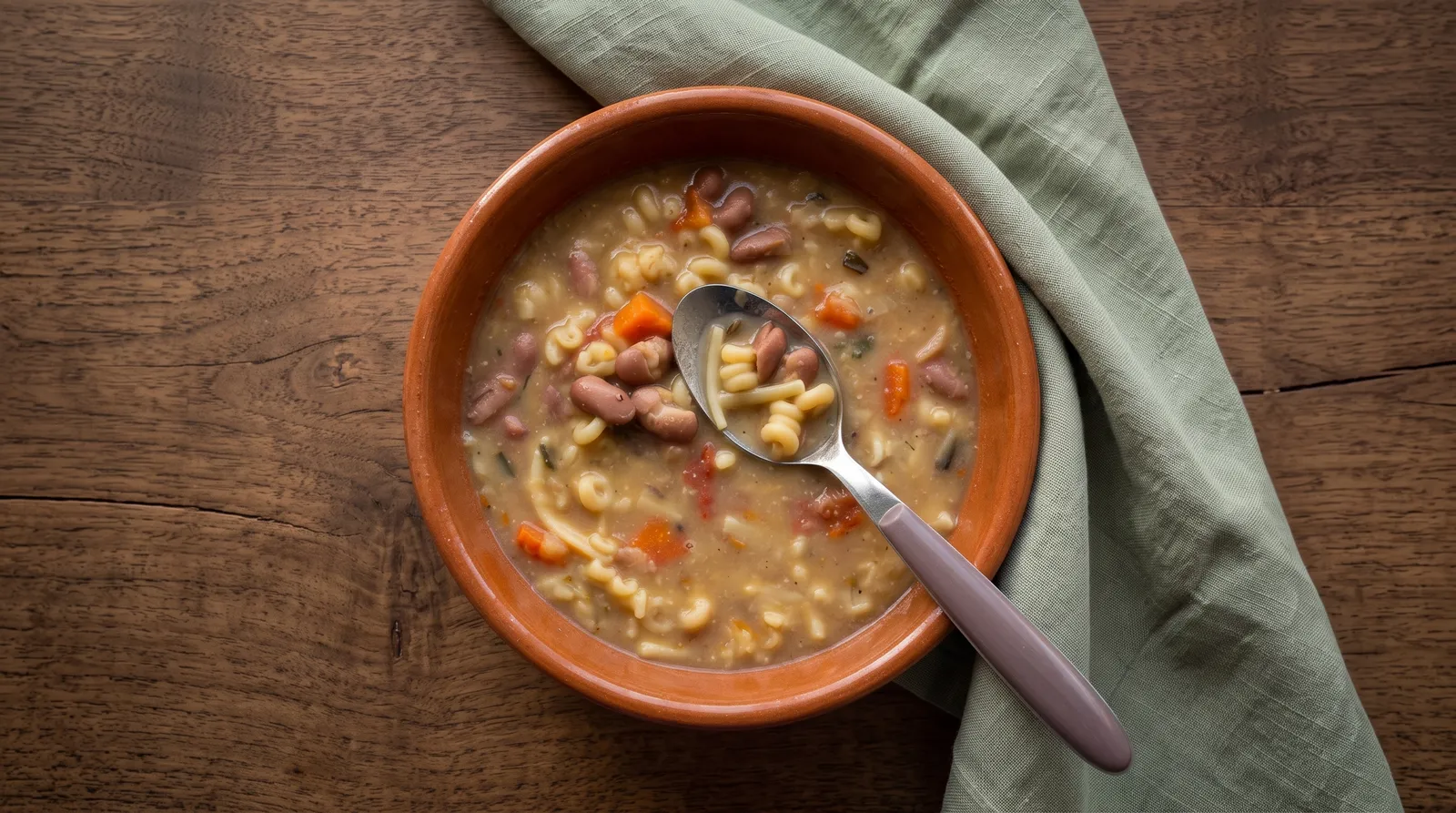
A substantial Corsican soup of soaked beans, panzetta, cabbage, vegetables, herbs and pasta, simmered until tender but still textured.

French National Dishes
Share
Soupe corse — served in a bowl
Prep 45 minutes
Cook 117 minutes
Total 892 minutes
Yield 1 large pot, 8 substantial bowls
Introduction and overview

Soupe corse — Corsican bean, vegetable and panzetta soup

Soupe corse is a substantial island soup rather than a generic vegetable broth. Documented Corsican household forms combine dried beans, cabbage and a wide range of vegetables with cured pork, then often add pasta near the end. Panzetta supplies the cured-pork depth here, and its rendered fat stays in the pot and contributes directly to both flavour and nutrition.

The beans set the pace. They soak cold overnight and then simmer with the cured-pork base and the firmer vegetables before potatoes, pumpkin, courgette and tomato are added. A gentle simmer is important: it softens beans and roots while keeping the final soup full of recognisable pieces instead of breaking down into purée.

Basil and nepita give the pot a distinctly Corsican aromatic direction, while the short pasta turns the broth into a complete meal. The soup rests briefly after cooking so its starches settle and the broth thickens slightly. It should still ladle cleanly, with beans, vegetables and panzetta spread through every bowl.
How to keep the soup substantial

How to keep the soup substantial

  • Render the panzetta before adding water and count its fat as part of the dish.
  • Keep the simmer gentle enough that beans and vegetables stay in pieces.
  • Add pasta only near the end so it does not dissolve into the broth.
Ingredients

Ingredients

Soup

  • 300 g dried white coco beans — picked over
  • 2500 ml cold water — fresh cooking water after soaking
  • 150 g panzetta or unsmoked cured pork belly — cut into small lardons; retain rendered fat
  • 40 g olive oil
  • 200 g yellow onion — chopped
  • 20 g garlic — chopped
  • 400 g green cabbage — shredded
  • 500 g potatoes — 2 cm dice
  • 350 g courgette — 2 cm dice
  • 300 g pumpkin — 2 cm dice
  • 200 g leek — sliced
  • 200 g turnips — 2 cm dice
  • 250 g carrots — sliced
  • 120 g celery stalk — sliced
  • 300 g ripe tomatoes — chopped
  • 180 g short dried pasta
  • 20 g fresh basil — chopped
  • 5 g dried nepita or calamint
  • 4 g fine salt
  • 2 g black pepper
Method

Method

Directions

  1. Cold-soak the beans. Cover the beans with cold water and refrigerate for 12 hours at 4 °C or below, then drain and rinse. The beans are evenly swollen and no longer hard-looking at the surface.

  2. Render the panzetta. Heat the olive oil, brown the panzetta lightly so it renders, then add the onion and garlic and soften them. The panzetta has released fat and browned lightly, while the onion is soft without burnt garlic.

  3. Wilt the cabbage. Add the cabbage and cook for 8 minutes. The cabbage has softened and reduced in volume but still shows distinct ribbons.

  4. Start the long simmer. Add the beans, 2500 ml fresh water, carrots, turnips, leek, celery, basil and nepita and simmer for 60 minutes. The beans are nearly tender and the root vegetables have softened without breaking apart.

  5. Add the softer vegetables. Add the potatoes, pumpkin, courgette and tomatoes and simmer for 25 minutes. The potatoes and pumpkin are tender when pierced but still hold their pieces.

  6. Cook the pasta. Add the pasta and cook for 12 minutes. The pasta is tender and the beans are fully creamy inside while the vegetables remain identifiable.

  7. Rest the soup briefly. Season with salt and pepper, take the pot off the heat and rest it for 10 minutes. The broth has thickened slightly and the solids settle evenly through the pot rather than separating.

Serving

Practical

Serving

Serve very hot in deep bowls with the visible beans, vegetables and panzetta distributed evenly. The soup is intended to eat like a complete meal rather than a thin first course.

Make-ahead

The soup can be cooked one day ahead; cool it promptly in shallow containers and refrigerate. It will thicken as the pasta and beans absorb liquid.

Storage and reheating

Refrigerate within 2 hours and use within 3–4 days. Reheat to 74 °C, adding only a measured splash of water if the stored soup has become too thick.

Substitutions

Another dried white bean can replace coco beans, but cooking time may shift with bean age and size. If the cured pork label lists sulphites or another regulated allergen, that label declaration must be carried through; do not assume all panzetta formulas are identical.

Troubleshooting

Troubleshooting

  • Hard beans with soft vegetablesThe beans did not get enough lead time. Simmer them close to tender before adding the potatoes, pumpkin and courgette.
  • Soup turns to mashThe pot boiled too hard or was stirred aggressively. Use a gentle simmer and broad, infrequent strokes.
Nutrition per serving

Nutrition per serving

  • Serving size1 substantial bowl, one eighth of the pot
  • Calories475 kcal
  • Carbohydrate70.6 g
  • Protein20.0 g
  • Fat14.1 g
  • Fibre12.6 g
  • Sodium578 mg
Allergens and food safety

Allergens and food safety

Allergens: Gluten (wheat), Celery.

Soak beans at 4 °C or below and cook them fully. Keep cured pork cold and separate from ready-to-eat foods during preparation. Refrigerate leftovers within 2 hours and reheat to 74 °C. Check the cured-pork label for sulphites or other declared allergens.

FAQ

FAQ

Why is the soup so thick?

Beans, potatoes and pasta all release starch during the long simmer; the result is meant to be substantial.

Can chestnuts be added?

Some Corsican versions use them, but they are outside this specific bean-panzetta-pasta preparation.

Closing

Closing

  • Result: A full Corsican meal soup with creamy beans, distinct vegetables, pasta and savoury panzetta.
  • Decisive technique: Give the beans a head start and keep the long simmer gentle enough to preserve pieces.