French Recipes

Potjevleesch

Potjevleesch is a French-Flemish cold meat terrine, not a stew served hot.

French Recipes
Share
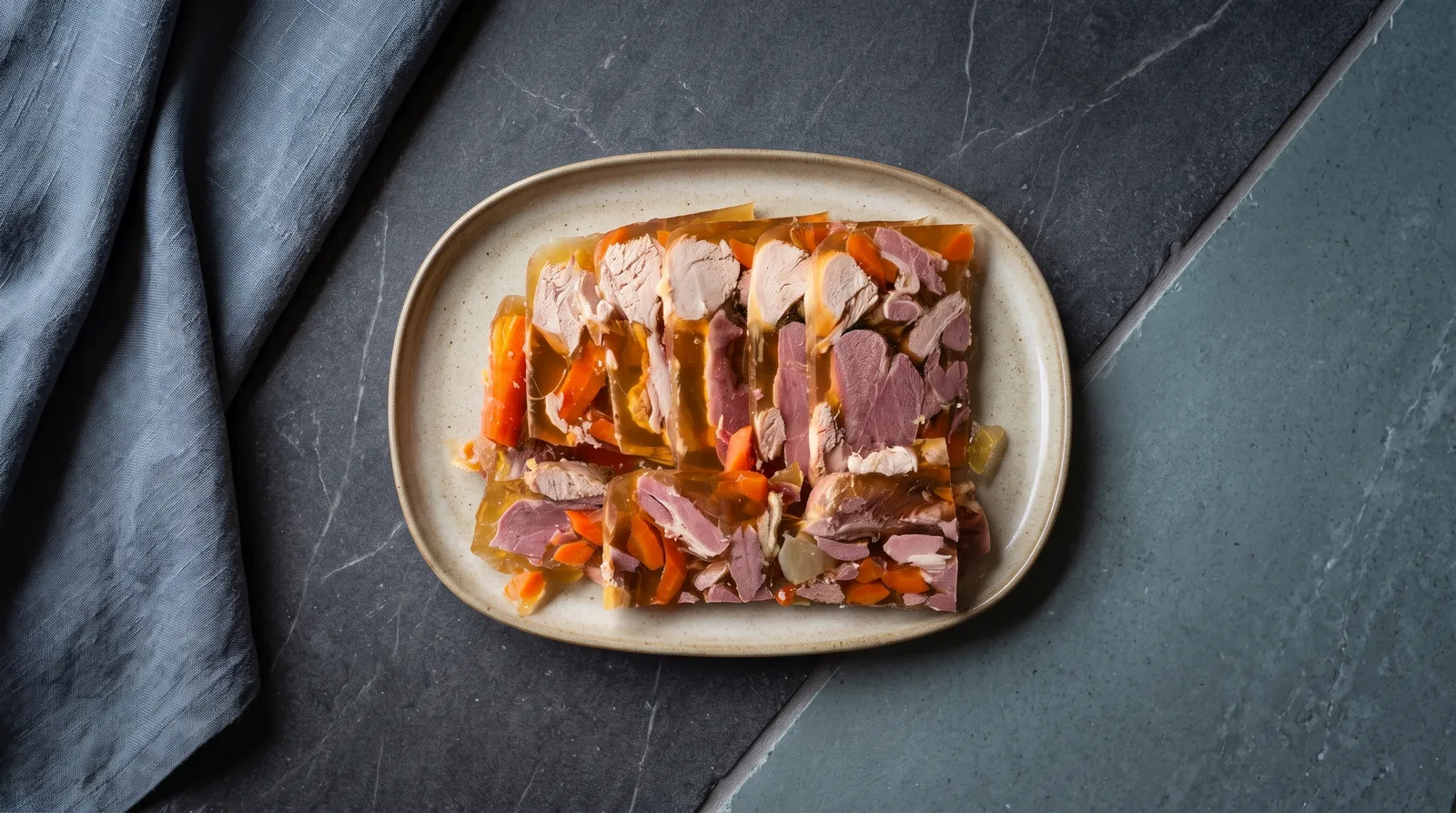
Potjevleesch — arranged on a serving platter
Cook time 160 minutes after 40 minutes of preparation.
Passive time 750 minutes after the 160-minute cooking schedule.
Calories per serving 340 kcal across the 950-minute schedule.
Yield 8 thick slices / meal portions.
Introduction and overview

Potjevleesch: French-Flemish cold terrine of chicken, rabbit, veal and pork cooked with white wine, wine vinegar and aromatics, then set in clear gelatine-strengthened jelly.

Potjevleesch is a French-Flemish cold meat terrine, not a stew served hot. The structure is built from distinct pieces of pale meat—chicken, rabbit, veal and pork—held in a lightly acidic clear jelly. Wine and vinegar season the cooking liquor, while a measured gelatine addition gives a reliable set for a domestic kitchen.

Food safety controls are unusually important because the dish moves from four raw meats to a long cook and then into cold service. Chicken is checked at 74 °C, rabbit at 71 °C, and the pork at or above its intact-cut minimum before the terrine leaves the oven. The hot liquor is then strained and gelled, and the assembled terrine is cooled rapidly rather than being left on the counter for hours.

The 12-hour refrigerator set is not decorative waiting time; it is part of the recipe’s structure and therefore counted in full. The terrine stays cold when sliced and served. Nutrition excludes rabbit bones and counts only the jelly actually surrounding the meat, rather than all liquid that may remain in the saucepan.
Success points

Success points

  • Keep the four meats in recognisable pieces rather than mincing them.
  • Use commercially dressed rabbit and remove any loose small bones before the jelly is poured.
  • Treat rapid cooling and the 12-hour refrigerator set as mandatory parts of the method.
Ingredients

Ingredients

Four meats

  • 300 g boneless chicken thigh, skinless; 4 cm pieces
  • 400 g commercially dressed rabbit hind legs, bone-in; about 300 g raw edible meat
  • 300 g veal shoulder, boneless; 4 cm pieces
  • 300 g pork shoulder, boneless; 4 cm pieces

Jelly and aromatics

  • 500 ml dry white wine
  • 150 ml white wine vinegar
  • 500 ml low-sodium chicken stock
  • 180 g yellow onions, thinly sliced
  • 200 g carrots, thin rounds
  • 12 g garlic, sliced
  • 3 g juniper berries, lightly crushed
  • 4 g thyme-bay bouquet, tied
  • 18 g powdered gelatine, unflavoured
  • 8 g fine salt
  • 2 g black pepper
Method

Method

Directions

  1. Prepare and layer the meats. Cut chicken, veal and pork into even 4 cm pieces. Joint the commercially dressed rabbit legs only as needed, leaving the major bones intact and easy to identify. Layer the four meats with onions, carrots, garlic, juniper and bouquet in a 2-litre terrine. The meats are in clearly separate pieces rather than minced, and rabbit bones are large and visible. Distinct pieces preserve the characteristic sliced appearance and make bone control possible. Use separate raw-meat utensils and wash hands between raw meat and ready-to-eat tasks.

  2. Add the acidic cooking liquor. Mix 500 ml wine, 150 ml vinegar and 500 ml stock with the salt and pepper, then pour over the terrine so the meat is mostly submerged. The liquid reaches around the layered meat without floating the pieces out of order. Wine, vinegar and stock create the lightly acidic jelly liquor. Wine contains sulphites and some alcohol may remain after cooking.

  3. Cook the terrine. Cover and cook at 150 °C for 150 minutes. Check that the chicken reaches 74 °C, rabbit reaches at least 71 °C, pork reaches at least 63 °C and the veal is fully tender before ending the cook. The meats are tender enough to cut with a fork but remain in recognisable chunks, and the cooking liquor is clear amber rather than opaque. Long covered cooking tenderises all four meats and extracts gelatinous body without frying or browning them. Measure temperatures away from bone. Keep the terrine covered when moving it because the liquor is scalding.

  4. Strengthen the jelly. Lift the meats carefully into a clean 2-litre mould, removing any small loose rabbit bones. Strain the hot liquor, bring it to a boil for 10 minutes, take it off the heat and whisk in the 18 g powdered gelatine until dissolved. Pour enough liquor over the layered meat to cover. The strained liquor is clear, the gelatine is fully dissolved and the meat is just covered in the mould. A measured gelatine addition gives a reliable cold set for home service. Do not boil after gelatine is fully dissolved; handle hot liquor and the mould with dry gloves.

  5. Cool rapidly. Set the covered mould into an ice bath and cool for 30 minutes passive cooling, changing ice as needed so the terrine stops steaming quickly. The mould is no longer hot to the touch and there is no visible steam before refrigeration. Rapid cooling shortens the time the cooked meat spends warm. Do not leave the terrine at room temperature for extended cooling.

  6. Chill until fully set. Refrigerate the terrine for 720 minutes chilling, keeping it covered and level. The jelly is fully firm, clear around the meat and slices without running. An overnight chill is essential to the identity and structure of potjevleesch. Keep the terrine refrigerated through service; do not let cold slices sit out for more than 2 hours.

  7. Slice and serve cold. Unmould only if the jelly is fully set, then cut 8 thick slices with a sharp knife and serve immediately while cold. Each slice shows distinct pieces of chicken, rabbit, veal and pork suspended in set jelly. Thick cold slices keep the layered structure intact. Check every slice for small rabbit bones before serving.

Serving and practical guidance

Practical

Serving and practical guidance

Serve cold in thick slices and return the terrine to refrigeration between servings.

Serving and practical guidance

This is a make-ahead dish by design; do not shorten the overnight set simply to reduce the displayed total time.

Serving and practical guidance

Do not reheat leftovers for service because heat melts the jelly and changes the intended dish.

Serving and practical guidance

A beer-based liquor is a defensible Flemish variation, but it changes flavour and may alter the allergen/sulphite profile depending on the beer.

Check

Jelly not setting: the liquid was too dilute or the gelatine was under-measured; use the full 18 g and allow the full 12-hour refrigerator set.

Check

Cloudy jelly: the terrine boiled hard or the liquor was not strained; keep the main cook covered and strain before adding gelatine.

FAQ

Why is potjevleesch served cold? The cooking liquor is meant to set into a firm jelly around the meats, so chilling is part of the dish rather than merely storage.

FAQ

Is gelatine compulsory in every historical version? No. Collagen-rich cuts can set naturally, but a measured gelatine addition gives a reliable household result without changing the cold-jelly identity.

Nutrition per serving

Nutrition per serving

  • Serving size1 thick slice with consumed jelly, about 180 g
  • Calories340 kcal
  • Carbohydrate8 g
  • Protein38 g
  • Fat16 g
  • Fibre1 g
  • Sodium720 mg
Allergens and food safety

Allergens and food safety

Allergens: sulphites from white wine; check stock and gelatine labels for additional allergens. - Chicken must reach 74 °C. - Rabbit must reach at least 71 °C; use commercially dressed rabbit and probe away from bone. - Intact pork must reach at least 63 °C and the long cook far exceeds the 3-minute rest requirement before chilling. - Keep raw meats separate from ready-to-eat foods. - Cool rapidly, refrigerate promptly and keep potjevleesch cold through service. - White wine may leave residual alcohol after cooking and supplies sulphites. - Warn diners about possible small rabbit bones.

Chicken must reach 74 °C.

Rabbit must reach at least 71 °C; use commercially dressed rabbit and probe away from bone.

Intact pork must reach at least 63 °C and the long cook far exceeds the 3-minute rest requirement before chilling.

Keep raw meats separate from ready-to-eat foods.

Cool rapidly, refrigerate promptly and keep potjevleesch cold through service.

White wine may leave residual alcohol after cooking and supplies sulphites.

Warn diners about possible small rabbit bones.

Closing

Closing

  • Result: Potjevleesch with the texture and regional identity described above, portioned according to 1 of 8 portions.
  • Decisive technique: Keep the four meats in recognisable pieces rather than mincing them.