French National Dishes

Poulet basquaise

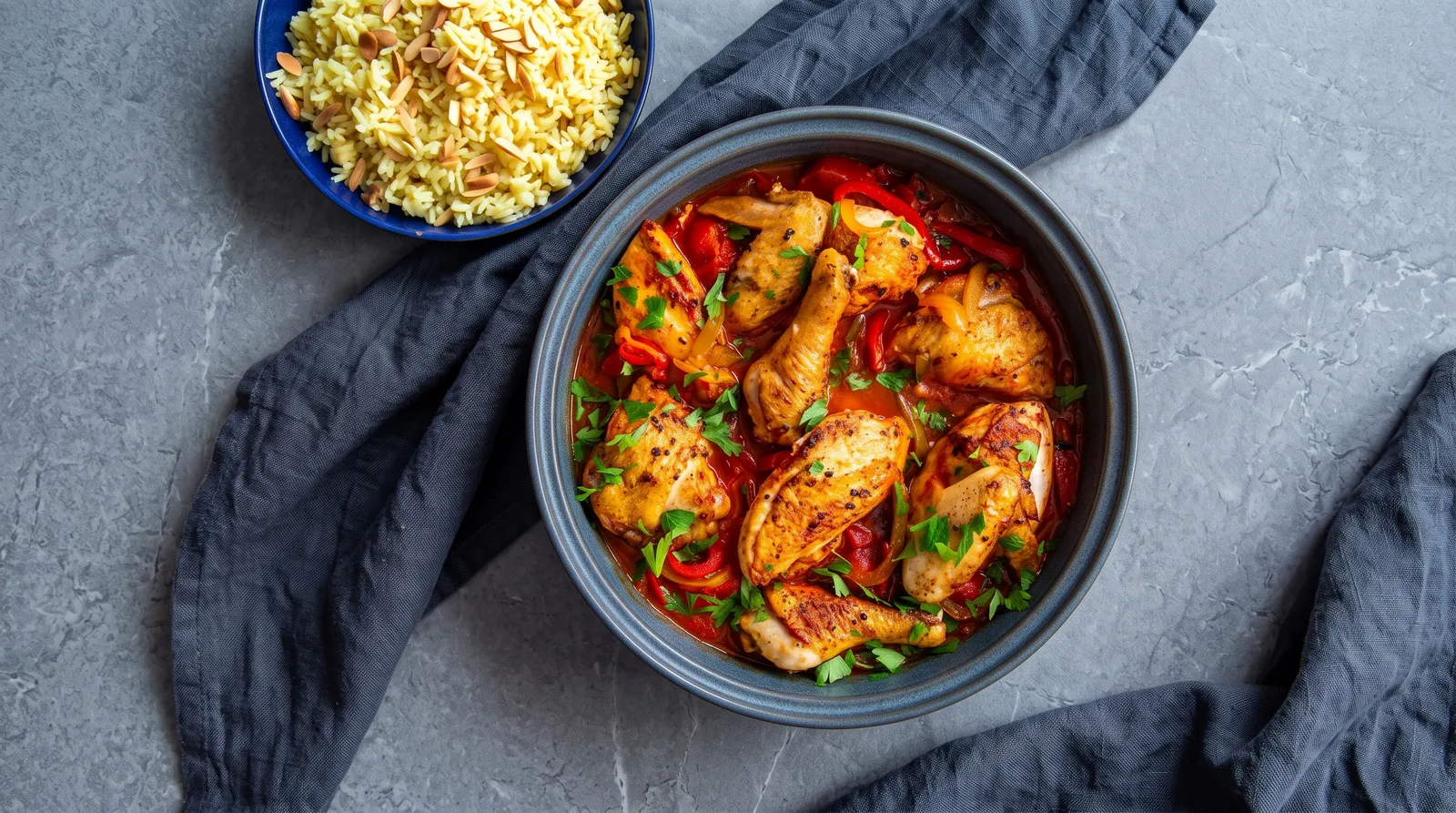
Bone-in chicken is browned and gently braised in a Basque piperade of onions, tomatoes and red and green sweet peppers, finished with Piment d’Espelette rather than a generic tomato sauce.

French National Dishes
Share
Poulet basquaise — shown in a cooking pot
Prep 25 minutes
Cook 70 minutes
Total 95 minutes
Yield 6 main-course portions
Overview

Poulet basquaise with peppers, tomato and Piment d’Espelette

Poulet basquaise is defined here by the relationship between browned chicken and piperade: onions, tomatoes and sweet peppers cooked until saucy but still visibly distinct, with Piment d’Espelette providing its characteristic warm chilli note. The chicken is not buried under a smooth tomato gravy, and the vegetables are not treated as ratatouille. Keeping the pepper strips recognisable gives the finished dish the texture and colour expected from a piperade-led preparation.

The technique is deliberately staged. Chicken pieces are browned first, then the onions, garlic and peppers are cooked in the same casserole so the browned fond becomes part of the sauce. Tomatoes go in only after the peppers have begun to soften. This order keeps the garlic from scorching and gives the peppers enough time to mellow without disappearing during the final braise.

Bone-in pieces need a thermometer rather than a visual guess. The sauce can look finished before the thickest thigh or breast section is safe, so check each large piece at the coldest point away from bone and require 74 °C. The sauce is served in full with the chicken, which means the vegetables, olive oil and seasoning are all part of the serving and of the nutrition estimate.
Success points

Success points

  • Brown in batches so the chicken colours instead of steaming.
  • Cook the peppers only to the point where their strips remain easy to identify.
  • Use Piment d’Espelette as the chilli seasoning; a generic curry blend changes the dish.
Ingredients

Ingredients

Chicken and seasoning

  • 1800 g bone-in chicken pieces — 8 skin-on pieces from one chicken; purchased weight; target cooked edible meat-and-skin yield about 1050 g
  • 35 g extra-virgin olive oil — for browning and vegetables
  • 8 g fine salt — divided
  • 2 g black pepper — freshly ground

Basque piperade

  • 300 g yellow onions — thinly sliced
  • 20 g garlic — finely chopped
  • 250 g red sweet pepper — seeded and cut into 1 cm strips
  • 250 g green sweet pepper — seeded and cut into 1 cm strips
  • 600 g ripe tomatoes — peeled, seeded and roughly chopped
  • 4 g Piment d’Espelette AOP — ground; defining Basque chilli seasoning
  • 3 g fresh thyme leaves
  • 1 bay leaf — remove before serving
Method

Method

Brown and build the piperade

  1. Prepare the chicken. Pat the chicken dry with paper towel, season it with the salt and black pepper, and keep it on a dedicated tray. Do not wash the bird. The chicken surface is dry enough to brown rather than steam.

  2. Brown in batches. Heat the olive oil in the casserole and brown the pieces in two batches, turning them to colour the skin and exposed meat. The skin is evenly golden but not scorched. Transfer the browned pieces to a clean plate.

  3. Soften the aromatics. Lower the heat, add the onions and garlic, and stir often for 6 minutes. The onions are translucent and supple with no dark edges.

  4. Keep the peppers distinct. Add both colours of sweet pepper and cook for 8 minutes, turning them through the onions. The peppers have softened at the edges but still hold distinct strips.

  5. Build the piperade. Stir in the tomatoes, thyme, bay leaf and Piment d’Espelette; cook uncovered for 8 minutes. The tomatoes have released juice and the mixture is saucy rather than watery.

  6. Braise to temperature. Nestle the chicken back into the piperade, cover partly and simmer gently for 30 minutes, turning the pieces once. The thickest part of every chicken piece registers 74 °C at the coldest point away from bone. Remove the bay leaf before serving.

Serving and planning

Practical

Serving and planning

Serve hot, spooning the full piperade around and over each piece of chicken. Bread, rice or potatoes may be offered separately, but they are not included in the quantities or nutrition below.

Make-ahead

The piperade can be prepared up to 1 day ahead, chilled promptly and reheated before the browned chicken is braised in it. Do not partially cook the chicken ahead.

Storage and reheating

Cool leftovers promptly and refrigerate within 2 hours. Keep covered for up to 3–4 days and reheat the chicken and sauce to 74 °C, adding only a small splash of water if the piperade has tightened.

Valid substitutions

A different mild ground chilli does not preserve the Piment d’Espelette identity; it makes an adaptation. Boneless chicken also changes the timing and edible-yield basis, so it is not a direct quantity-for-quantity swap.

Nutrition per serving

Nutrition per serving

  • Serving sizeabout 175 g cooked edible chicken meat and skin plus about 180 g piperade
  • Calories560 kcal
  • Carbohydrate18 g
  • Protein46 g
  • Fat31 g
  • Fibre5 g
  • Sodium760 mg
Allergens and food safety

Allergens and food safety

None among the major declarable allergens in the base ingredient list; check packaged spice cross-contact statements if relevant.

Do not wash raw chicken; prevent splashing and cross-contamination.

Cook every poultry piece to 74 °C at the coldest thick point away from bone; colour or clear juices alone are not safety tests.

Refrigerate cooked leftovers within 2 hours and reheat leftovers to 74 °C.

Bones and hot casserole fat are physical hazards.

Closing

Closing

  • Result: browned chicken in a vegetable-rich Basque piperade, with sweet peppers still distinct and a measured Espelette warmth.
  • Decisive technique: build the piperade in stages, then verify every bone-in chicken piece at 74 °C away from bone.