French Recipes

Pommes de terre sarladaises

Pommes de terre sarladaises belong to the Périgord cooking repertoire, and their identity is unusually clear: sliced potatoes, duck or goose fat, garlic and parsley.

French Recipes
Share
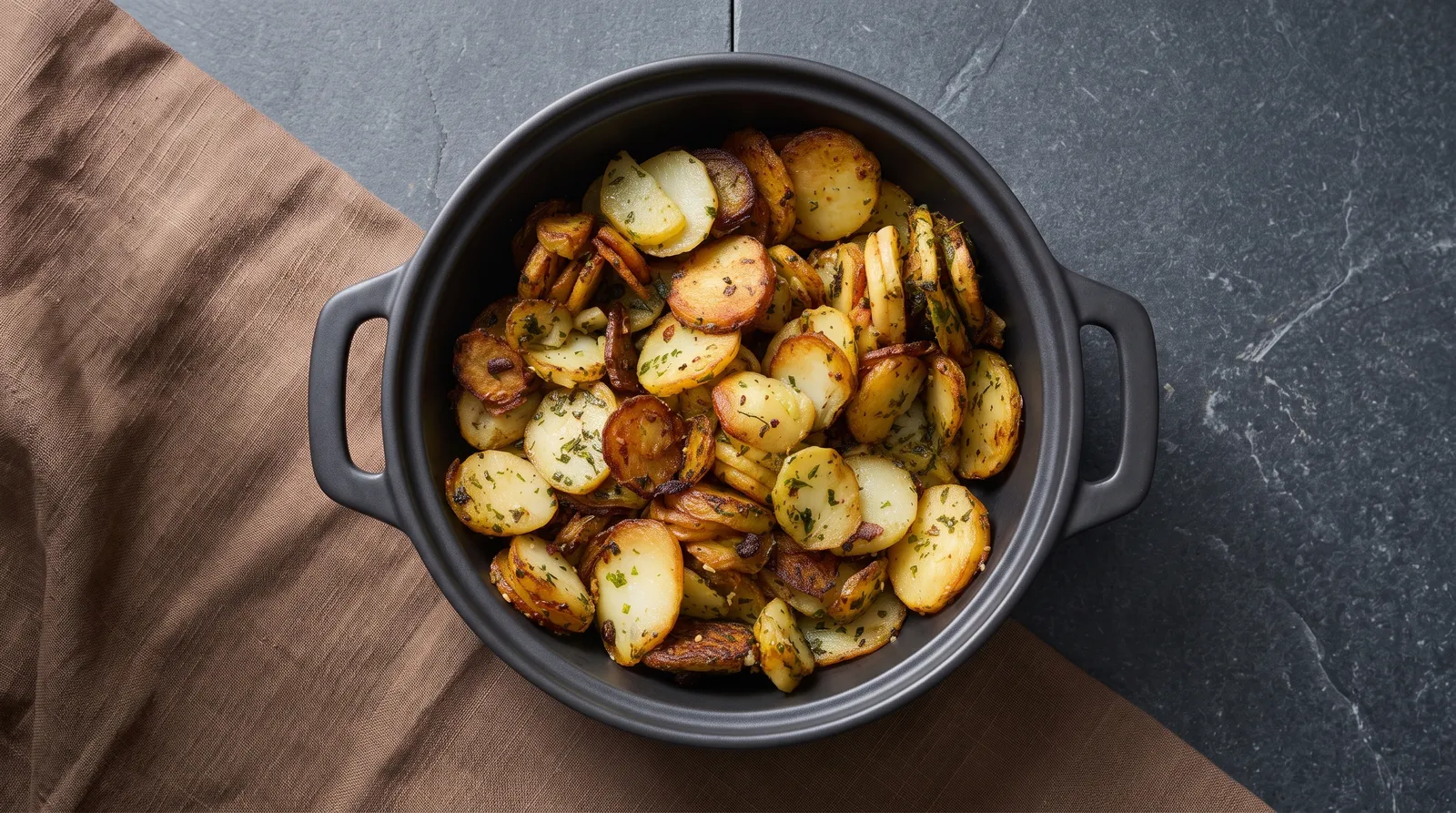
Pommes de terre sarladaises — served on a plate
Cook time 30 minutes after 20 minutes of preparation.
Passive time 0 minutes after the 30-minute cooking schedule.
Calories per serving 305 kcal across the 50-minute schedule.
Yield 4 side-dish portions.
Introduction and overview

Pommes de terre sarladaises: Périgord Noir pan-cooked sliced potatoes in duck fat with garlic and flat-leaf parsley.

Pommes de terre sarladaises belong to the Périgord cooking repertoire, and their identity is unusually clear: sliced potatoes, duck or goose fat, garlic and parsley. Bacon, cream and cheese belong to other potato dishes and would blur the distinction the name is meant to carry.

The cooking sequence balances two competing goals. The potatoes need enough direct contact with the pan to colour, yet the centres must become fully tender before the exterior darkens. A covered middle phase gives the centres time to soften; the final uncovered minutes restore edge colour and carry the garlic-parsley finish.

Fat measurement matters because the dish is generous but not a deep-fry. Seventy grams is supplied to the pan, while the nutrition estimate counts about 55 g retained on the plated potatoes after a small residue is left in the cookware. That is more realistic than either ignoring the fat or counting every gram as eaten.
Success points

Success points

  • Use waxy potatoes and keep the 4 mm thickness consistent.
  • Dry the slices before they meet the hot fat.
  • Add the garlic and parsley only at the end so neither scorches during the longer cook.
Ingredients

Ingredients

  • 900 g waxy potatoes, peeled weight; sliced 4 mm — about 1,000 g purchased before peeling
  • 70 g duck fat, measured before cooking — about 55 g estimated retained in the plated batch
  • 12 g garlic, germ removed and finely chopped
  • 20 g flat-leaf parsley, finely chopped
  • 4 g fine salt
  • 1.5 g black pepper, freshly ground
Method

Method

Directions

  1. Slice and dry. Slice the 900 g peeled potatoes evenly to 4 mm using a guarded mandoline or sharp knife, then dry both sides well with clean towels. The slices are uniformly 4 mm thick and feel dry rather than wet on the surface. Dry, even slices brown more predictably and spit less in hot fat. Use the mandoline hand guard and keep towels away from the hob.

  2. Start the browning. Heat 45 g duck fat in a 30 cm heavy sauté pan over medium heat. Add the potatoes in an even layer and cook for 12 minutes, turning sections carefully rather than constantly stirring. Several potato faces are pale golden, but the centres are still firm. Early browning builds the characteristic fried-fat flavour without scorching the garlic. Duck fat is very hot; lower slices into the pan rather than dropping them.

  3. Tenderise under cover. Add the remaining 25 g duck fat, season with the 4 g salt and pepper, cover and cook over medium-low heat for 15 minutes, turning once or twice. A knife slips through the centre of a slice without resistance while the slices still hold their shape. The covered phase finishes the centres while the retained fat protects the edges from drying. Lift the lid away from your face to avoid a steam burn.

  4. Finish with persillade. Uncover, raise to medium heat and cook for 3 minutes with the garlic and parsley, tossing gently until aromatic. The edges are golden, the garlic smells sweet rather than raw, and the parsley remains bright green. Adding garlic and parsley at the end preserves freshness and limits burnt garlic. Do not leave the pan unattended during the garlic finish.

Serving and practical guidance

Practical

Serving and practical guidance

Serve straight from the pan; the contrast between golden edges and tender centres fades as the potatoes sit.

Serving and practical guidance

Peel whole potatoes ahead if necessary, but delay slicing and drying until close to cooking.

Serving and practical guidance

Cool leftovers promptly and reheat in a broad pan rather than adding more fat automatically.

Serving and practical guidance

Goose fat is a regionally coherent alternative; neutral oil changes the defining flavour and should be described as an adaptation rather than the same dish.

Check

Pale, soft potatoes usually indicate too crowded a pan or wet slices; dry thoroughly and use a broad pan.

Check

Burnt garlic means it was added too early; keep the persillade for the final minutes.

FAQ

Do the potatoes need bacon? No. Bacon belongs to other French potato preparations; sarladaise potatoes are defined here by duck or goose fat, garlic and parsley.

FAQ

Can goose fat be used? Yes. Sarlat tourism material explicitly supports goose or duck fat.

Nutrition per serving

Nutrition per serving

  • Serving sizeabout 240 g finished potatoes
  • Calories305 kcal
  • Carbohydrate40 g
  • Protein5 g
  • Fat14 g
  • Fibre5 g
  • Sodium450 mg
Allergens and food safety

Allergens and food safety

Allergens: No major regulated allergens are introduced by the listed ingredients; check packaged ingredient labels for product-specific cross-contact. - Use a guard on the mandoline. - Hot duck fat can spit and cause burns. - Refrigerate leftovers within 2 hours.

Use a guard on the mandoline.

Hot duck fat can spit and cause burns.

Refrigerate leftovers within 2 hours.

Closing

Closing

  • Result: Pommes de terre sarladaises with the texture and regional identity described above, portioned according to 1 of 4 portions.
  • Decisive technique: Use waxy potatoes and keep the 4 mm thickness consistent.