French National Dishes

Pompe à l’huile

Pompe à l’huile is a Provençal olive-oil yeast bread associated with the thirteen Christmas desserts.

French National Dishes
Share
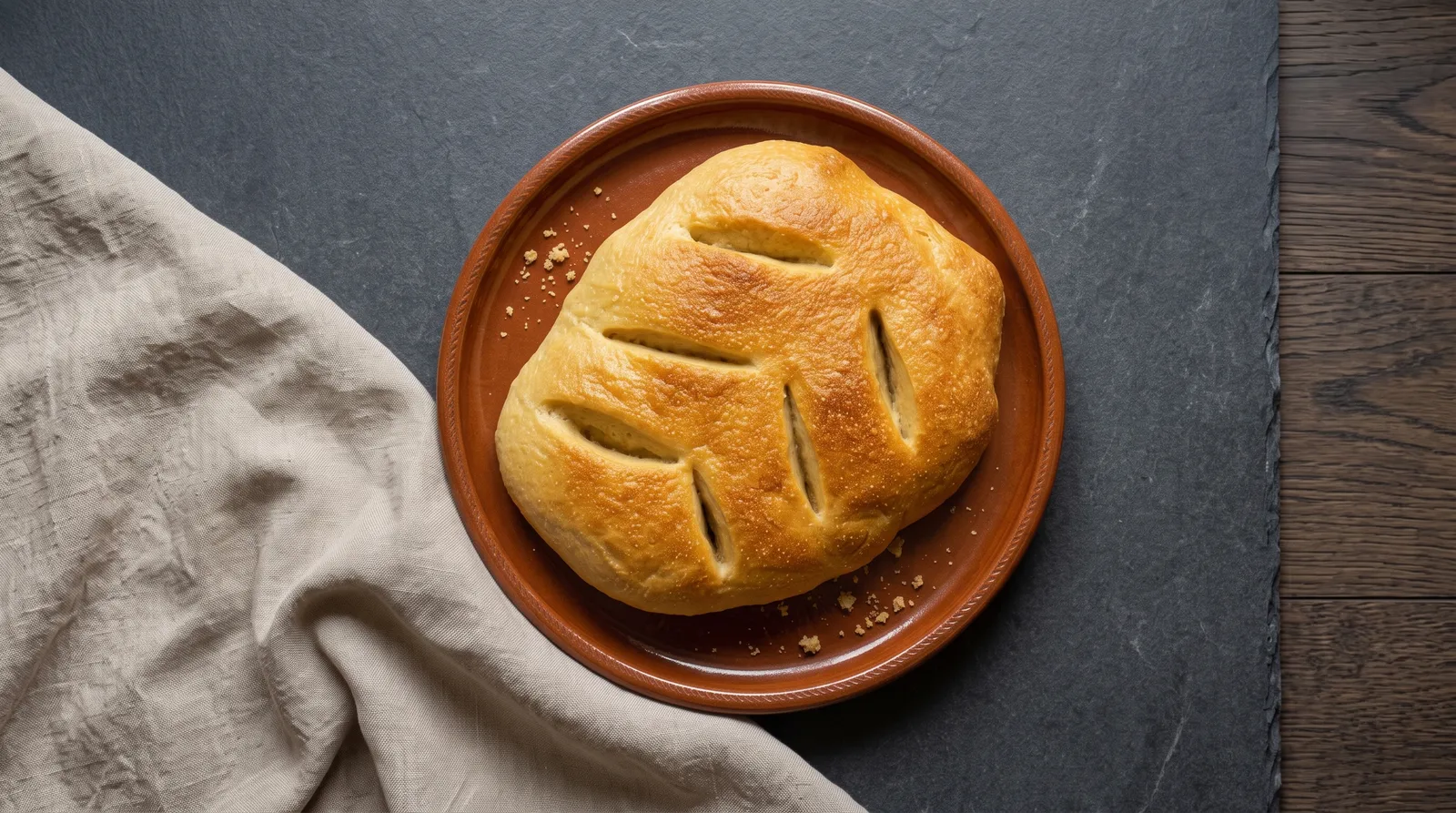
Pompe à l’huile — bread shown after baking
Cook time 20 minutes after 35 minutes of preparation.
Passive time 210 minutes after the 20-minute cooking schedule.
Calories per serving 380 kcal across the 265-minute schedule.
Yield 8 pieces.
Introduction and overview

Pompe à l’huile: Provençal flat yeast bread enriched with olive oil, sugar, orange-blossom water and orange zest, shaped with characteristic slits.

Pompe à l’huile is a Provençal olive-oil yeast bread associated with the thirteen Christmas desserts. Its sweetness is restrained compared with cake, and its richness comes from olive oil rather than butter. Orange-blossom water and citrus zest supply the aromatic profile without turning the dough into a brioche.

The dough needs real gluten development despite the high proportion of oil. Mixing the flour and water before fully incorporating the oil helps the dough become elastic instead of slick and fragile. Two visible rises are counted in the schedule: a long first proof, then a shorter final proof after the characteristic oval has been cut with open slits.

The bread should bake to a tender interior and only lightly golden edges. Cooling is also part of the timetable, because a hot enriched crumb can seem gummy when torn immediately. The custom of breaking the pompe by hand is worth preserving as cultural context, but the practical baking cues remain volume, elasticity, colour and a set crumb.
Success points

Success points

  • Aim for a 24–26 °C dough rather than trying to accelerate proofing with high heat.
  • Knead until elastic before judging stickiness; the olive oil makes the dough softer than lean bread dough.
  • Keep the five slits open during shaping so they remain visible after the final proof.
Ingredients

Ingredients

  • 500 g French T55 wheat flour
  • 220 ml water, lukewarm
  • 100 g extra-virgin olive oil
  • 80 g caster sugar
  • 15 g fresh baker’s yeast, crumbled
  • 25 ml orange-blossom water
  • 6 g fine salt
  • 8 g finely grated orange zest
Method

Method

Directions

  1. Mix the dough. Dissolve the 15 g fresh yeast in the 220 ml lukewarm water. Mix in the flour, sugar, orange-blossom water and orange zest, then add the salt and olive oil. Knead until the dough is supple and cohesive. The dough is smooth, elastic and slightly tacky rather than greasy or runny. Adding the oil after the flour is hydrated helps the gluten network form despite the high olive-oil content. Keep the dough near 24–26 °C; excessively hot liquid can weaken yeast activity.

  2. First proof. Cover the dough and rest it in a warm, draft-free place for 120 minutes passive rest. The dough is visibly expanded to roughly double its original volume and feels aerated under a fingertip. A full first rise develops the tender, open crumb expected from a yeast-leavened pompe. Do not place the bowl on a direct heat source.

  3. Shape and cut the slits. Gently deflate the dough and shape it on baking paper into an oval about 30 × 22 cm and roughly 2 cm thick. Cut 5 long slits with a sharp blade, widening each opening with your fingers without cutting the oval into separate pieces. Five open slits are visible and the dough remains one connected oval. The openings are a defining visual and help the flat loaf bake evenly. Cut away from your supporting hand.

  4. Final proof. Cover loosely and rest for 45 minutes passive rest. The oval looks puffy, the slits have widened slightly and a fingertip indentation returns slowly. The second proof restores gas lost during shaping. Do not overproof until the dough becomes fragile or collapses.

  5. Bake the shaped loaf. Bake at 180 °C for 20 minutes. The edges are lightly golden and the centre reads as a fully baked, tender crumb rather than wet dough. A moderate oven keeps the olive-oil bread tender rather than making the exterior hard. Use oven gloves and keep the tray level when removing it.

  6. Cool before breaking. Transfer the pompe to a rack and cool for 45 minutes passive cooling before serving. The crumb has set and the loaf is warm or at room temperature rather than steaming hot. Cooling completes the crumb structure and makes the bread easier to break cleanly. Do not wrap while hot or condensation will soften the surface.

Serving and practical guidance

Practical

Serving and practical guidance

Serve once fully cooled or just slightly warm; the orange-blossom aroma is clearer when the crumb is no longer steaming.

Serving and practical guidance

Make it a day ahead if needed, but cool completely before wrapping so condensation does not make the surface leathery.

Serving and practical guidance

Short gentle reheating refreshes the crumb. Freezing works best in portions that can thaw without repeated handling of the whole loaf.

Serving and practical guidance

Olive oil is not interchangeable with butter if the name pompe à l’huile is to retain its Provençal meaning.

Check

A dense crumb usually means insufficient proofing or under-kneading; wait for clear volume increase rather than relying only on the clock.

Check

Slits closing completely means they were too narrow before the final proof; widen them gently while shaping.

FAQ

Is pompe à l’huile a brioche? Not in this preparation. The richness comes from olive oil, without butter or eggs, and the loaf is shaped flat with open slits.

FAQ

Why count cooling as passive time? The crumb continues to set after baking, and the bread is intended to be served after that cooling period rather than straight from the oven.

Nutrition per serving

Nutrition per serving

  • Serving size1 of 8 pieces, about 105 g
  • Calories380 kcal
  • Carbohydrate59 g
  • Protein7 g
  • Fat13 g
  • Fibre3 g
  • Sodium300 mg
Allergens and food safety

Allergens and food safety

Allergens: gluten (wheat). - Contains wheat gluten. - Keep the rising dough at a moderate warm temperature, not against an uncontrolled heat source.

Contains wheat gluten.

Keep the rising dough at a moderate warm temperature, not against an uncontrolled heat source.

Closing

Closing

  • Result: Pompe à l’huile with the texture and regional identity described above, portioned according to 1 of 8 pieces.
  • Decisive technique: Aim for a 24–26 °C dough rather than trying to accelerate proofing with high heat.