French Recipes

Palets bretons

Thick Breton sablé biscuits made with salted butter and egg yolk, chilled for clean cutting and baked inside rings for straight sides and a sandy crumb.

French Recipes
Share
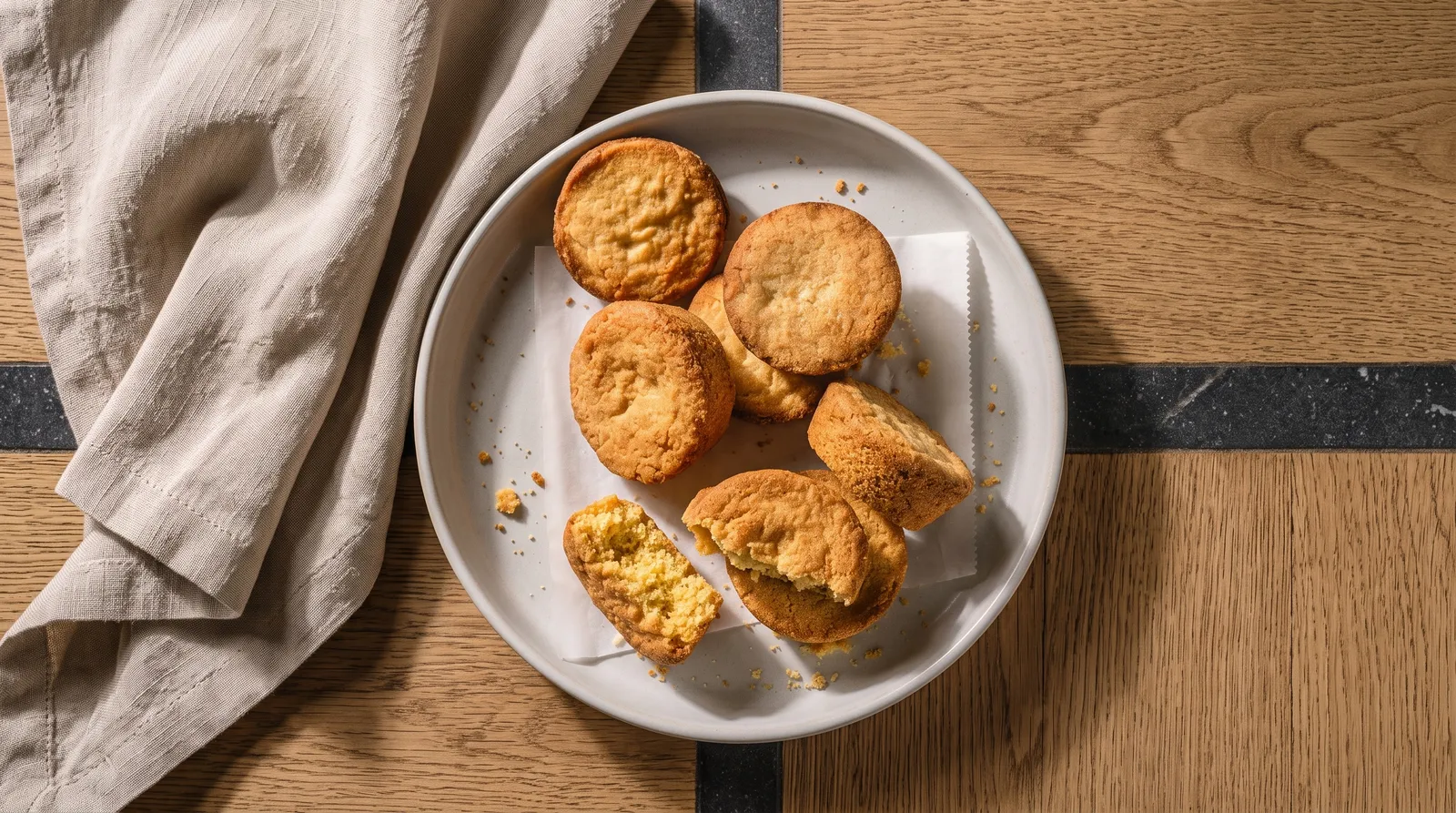
Palets bretons — served on a plate
Prep 25 minutes
Cook 18 minutes
Total 133 minutes
Yield 12 palets
Introduction and overview

Palets bretons with salted butter and egg yolk

Palets bretons are thick Breton sablé biscuits, not the thin galettes bretonnes that share the region's butter-rich baking tradition. Their recognizable shape comes from a substantial dough thickness and ring baking: each disc is held inside a metal ring so it rises and sets with straight sides instead of spreading into a flat cookie.

The dough is deliberately short and rich. Salted butter provides both fat and the savoury edge that balances the sugar, while egg yolks add colour, tenderness and cohesion. Flour and a small amount of baking powder go in last, and the mixing stops as soon as the dough comes together. Excess working develops gluten and moves the texture away from the intended crumbly, sandy bite.

Chilling is as important as mixing. The dough rests cold for an hour, then is rolled to 12 mm and cut into twelve 6 cm discs. Each one bakes inside its own ring at 180 °C until evenly golden and fully set through the centre. The metal rings remain dangerously hot after the tray leaves the oven, so let the biscuits settle and handle the rings only with proper heat protection.
Success points

Success points

  • Use salted butter of about 82% fat for the intended richness and seasoning.
  • Stop mixing immediately once the flour is incorporated.
  • Chill for the full hour and roll the dough to 12 mm before cutting.
  • Bake every disc inside a 6 cm ring and cool completely before judging the crumb.
Ingredients

Ingredients

  • 150 g wheat flour
  • 100 g salted butter, softened, about 82% fat
  • 80 g granulated sugar
  • 2 egg yolks, about 36 g total
  • 5 g baking powder
Method

Method

Directions

  1. Cream butter and sugar. Beat the softened salted butter and sugar for about 10 minutes including measuring, then beat in the egg yolks. The mixture is creamy and uniform with no visible streaks of yolk. The aim is even mixing rather than maximum volume.

  2. Add the dry ingredients. Mix in the flour and baking powder for about 5 minutes, stopping as soon as the dough comes together. The dough is cohesive with no dry flour but has not been kneaded smooth.

  3. Chill the dough. Flatten, wrap and refrigerate for 60 minutes. The dough is firm enough to roll and cut cleanly without smearing.

  4. Cut thick discs. Roll the chilled dough to 12 mm, cut twelve 6 cm discs and place each inside a 6 cm metal ring on a lined tray, allowing about 10 minutes. Twelve discs are about 12 mm thick and sit neatly inside 6 cm rings. Keep fingers clear of the rolling pin and ring edges.

  5. Bake in the rings. Bake at 180 °C for 18 minutes. The palets are evenly golden, hold straight sides and have a fully set crumb with no raw centre. The metal rings are very hot, so handle them only with oven gloves or tongs.

  6. Cool completely. Let the biscuits settle briefly in their rings, then remove the rings safely and cool on a rack for 30 minutes. The biscuits are completely cool, firm and crumbly rather than soft at the centre.

Serving and make-ahead

Practical

Serving and make-ahead

Serve the palets only after they are completely cool, when the butter-rich crumb has become sandy and crisp. The dough can be mixed and refrigerated overnight. Before rolling, let it soften only enough to move under the rolling pin without cracking.

Storage and substitutions

Store fully cooled biscuits airtight at room temperature for several days. They do not need reheating; protecting them from moisture matters more. Unsalted butter with added salt can approximate the seasoning, but it does not exactly reproduce the mineral and water balance of a specific salted butter. A major reduction in butter would produce a drier, less friable biscuit.

Troubleshooting

Troubleshooting

  • The discs spread badlyThe butter-rich dough became too warm. Chill the cut discs again before putting them in the oven and keep them inside the rings.
  • The crumb is toughThe flour was mixed too long. Stop as soon as the dough is cohesive and avoid kneading.
Nutrition per serving

Nutrition per serving

  • Serving size2 palets from a batch of 12
  • Calories282 kcal
  • Carbohydrate32.9 g
  • Protein3.7 g
  • Fat15.4 g
  • Fibre0.7 g
  • Sodium199 mg
Allergens and food safety

Allergens and food safety

Allergens: egg, milk and wheat/gluten. Do not taste raw dough containing uncooked flour and egg yolk. Bake at 180 °C until the crumb is fully set. The baking rings become extremely hot and should be moved or removed only with oven gloves or suitable tongs. Cool the biscuits fully before storing airtight.

FAQ

FAQ

Why are rings necessary?

The dough is thick and butter-rich. Rings restrain sideways spread so the biscuits keep the straight sides and substantial profile expected of palets bretons.

Are these the same as galettes bretonnes?

No. Galettes are generally thinner; palets are thicker, more substantial sablé biscuits with a characteristically crumbly interior.

Closing

Closing

  • Result: The finished palets are thick, evenly golden and sandy-crumbed, with a clear salted-butter flavour.
  • Decisive technique: Chill the dough well, cut it to 12 mm and bake every disc inside a ring so the sides remain straight.