French National Dishes

Pan bagnat

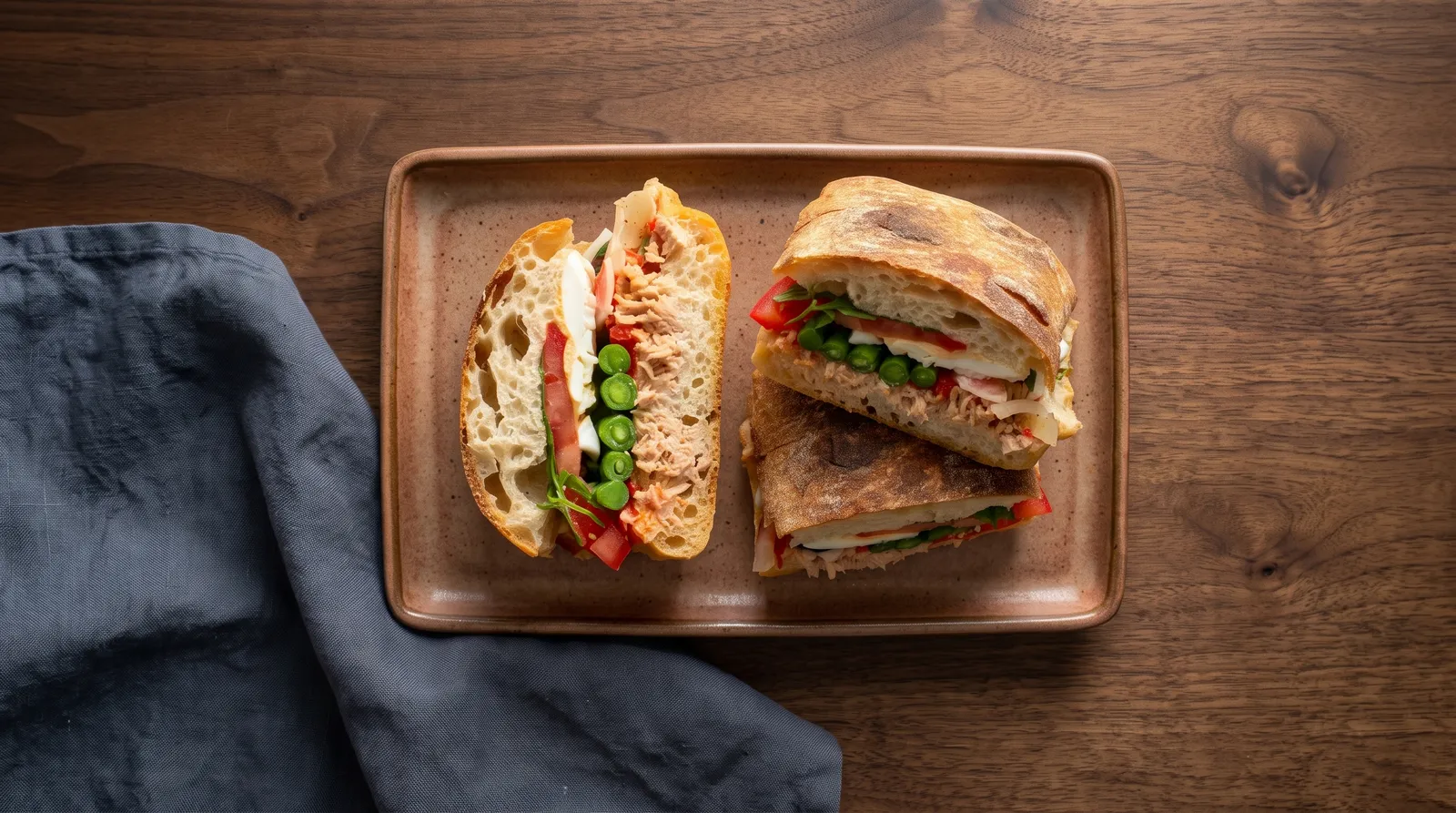
A round Niçois loaf deliberately moistened with ripe tomato, olive oil and a little vinegar, then packed with tuna, anchovy, hard-cooked egg, crisp vegetables, black olives and basil.

French National Dishes
Share
Pan bagnat — served on a plate
Prep 25 minutes
Cook 10 minutes
Total 65 minutes
Yield 1 round 18 cm sandwich, cut into 2 halves
Introduction and overview

Pan bagnat with tuna, anchovy, egg and Niçois vegetables

Pan bagnat is not a mayonnaise-bound tuna sandwich. Its defining idea is the bread itself: a round loaf whose crumb is deliberately moistened with ripe tomato and olive oil before it receives a filling drawn from the same ingredient vocabulary as salade niçoise. The result should be juicy and savoury but still structurally sound enough to carry, press and cut without the base collapsing.

This 18 cm loaf uses both tuna and anchovy, a combination supported in Niçois practice, together with tomato, radish, spring onion, green salad pepper, hard-cooked egg, black olives and basil. Cooked potato, green beans and mayonnaise are deliberately absent because they would move the sandwich away from the profile used here. The wet ingredients are drained before layering, and the oil is measured rather than poured freely so the bread can absorb flavour without becoming sodden.

The short refrigerated press matters as much as the filling order. Thirty minutes under a light weight settles the vegetables, fish and egg into the crumb and distributes the tomato-oil dressing, but it is not long enough to turn the loaf dense. Because the sandwich contains cooked egg and fish, assemble it with chilled ingredients, press it in the refrigerator and keep room-temperature holding brief.
Success points

Success points

  • The bread should taste thoroughly seasoned by tomato and olive oil while remaining springy. Thin, dry vegetable slices and a light press make that balance possible.
Ingredients

Ingredients

Sandwich

  • 300 g round crusty country bread, one 18 cm loaf
  • 250 g ripe tomatoes, one very ripe for rubbing, remainder sliced and drained
  • 60 g radishes, thinly sliced
  • 30 g spring onion, thinly sliced
  • 40 g small green salad pepper, seeded and thinly sliced
  • 100 g large eggs, 2 eggs, shell-on purchased state; hard-cooked and peeled
  • 80 g tuna in olive oil, drained edible weight
  • 20 g cured anchovy fillets, rinsed and drained
  • 40 g small black olives, pitted household version
  • 6 g fresh basil leaves, torn
  • 45 ml extra-virgin olive oil, measured; about 40 ml retained in the sandwich
  • 10 ml red-wine vinegar
  • 5 g garlic, 1 small clove, halved
  • 1.5 g fine salt, divided
  • 1 g black pepper, freshly ground
Method

Method

Directions

  1. Cook the eggs. Place the eggs in a small saucepan, cover with cold water, bring to a boil, cook for 9 minutes, then transfer immediately to fresh cold water, peel and slice. The white and yolk are firm throughout. Working temperature: 100 °C. Keep cooked eggs chilled until assembly.

  2. Moisten the loaf. Split the 18 cm loaf horizontally and remove only a thin layer of crumb. Rub the cut faces with garlic, then rub with the very ripe tomato and drizzle evenly with vinegar and olive oil. The crumb is evenly moistened but still holds its structure. Use a clean board and knife away from raw egg shells.

  3. Layer the filling. Pat the sliced tomatoes, radishes, spring onion and pepper dry. Layer tomatoes, radishes, spring onion, pepper, tuna, anchovy, sliced egg, olives and basil across the bottom half; season with the measured salt and pepper. The filling is evenly distributed from edge to edge without pools of tomato liquid. Keep tuna and egg cold during assembly and return the sandwich to refrigeration promptly.

  4. Press and chill. Close the loaf, wrap tightly, press with a light 1 kg weight and refrigerate for 30 minutes before cutting into two halves. The filling has settled into the crumb while the loaf remains springy rather than crushed. Working temperature: 4 °C. Refrigerate at 4 °C or below; do not leave the fish-and-egg sandwich at room temperature for more than 2 hours cumulatively.

Serving and planning

Practical

Serving and planning

Serve cool but not ice-cold, cut into two substantial halves.

Serving and planning

Boil and peel the eggs up to one day ahead and refrigerate them; assemble the sandwich up to 4 hours before serving.

Storage and reheating

Keep wrapped at 4 °C or below and eat within 24 hours for best bread texture. Reheating is not appropriate.

Substitutions

Anchovy may be omitted while retaining tuna; the result is milder but remains within a documented Niçois tuna-and/or-anchovy boundary.

Substitutions

Seasonal broad beans or young purple artichoke can be added only when tender and prepared as in Niçois sources; they are not required here.

Nutrition per serving

Nutrition per serving

  • Serving size1 half sandwich
  • Calories659 kcal
  • Carbohydrate86.0 g
  • Protein29.0 g
  • Fat23.3 g
  • Fibre7.9 g
  • Sodium1443 mg
Allergens and food safety

Allergens and food safety

Cook the eggs until fully set and chill promptly.

Keep tuna, anchovy and egg refrigerated at 4 °C or below.

Limit cumulative room-temperature holding of the assembled sandwich to 2 hours.

Allergens: fish, egg, gluten.

FAQ

FAQ

Can mayonnaise be added?

Not to this Niçois profile. The moisture and richness come from tomato, olive oil, egg and fish rather than a mayonnaise dressing.

Why press the sandwich?

Light pressure settles the layers into the moistened crumb. A heavy weight or an overnight press can flatten the loaf and force out too much juice.

Closing

Closing

  • Result: A round Niçois loaf deliberately moistened with ripe tomato, olive oil and a little vinegar, then packed with tuna, anchovy, hard-cooked egg, crisp vegetables, black olives and basil.
  • Decisive technique: The bread should taste thoroughly seasoned by tomato and olive oil while remaining springy. Thin, dry vegetable slices and a light press make that balance possible.