French Recipes

Oreillettes

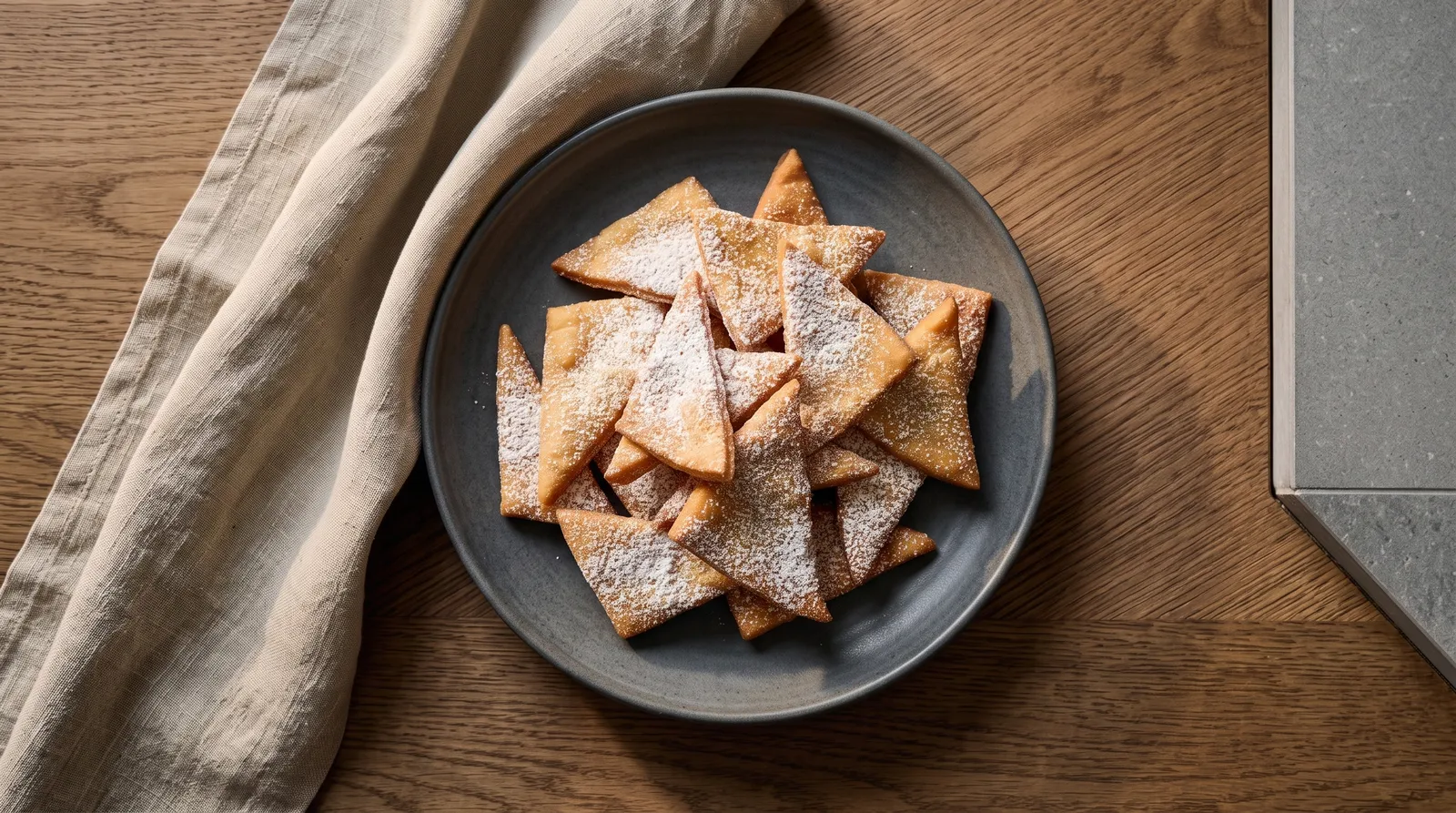
Very thin sheets of orange-scented dough are rested, rolled to about 2 mm, fried until blistered and crisp, then cooled and dusted with icing sugar.

French Recipes
Share
Oreillettes — presented in a serving dish
Prep 45 minutes
Cook 23 minutes
Total 118 minutes
Yield about 30 oreillettes
Introduction and overview

Languedoc-style oreillettes with orange zest and sugar

Oreillettes are one of southern France's fragile fried pastries: thin, irregular sheets that blister in hot oil and finish crisp enough to crack rather than bend like a doughnut. In Languedoc and neighbouring areas they appear in festive cooking, and their identity depends more on thinness and frying technique than on a thick, enriched crumb.

This preparation uses an unleavened dough of flour, egg, sugar and butter, scented with orange zest and a modest amount of dark rum. The rum is an aromatic ingredient, not a raising agent, and the brief frying time does not justify claiming that all alcohol disappears. After mixing, the dough rests for 30 minutes so it can be rolled with less spring-back. The target thickness is about 2 mm, producing sheets light enough to blister but sturdy enough to lift into the oil.

The frying stage rewards control. Keep the oil at 175 °C, work in small batches and turn each sheet only as needed. The pastries should emerge pale gold, dry-looking and crisp, with no thick doughy core. Let them cool before adding icing sugar; sugaring while warm melts the finish and encourages softness. Because frying oil is a cooking medium rather than an ingredient entirely consumed, only a measured absorption estimate is reflected in the finished pastry.
Success points

Success points

  • Rest the dough before rolling so it can be taken very thin without fighting back.
  • Check the dough thickness rather than relying on piece size alone; about 2 mm gives the intended crispness.
  • Bring the oil back to 175 °C between batches and do not overcrowd the pan.
Ingredients

Ingredients

  • 500 g wheat flour
  • 4 l arge shell eggs, about 200 g edible egg in total
  • 100 g granulated sugar for the dough
  • 80 g unsalted butter, melted and cooled slightly
  • 12 g finely grated orange zest
  • 45 ml dark rum
  • 5 g fine salt
  • 1500 ml neutral frying oil; about 90 g is estimated to remain in the drained pastries
  • 80 g icing sugar for dusting
Method

Method

Directions

  1. Mix the dough. Combine the flour, eggs, 100 g sugar, melted butter, orange zest, rum and salt in a large bowl and knead just until cohesive, about 15 minutes including mixing. The dough is smooth, cohesive and firm enough to roll without sticking heavily.

  2. Rest before rolling. Cover the dough and leave it at room temperature for 30 minutes. The dough relaxes and rolls without springing back strongly.

  3. Roll paper-thin sheets. Divide the dough into manageable portions, roll each to about 2 mm and cut rough rectangles around 8 × 12 cm. The sheets are about 2 mm thick and thin enough to show slight translucency at the edges. Keep fingers clear of the rolling pin and blade.

  4. Heat the oil. Pour the oil into a deep, heavy pan and heat it to 175 °C over medium-high heat, allowing about 8 minutes. The oil is stable at 175 °C before the first dough sheet is added. Never leave hot oil unattended.

  5. Fry in small batches. Fry the sheets in about five batches for roughly 3 minutes per batch, turning once and draining each batch well. Each oreillette is blistered, crisp and pale gold with no raw doughy patches. Use tongs and keep hands away from hot oil and steam.

  6. Cool and sugar. Transfer the fried sheets to a rack and leave them for 20 minutes before dusting with the 80 g icing sugar. The pastries are cool, crisp and dry on the surface before sugaring.

Serving and storage

Practical

Serving and storage

Serve the oreillettes at room temperature once fully cool. Their appeal is the contrast between a brittle, blistered sheet and the fine sugar coating, so avoid covering them while warm. In a cool, dry kitchen, store completely cooled pastries in an airtight container for about two days. Reheating is unnecessary and can make the sugar sticky.

Make-ahead and flavour choices

The dough can be mixed several hours ahead and kept covered in the refrigerator. Let it lose the deepest chill before rolling so it remains pliable. Orange-blossom water appears in other southern preparations, but changing from rum to another aromatic changes the flavour profile; do not assume the finished pastry becomes identical.

Troubleshooting

Troubleshooting

  • Oreillettes turn thick and chewyThe sheets were not rolled thin enough. Rest the dough fully and work toward about 2 mm before cutting.
  • The fried sheets feel greasyThe oil temperature dropped too far. Fry fewer pieces at once and restore 175 °C before the next batch.
Nutrition per serving

Nutrition per serving

  • Serving size3 oreillettes from a batch of about 30
  • Calories429 kcal
  • Carbohydrate56.6 g
  • Protein7.8 g
  • Fat17.9 g
  • Fibre1.5 g
  • Sodium227 mg
Allergens and food safety

Allergens and food safety

Allergens: egg, milk and wheat/gluten. Do not taste the raw dough because it contains uncooked flour and egg. Hot oil at 175 °C can cause severe burns; use a deep stable pan, long tongs and keep water away from the frying area. The rum receives only brief cooking, so residual alcohol may remain. Let the pastries cool before storage so trapped steam does not soften them.

FAQ

FAQ

Are oreillettes the same as thick beignets?

No. The defining result here is a very thin, blistered, crisp fried sheet rather than a thick, soft or yeasted doughnut.

Why is not all 1500 ml frying oil counted as eaten?

Most of the oil remains in the pan. The finished batch is treated as retaining an estimated 90 g after frying and draining, which is more realistic than treating the whole frying medium as consumed.

Closing

Closing

  • Result: The finished oreillettes are thin, blistered and crisp, scented with orange and lightly covered in sugar.
  • Decisive technique: Rest the dough, roll it to about 2 mm and keep the frying oil steady at 175 °C.