French National Dishes

Pain au chocolat

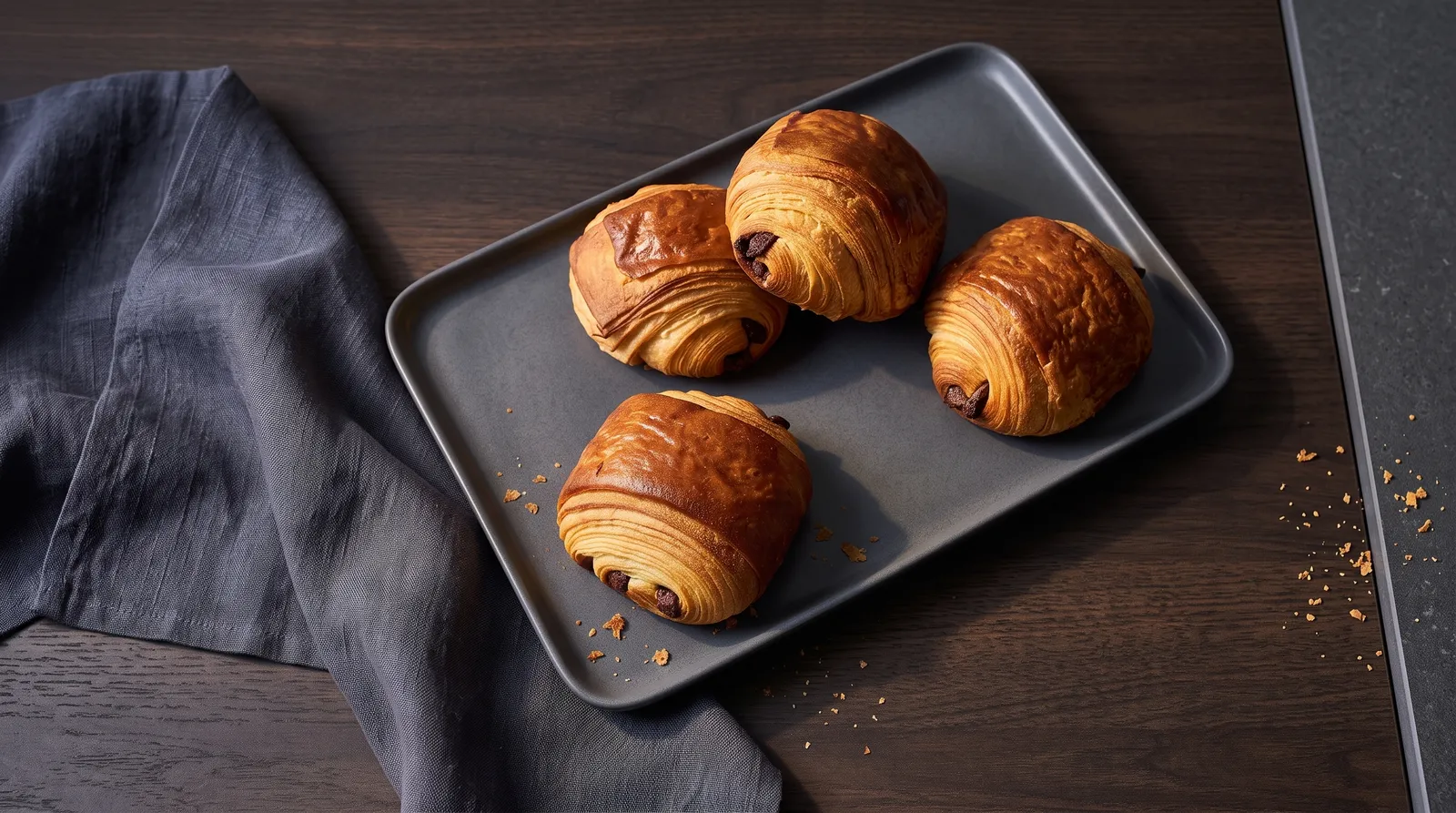
A rectangular laminated viennoiserie made with yeasted dough, a butter block and two dark-chocolate batons in every pastry.

French National Dishes
Share
Pain au chocolat — served on a plate
Prep 70 minutes
Cook 20 minutes
Total 360 minutes
Yield 12 pains au chocolat
Introduction and overview

French pain au chocolat with laminated yeast dough and two chocolate batons

Pain au chocolat is not a brioche with chocolate tucked inside and not a shortcut puff-pastry parcel. Its structure comes from a yeasted détrempe laminated with a separate butter block, then rolled into rectangles around two chocolate batons. The final pastry should show crisp, distinct outer layers and a tender, fully set honeycomb-like crumb around the chocolate.

Lamination depends on matching the firmness of dough and butter. If the butter is much harder than the dough it can shatter into slabs; if it is much softer it smears into the dough and erases the layers. This method uses one double turn and one simple turn, with a full chill before lamination and 30-minute chills between turns. The final sheet is rolled to about 3.5–4 mm and cut into twelve rectangles about 8 × 18 cm.

Proofing is deliberately generous because the pastries must expand before baking, but warmth should never be so aggressive that the butter begins to melt out. Look for a visibly larger pastry with a light wobble when the tray is nudged. Egg-wash immediately before baking, then bake at 190 °C until deeply golden and fully set through the centre. A golden shell alone is not enough if a compressed line of raw dough remains around the chocolate.
Success points

Success points

  • Keep the dough and 250 g lamination butter at comparable cool, pliable firmness.
  • Chill after each turn rather than trying to complete lamination in one uninterrupted session.
  • Shape twelve equal rectangles, each with exactly two 6.5 g chocolate batons.
  • Proof for visible expansion and a light wobble, then bake to a fully set crumb.
Ingredients

Ingredients

  • 500 g wheat flour
  • 250 ml cold whole milk
  • 60 ml cold water
  • 60 g granulated sugar
  • 10 g instant dry yeast
  • 10 g fine salt
  • 40 g unsalted butter, softened, for the dough
  • 250 g unsalted butter, cool and pliable, for lamination
  • 156 g dark chocolate batons: 24 batons of 6.5 g each, two per pastry
  • 1 shell egg, about 50 g, beaten for egg wash
Method

Method

Directions

  1. Mix the détrempe. Combine the flour, milk, 60 ml water, sugar, yeast, salt and 40 g softened butter and knead for about 15 minutes, stopping once the dough is developed and even. The dough is smooth, moderately elastic and no dry flour remains.

  2. Chill the base dough. Flatten the dough into a rectangle, cover and refrigerate for 60 minutes. The dough is thoroughly chilled and firm but still flexible.

  3. Enclose the butter. Shape the 250 g lamination butter into an even 15 × 20 cm slab, set it on the chilled dough and seal the dough around it in about 15 minutes. The butter is fully enclosed with no exposed edges or broken patches. Keep fingers clear of the rolling pin.

  4. Make the double turn. Roll the packet evenly, keep the corners square and give one double turn in about 10 minutes. The first turn is even and the butter remains in a continuous layer without leaking.

  5. Chill after the first turn. Cover and refrigerate for 30 minutes. The folded dough is chilled enough to roll without butter smearing.

  6. Make the simple turn. Roll the dough again and give one simple turn in about 10 minutes. The second turn is even and the laminated block keeps straight layered edges.

  7. Chill before shaping. Cover and refrigerate for another 30 minutes. The laminated block is firm and cool before final rolling.

  8. Roll, cut and fill. Roll to about 3.5–4 mm, trim into twelve rectangles around 8 × 18 cm, place two 6.5 g chocolate batons in each and roll into neat rectangles over about 20 minutes. Twelve evenly sized pastries are formed, each enclosing two chocolate batons.

  9. Proof on the trays. Arrange seam-side down on lined baking trays and leave to proof in a warm room for 120 minutes. The pastries are visibly expanded and show a light wobble when the tray is nudged. Keep them away from excessive heat that would melt the butter layers.

  10. Egg-wash and bake. Brush with the beaten egg and bake at 190 °C for 20 minutes. The pastries are deeply golden, the layers are crisp outside and the crumb is fully set with no raw dough line. Use dry oven gloves for the trays.

  11. Cool before eating. Transfer to a rack and leave for 30 minutes. The pastries are warm rather than oven-hot and the chocolate no longer flows dangerously.

Serving and make-ahead

Practical

Serving and make-ahead

Pain au chocolat is at its best on the day it is baked, after the first 30-minute cooling period but while the pastry still tastes fresh and the layers remain crisp. The laminated block can be prepared through the final turn a day ahead and kept well covered in the refrigerator; shape, proof and bake the next day.

Storage and reheating

Cool completely before storing airtight. A short rewarming in a moderate oven can refresh the crust, while a microwave softens the laminated layers. Do not reheat until the chocolate is dangerously fluid. The dough contains raw flour and the surface receives raw egg wash, so do not taste the unbaked pastry.

Substitutions

Firm chocolate sticks can replace commercial batons if the total remains 156 g and each pastry receives an even share. Ready-made puff pastry is not an equivalent shortcut because pain au chocolat depends on yeasted laminated dough.

Troubleshooting

Troubleshooting

  • Butter breaks through the doughThe butter and dough are at incompatible firmness or the packet has become too warm. Stop rolling, cover and chill before continuing.
  • Pastries bake denseThe final proof was too short or the lamination was compressed. Wait for clear expansion and a light wobble before egg-washing and baking.
Nutrition per serving

Nutrition per serving

  • Serving size1 pain au chocolat from a batch of 12
  • Calories437 kcal
  • Carbohydrate46.1 g
  • Protein6.7 g
  • Fat25.2 g
  • Fibre2.3 g
  • Sodium350 mg
Allergens and food safety

Allergens and food safety

Allergens: wheat/gluten, milk, egg, and soy if the chocolate contains soy lecithin. Do not taste raw dough. Bake at 190 °C until the crumb is fully set rather than judging only the surface colour. Use care with the rolling pin and hot baking trays. The chocolate filling can stay hot after the pastry leaves the oven, so allow the full 30-minute cooling period before eating.

FAQ

FAQ

Why two chocolate batons?

Two batons give an even line of chocolate across the rectangular pastry and are a recognizable feature of the French bakery format.

Can the proof be shortened by putting the tray somewhere very hot?

Aggressive heat risks melting the lamination butter before the dough is ready. A slower warm-room proof protects the layers and gives a more controlled rise.

Closing

Closing

  • Result: A successful pain au chocolat has a deeply golden layered shell, a fully set laminated crumb and two defined lines of chocolate.
  • Decisive technique: Keep butter and dough cool through the turns, then give the shaped pastries enough proofing time before the 190 °C bake.