French National Dishes

Ouillade catalane

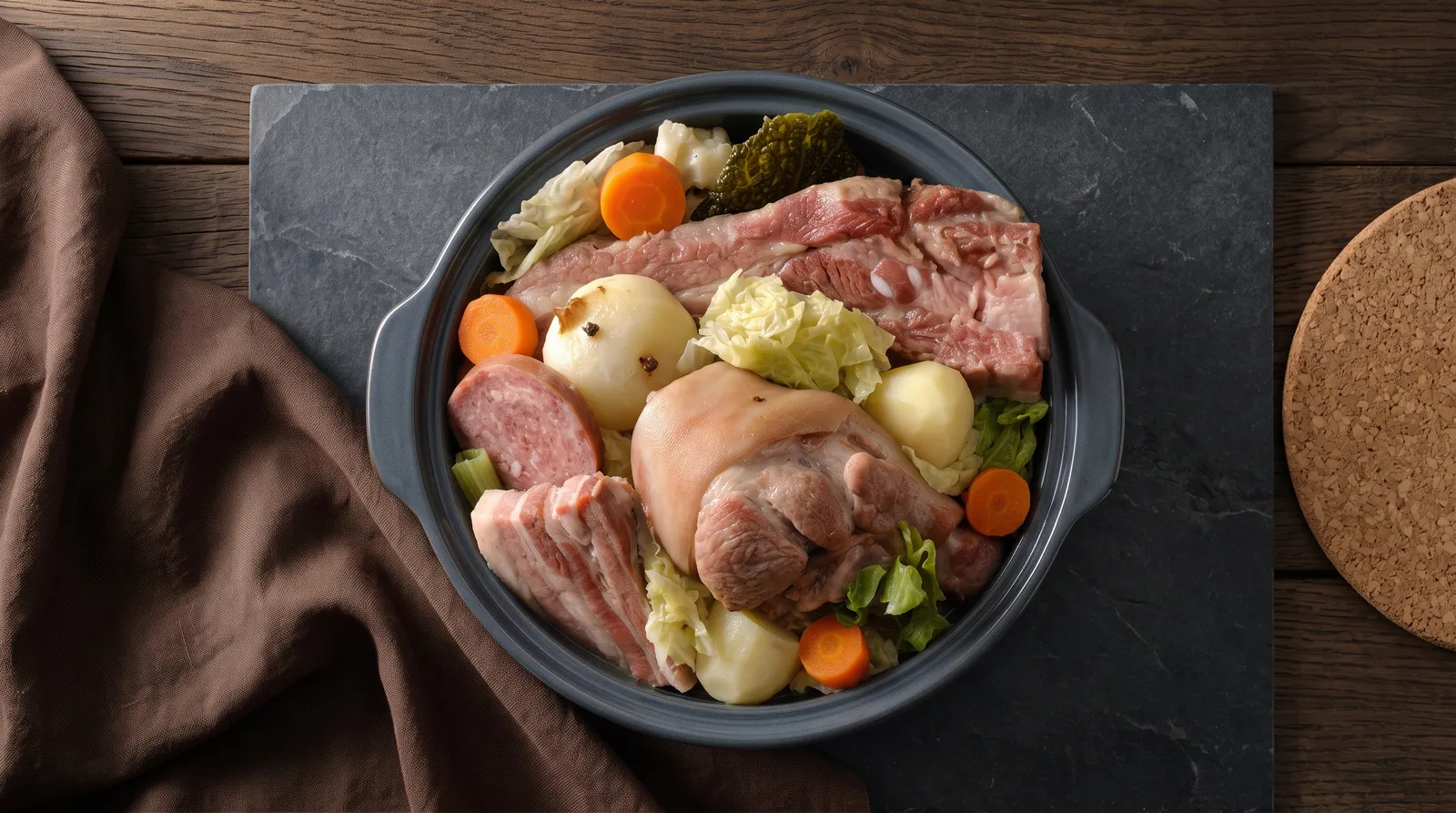
A substantial Roussillon one-pot stew of soaked white beans, cabbage, root vegetables, pork hock, bacon and fresh sausage, simmered slowly and served with its broth.

French National Dishes
Share
Ouillade catalane — served in a bowl
Prep 40 minutes
Cook 195 minutes
Total 955 minutes
Yield 6 large bowls
Introduction and overview

Ouillade catalane with white beans, cabbage and pork

Ouillade catalane, also encountered through the Catalan name ollada, belongs to the winter cooking of Roussillon in the French Catalan south. It is a deep, practical pot of beans, cabbage, roots and pork, historically linked in name to the olla cooking pot. It should not be flattened into cassoulet: there is no baked crust-building stage, and the broth, cabbage and mixed vegetables remain central to the bowl.

The method begins the day before with dry white beans. They are soaked under refrigeration, drained and given fresh cooking water rather than simmered in the soak liquid. A bone-in pork hock and salted bacon start with the beans, allowing the toughest cut and the pulses the longest time. Cabbage and roots follow later, while potatoes and fresh pork sausage go in for the final half hour so they remain intact.

This is also a recipe where purchased weight and edible yield need to stay distinct. The 600 g pork hock includes bone and inedible connective material; after cooking and deboning, about 270 g cooked edible meat is returned to the pot and shared between six bowls. The fresh sausage is a ground-pork product and must reach 71 °C in the centre. The finished ouillade is served hot with its broth, not maintained indefinitely at room temperature or treated as a perpetual stew.

Success points

Success points

  • Use fresh cooking water after the refrigerated bean soak.
  • Keep the long cooking phase at a gentle simmer rather than a violent boil.
  • Add potatoes and sausage only for the last 30 minutes so they cook without dissolving into the broth.
  • Debone the hock carefully before portioning.
Ingredients

Ingredients

  • 350 g dry white beans
  • 600 g raw bone-in pork hock; expect about 270 g cooked edible meat after removing bone and inedible parts
  • 240 g fresh pork sausage
  • 120 g salted bacon
  • 5000 ml fresh water, divided into 2000 ml for soaking and 3000 ml for cooking
  • 700 g green cabbage, trimmed and cut into chunks
  • 300 g carrots, peeled and cut into chunks
  • 800 g potatoes, peeled and cut into large chunks
  • 250 g leeks, cleaned and thickly sliced
  • 100 g celery, cut into chunks
  • 20 g garlic, crushed
  • 2 g bay leaf, about 2 leaves
  • 2 g dried thyme
  • 1 g freshly ground black pepper
Method

Method

Directions

  1. Soak the beans cold. Cover the 350 g beans with 2000 ml of the fresh water and refrigerate for 12 hours. Drain completely and discard that soak water. The beans are plumped and the soaking water has been fully discarded.

  2. Prepare the vegetables. Cut the cabbage, carrots, potatoes, leeks, celery and garlic into the stated sizes in about 25 minutes, keeping the potatoes separate. The vegetables are evenly cut and the potatoes are held separately for their later addition.

  3. Start with fresh cooking water. Put the drained beans, pork hock and bacon in a 7 litre stockpot and add the remaining 3000 ml fresh water. Bring to a full boil over high heat, then skim the surface, allowing about 15 minutes. The pot reaches a full boil and surface foam has been skimmed. The liquid is at about 100 °C; keep clear of steam.

  4. Give beans and hock the longest simmer. Lower the heat and simmer gently for 90 minutes. The beans are partly tender and the pork hock is beginning to loosen from the bone.

  5. Add cabbage and roots. Add the cabbage, carrots, leeks, celery and garlic and continue at a gentle simmer for 60 minutes. The cabbage and roots are tender but still identifiable in the broth.

  6. Cook potatoes and sausage last. Add the potatoes and whole fresh pork sausage and simmer for 30 minutes. The potatoes are tender, the beans are creamy inside and the sausage centre reaches 71 °C. Check the sausage with a food thermometer rather than relying on colour.

  7. Debone and portion. Lift out the hock, remove the bone and inedible connective parts, return about 270 g edible meat to the pot, slice the sausage and divide everything between six bowls in about 15 minutes. The bone has been removed and each bowl receives beans, vegetables, broth and an even share of edible meat.

Serving and make-ahead

Practical

Serving and make-ahead

Serve the ouillade piping hot in deep bowls with enough broth to carry the beans and vegetables. The beans can be soaked overnight, and the whole pot can be cooked a day before serving. If making it ahead, cool it promptly rather than leaving the stockpot warm for hours.

Storage and reheating

Refrigerate cooked ouillade within two hours. Reheat leftovers thoroughly to 74 °C, stirring so the dense bean-and-vegetable mixture heats evenly. Do not keep topping up the same pot over several days at room temperature. Freezing is possible from a safety perspective after prompt cooling, although potatoes may become more fragile and mealy after thawing.

Substitutions

Small white haricot or navy beans fit the white-bean structure. A different fresh pork sausage can be practical, but its seasoning and fat level change the flavour. Keep the pork, cabbage and white-bean framework if the dish is still to read as ouillade rather than another regional bean stew.

Troubleshooting

Troubleshooting

  • Beans are still firmThey need additional gentle simmering. Keep the liquid level sufficient and extend the time rather than boiling violently.
  • Vegetables are breaking downThey were added too early or the pot was boiling too hard. Keep the simmer gentle and preserve the staged additions.
Nutrition per serving

Nutrition per serving

  • Serving size1 large bowl with broth, beans, vegetables and an equal share of edible pork
  • Calories693 kcal
  • Carbohydrate78.2 g
  • Protein39.5 g
  • Fat26.1 g
  • Fibre16.9 g
  • Sodium818 mg
Allergens and food safety

Allergens and food safety

Allergen: celery. Soak the beans under refrigeration and discard the soak water. Fresh pork sausage, as a ground-pork component, must reach 71 °C in the centre. Check the cooked hock carefully for small bone fragments before serving. Refrigerate leftovers within two hours and reheat them to 74 °C. This is a cooked stew, not a pot to leave at room temperature and refresh indefinitely.

FAQ

FAQ

Is ouillade the same as cassoulet?

No. Both may contain white beans and pork, but ouillade is a brothier Roussillon/French-Catalan pot built around beans, cabbage and vegetables rather than a baked cassoulet structure.

Why count only 270 g of the 600 g pork hock in nutrition?

The purchased hock includes bone and other inedible material. Nutrition is based on the approximate cooked edible meat returned to the pot, not on the full bone-in purchase weight.

Closing

Closing

  • Result: The bowl should be substantial but brothy, with creamy beans, tender cabbage and roots, and clearly distributed pieces of pork.
  • Decisive technique: Stage the long simmer so beans and hock start first, vegetables follow, and potatoes plus sausage cook last.