French Recipes

Macaron parisien

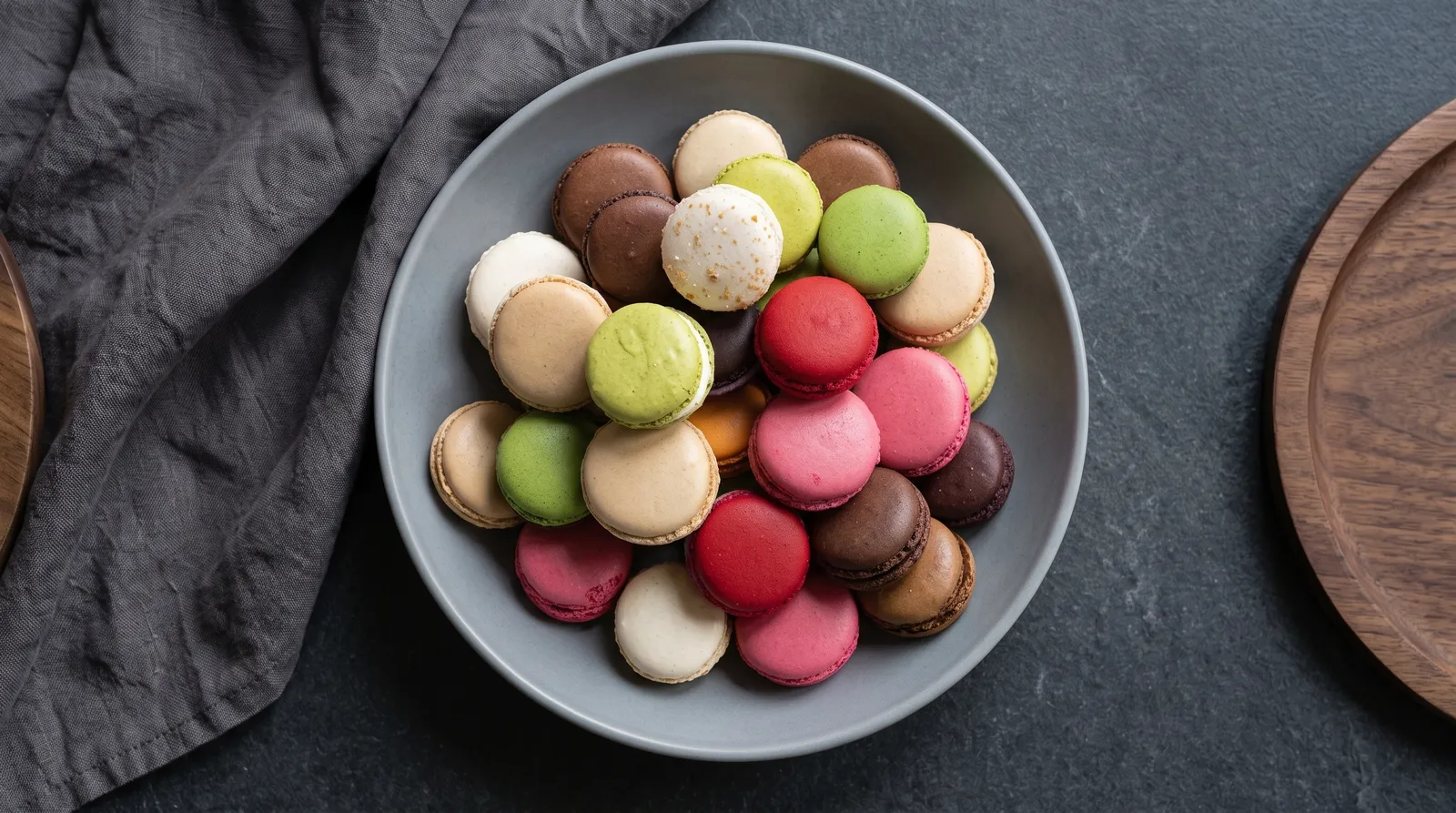
Twenty smooth almond-meringue sandwich macarons with defined feet and a measured dark-chocolate ganache, matured chilled for a tender centre.

French Recipes
Share
Macaron parisien — served on a plate
Prep 50 minutes
Cook 35 minutes
Total 925 minutes
Yield 20 filled macarons (40 shells), about 4 cm diameter
Introduction and overview

Parisian chocolate macarons with dark-chocolate ganache

Macaron parisien means the filled sandwich form: two smooth almond-meringue shells joined around a cream, ganache or buttercream. That construction distinguishes it from older regional single-shell macarons and from coconut macaroons. This recipe stays with one flavour—dark chocolate—rather than producing a novelty assortment.

The shells use pasteurised egg whites, almond flour, icing sugar, caster sugar and a little cocoa. The key point is macaronage: after the dry mixture is folded into the firm glossy meringue, the batter should flow as a slow ribbon and merge back into itself in about twenty seconds. Too stiff and the piped peaks remain; too loose and the shells spread flat.

Piped shells rest until their surface is dry to a light touch, then two trays bake sequentially for consistent domestic-oven heat. After complete cooling, exactly 8 g ganache is piped into each of twenty sandwiches. A twelve-hour refrigerated maturation softens the inner shell slightly while the outer surface and foot remain intact.
Success points

Success points

  • Use pasteurised egg whites and do not taste raw meringue.
  • Stop macaronage at the 20-second ribbon cue.
  • Weigh 8 g ganache into each of exactly 20 macarons.
Ingredients

Ingredients

Chocolate ganache

  • 100 g 70% dark chocolate — finely chopped
  • 60 ml cream — about 30% fat

Macaron shells

  • 125 g fine almond flour
  • 125 g icing sugar
  • 100 g pasteurised egg whites — cool room temperature
  • 100 g caster sugar
  • 8 g unsweetened cocoa powder
Method

Method

Ganache

  1. Browning the cream just. Heat the cream just to steaming, pour it over the chopped dark chocolate, rest for one minute, then stir from the centre until glossy; spread in a shallow container and cool rapidly before refrigerating. Tool: small saucepan, bowl and shallow container. Heat: medium-low heat. Time: 5 minutes cooking + 60 minutes passive refrigeration. Temperature: ganache chilled to about 8 °C. The ganache is glossy, fully emulsified and firm enough to pipe after chilling. A shallow container cools the perishable filling faster and evenly. Refrigerate the ganache promptly and do not leave it at room temperature for more than 2 hours cumulatively.

Shells

  1. Sifting the almond flour. Sift the almond flour, icing sugar and cocoa together twice, discarding only coarse almond pieces that will not pass the sieve. Tool: fine sieve and bowl. Time: 5 minutes. Temperature: room temperature. The dry mixture is fine, even and free of visible lumps. Fine dry particles help produce smooth shell tops.

  2. Whipping the pasteurised egg. Whip the pasteurised egg whites to soft peaks, then add the caster sugar gradually and continue until a firm glossy meringue forms. Tool: stand mixer or hand mixer. Time: 10 minutes. Temperature: cool room temperature. The meringue is glossy and holds a firm peak with a slightly curved tip. A stable meringue provides the shell structure. Do not taste the unbaked meringue.

  3. Folding the dry mixture. Fold the dry mixture into the meringue and macaronage until the batter flows in a slow continuous ribbon that merges back into itself in about 20 seconds. Tool: large bowl and flexible spatula. Time: 5 minutes. Temperature: room temperature. A ribbon of batter settles back into the bowl in about 20 seconds without remaining as a stiff ridge. The flow cue prevents both under- and over-macaronage.

  4. Piping 40 rounds about. Pipe 40 rounds about 4 cm wide on two lined trays, keeping the piping bag vertical; rap each tray firmly several times to release large bubbles. Tool: piping bag with 8–10 mm plain tip and 2 baking trays. Time: 10 minutes. Temperature: room temperature. The rounds are close to 4 cm wide and obvious surface bubbles have risen or burst after tray rapping. Even shell size allows accurate pairing and baking.

  5. Resting the piped shells. Rest the piped shells uncovered until a dry skin forms. Tool: 2 baking trays. Time: 30 minutes passive resting. Temperature: room temperature. A clean fingertip can lightly touch the surface without batter sticking. A dry surface supports a defined foot during baking.

  6. Baking the two trays. Bake the two trays in two sequential batches at 150 °C for 15 minutes per batch, rotating once if the oven browns unevenly. Tool: oven and 2 trays. Heat: 150 °C oven. Time: 15 minutes per batch; 30 minutes total. Temperature: 150 °C. The shells have smooth tops, a defined ruffled foot, and lift from the paper with dry bases after cooling for a minute. Sequential trays give more consistent heat in a domestic oven. The shells must be fully baked; do not eat raw shell batter.

  7. Opening the shells completely. Cool the shells completely on the trays before lifting and pairing them by size. Tool: trays and rack. Time: 30 minutes passive cooling. Temperature: room temperature. The shells are completely cool, release cleanly and have dry bases with a slightly tender interior. Warm shells can tear and melt the filling.

Fill and mature

  1. Piping exactly 8 g. Pipe exactly 8 g chilled ganache onto each of 20 shells and top with the matching shells, pressing just enough for the filling to reach near the edge. Tool: piping bag and scale. Time: 15 minutes. Temperature: ganache chilled. All 20 sandwiches contain about 8 g ganache and sit level without filling squeezing out. A controlled filling weight keeps nutrition and texture consistent.

  2. Chilling the assembled macarons. Refrigerate the assembled macarons in a covered container for maturation, then let individual macarons temper briefly before serving. Tool: covered container. Time: 720 minutes passive refrigeration. Temperature: 4 °C or below. After maturation, the shell remains intact while the centre has softened slightly around the ganache. Chilled maturation allows moisture to equilibrate between shell and filling. Keep the cream ganache at 4 °C or below during maturation.

Serving and planning

Practical

Serving and planning

Serve after 10–15 minutes out of the refrigerator so the ganache softens slightly without a long warm hold.

Serving and planning

Ganache can be made early the same day and kept covered and chilled. Unfilled shells can be stored airtight for a day once completely cool.

Serving and planning

Changing to another stable ganache or buttercream is possible, but filling weight, allergens and nutrition must be recalculated. Almond flour cannot be replaced with coconut without changing the confection’s identity.

Storage

Keep filled macarons refrigerated at 4 °C or below and use within 3 days. Do not leave them at room temperature for more than 2 hours cumulatively. Freezing is possible for texture but is outside this base handling plan.

Make-ahead

The ganache can be made earlier the same day and kept covered at 4 °C. Unfilled shells can be kept airtight for 1 day once completely cool.

Substitutions

Other stable ganaches or buttercreams can create valid Parisian macarons, but the filling weight and nutrition must be recalculated.

Substitutions

Do not replace almond flour with coconut and continue to call the result macaron parisien.

Troubleshooting

Troubleshooting

  • IssueCracked shells — the surface was not dry enough or the oven heat was too aggressive; extend the skin-forming rest and verify oven temperature.
  • IssueNo feet — meringue or macaronage was too weak; stop at the firm-peak and ribbon cues.
  • IssueHollow shells — overwhipping, over-macaronage or excessive heat can be responsible; keep all three controls within the stated cues.
  • IssueGanache squeezes out — it is too warm; chill to piping consistency before filling.
Nutrition per serving

Nutrition per serving

  • Serving size1 filled macaron, about 4 cm diameter with 8 g ganache
  • Calories121 kcal
  • Carbohydrate15.0 g
  • Protein2.3 g
  • Fat6.2 g
  • Fibre1.3 g
  • Sodium10 mg
Allergens and food safety

Allergens and food safety

Allergens: Egg; Almond; Milk

Safety: Use pasteurised egg whites.

Safety: Do not taste raw egg foam or shell batter.

Safety: Bake shells fully and cool completely before filling.

Safety: Cool ganache rapidly and keep it chilled.

Safety: Keep filled macarons at 4 °C or below and limit room-temperature exposure to 2 hours cumulatively.

FAQ

FAQ

Why mature the filled macarons overnight?

Moisture slowly moves from the filling into the inner shell, producing the tender centre associated with the sandwich macaron.

Why use pasteurised whites if the shells are baked?

They reduce risk during handling and make it unnecessary to encourage tasting raw egg foam during the process.

Closing

Closing

  • Result: Twenty smooth almond-meringue sandwich macarons with defined feet and a measured dark-chocolate ganache, matured chilled for a tender centre.
  • Decisive technique: Use pasteurised egg whites and do not taste raw meringue.