French Recipes

Kig ha farz

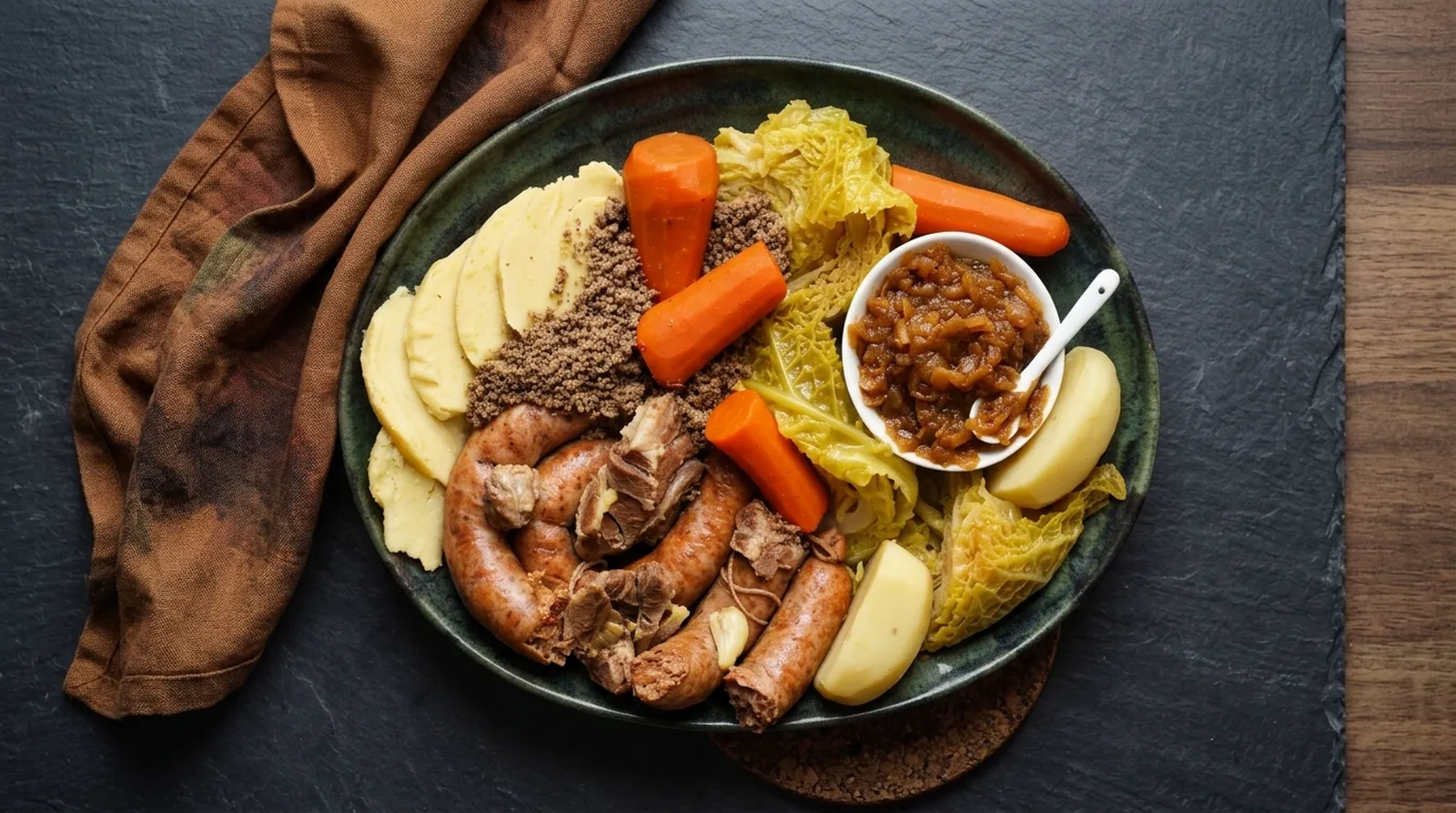
A Léon-style one-pot meal of long-simmered beef, pork and vegetables with buckwheat far cooked inside a securely tied cloth bag, then served with a butter-shallot lipig.

French Recipes
Share
Kig ha farz — arranged on a serving platter
Prep 50 minutes
Cook 190 minutes
Total 250 minutes
Yield 8 generous main-course portions
Introduction and overview

Kig ha farz with buckwheat far and lipig

Kig ha farz belongs to the Pays de Léon in northern Finistère. Its defining feature is not simply meat and vegetables in broth: a batter of buckwheat flour is sealed inside a cloth bag and cooks in the same pot until it becomes a firm far that can be crumbled or sliced. That bag-cooked element keeps this dish separate from an ordinary pot-au-feu with dumplings.

Bone-in beef shank and boneless semi-salted pork belly provide the meat. The beef contributes gelatin and depth, while the pork adds richness without creating another poultry safety threshold. The vegetables go in only for the final part of the simmer so carrots, turnips, leeks and cabbage keep their shape instead of dissolving into the broth.

The far needs its own readiness test. A securely tied food-contact bag is filled to about 85% so the batter has room to expand, then it stays immersed for a full two hours. The far is ready only when the bag feels uniformly firm and there is no liquid centre. Lipig, a glossy butter-and-shallot sauce loosened with a measured ladle of broth, is spooned over the far at the table.
Success points

Success points

  • Treat the far bag as a cooking vessel: food-safe cloth, strong cord and expansion room are essential.
  • Keep the pot at a gentle simmer rather than a hard boil.
  • Test meat tenderness, vegetable texture and far firmness separately.
Ingredients

Ingredients

Meat and vegetables

  • 900 g bone-in beef shank — commercially cut into 2 large pieces — Approx. 540 g cooked edible beef after bone and cooking loss
  • 500 g boneless semi-salted pork belly — rinsed and patted dry — Approx. 350 g cooked edible pork after rendered fat loss
  • 600 g carrots — peeled, cut into large pieces
  • 400 g leeks — washed, white and pale green parts in 6 cm lengths
  • 300 g turnips — peeled, quartered
  • 500 g Savoy cabbage — cut into 8 wedges
  • 8 g fine salt — for broth and final adjustment

Buckwheat far

  • 400 g buckwheat flour
  • 100 g whole egg — 2 large eggs, beaten
  • 500 ml whole milk
  • 80 g salted butter — melted and cooled slightly

Lipig

  • 120 g salted butter
  • 120 g shallots — finely sliced
  • 150 ml served cooking broth — measured from the pot after cooking
Method

Method

Pot and far

  1. Preparing the commercially cut. Prepare the commercially cut meat and vegetables, keeping raw meat on a separate board and tray. Tool: 12–15 l stockpot, separate boards and knives. Time: 20 minutes. Temperature: room temperature. The vegetables are in large, even pieces and the raw meat has not contacted ready-to-eat food. Large pieces withstand the long simmer. Wash hands and sanitise tools after raw meat handling.

  2. Simmering the beef and. Cover the beef and pork with cold water in the stockpot, bring gradually to a gentle simmer, skim, and cook uncovered or partly covered. Tool: 12–15 l stockpot. Heat: gentle simmer. Time: 60 minutes. Temperature: about 90–95 °C liquid. The broth is gently bubbling rather than boiling hard, and most surface foam has been skimmed. A quiet simmer keeps the broth clearer and avoids toughening the meat surface. Beware boiling stock and steam.

  3. Mixing the buckwheat flour. Mix the buckwheat flour, beaten egg, milk and 80 g melted salted butter to a thick pourable batter. Tool: large bowl and whisk. Time: 10 minutes. Temperature: room temperature. The batter is smooth enough to pour slowly and has no dry pockets of buckwheat flour. Even hydration helps the far set uniformly in the bag.

  4. Filling a food-contact linen-cotton. Wet a food-contact linen-cotton far bag about 43 × 19 cm, fill it only to about 85% of its usable volume, expel excess surface air without compressing the batter, and tie it very securely with heat-safe cotton cord. Tool: 43 × 19 cm food-contact far bag and cotton cord. Time: 10 minutes. Temperature: room temperature. The bag is securely tied and retains about 15% expansion room. Buckwheat batter expands and firms during the long immersion. Do not use dyed or non-food-contact cloth; make sure the knot cannot loosen in the pot.

  5. Cooking the tied far. Immerse the tied far bag fully in the simmering broth and cook for 120 minutes; after 70 minutes add the carrots, turnips, leeks and cabbage for the final 50 minutes. Turn the bag once with tongs if it floats unevenly. Tool: stockpot and long tongs. Heat: gentle simmer. Time: 120 minutes. Temperature: about 90–95 °C liquid. The beef and pork are fork-tender, the vegetables are tender but still hold their shape, and the far bag feels uniformly firm with no liquid centre. The staggered vegetable timing prevents them collapsing before the far is cooked through. Keep the bag away from the pot base if it risks scorching; use long tongs to avoid scalding.

Lipig and serving

  1. Making 120 g salted. Melt 120 g salted butter, add the shallots and cook gently until very soft, then stir in 150 ml measured broth and simmer briefly. Tool: small saucepan. Heat: low heat. Time: 10 minutes. Temperature: gentle simmer. The shallots are soft and translucent and the lipig is glossy, buttery and spoonable. The broth loosens the butter-shallot mixture without turning it into a flour-thickened sauce. Hot butter can spit; keep the heat low.

  2. Draining the far bag. Lift the far bag with tongs into a heatproof bowl and let excess broth drain before untying. Tool: tongs, heatproof bowl, scissors if needed. Time: 5 minutes. Temperature: hot. The bag is stable in the bowl and no longer dripping broth across the work surface. Controlled draining makes opening safer. The bag and trapped steam are extremely hot; keep hands and face away from the opening.

  3. Opening the bag briefly. Cool the bag briefly, then open it carefully and crumble the far with the cloth or slice it, according to the texture you prefer. Tool: heatproof bowl and serving spoon. Time: 10 minutes passive cooling + 5 minutes active. Temperature: hot to warm. The far is fully set, crumbly or sliceable, with no raw batter in the centre. A short cooling interval reduces scalding risk while the far remains hot enough to serve. Open the bag away from the face because steam may escape.

Serving and planning

Practical

Serving and planning

Serve in warm shallow bowls with a little broth around the meat, vegetables and far, then add lipig over the far rather than stirring it through the whole pot.

Serving and planning

For make-ahead service, chill the components separately and reheat the broth, meat and vegetables together; warm far slices in a little broth and heat lipig gently.

Serving and planning

A boneless beef cut can simplify serving but changes the broth and yield. Do not replace the buckwheat far with ordinary dumplings and still present the dish as the same preparation.

Storage

Refrigerate meat, vegetables, broth, far and lipig in shallow covered containers within 2 hours. Use within 3 days. Reheat the broth-based components to steaming hot; warm lipig gently so the butter does not split.

Make-ahead

The far can be cooked earlier the same day, cooled safely, then reheated in slices with a little broth; keep the lipig separate until service.

Substitutions

Do not replace the buckwheat far with ordinary dumplings under the same dish identity.

Substitutions

A boneless beef braising cut can simplify serving, but it changes the broth character and removes the bone-yield calculation.

Troubleshooting

Troubleshooting

  • IssueFar bag too loose — the batter can leak; retie before immersion and maintain expansion room.
  • IssueFar still wet in the centre — continue gentle simmering in the broth until uniformly firm.
  • IssueLipig greasy rather than spoonable — whisk in a little measured hot broth over low heat.
Nutrition per serving

Nutrition per serving

  • Serving size1 plate: about 110 g cooked meat, 100 g vegetables, 1/8 far, 1/8 lipig and about 100 ml broth
  • Calories873 kcal
  • Carbohydrate61.8 g
  • Protein39.9 g
  • Fat55.1 g
  • Fibre10.7 g
  • Sodium929 mg
Allergens and food safety

Allergens and food safety

Allergens: Egg; Milk; Celery may be present if a purchased broth is used; the specified plain cooking broth contains no added celery.; Gluten is not inherent to buckwheat, but verify processed meat labels and kitchen cross-contact if serving someone with coeliac disease.

Safety: Keep raw beef and pork separate from vegetables and serving utensils.

Safety: Beware bones in the beef shank and hot steam from the far bag.

Safety: Refrigerate leftovers within 2 hours.

FAQ

FAQ

Can the far be sliced instead of crumbled?

Yes. Once fully set, it may be crumbled or sliced; both serving textures are compatible with this preparation.

Why leave space in the bag?

The buckwheat batter expands as it cooks. A completely packed bag can prevent even setting and makes the tie more likely to fail.

Closing

Closing

  • Result: A Léon-style one-pot meal of long-simmered beef, pork and vegetables with buckwheat far cooked inside a securely tied cloth bag, then served with a butter-shallot lipig.
  • Decisive technique: Treat the far bag as a cooking vessel: food-safe cloth, strong cord and expansion room are essential.