French National Dishes

Kouign-amann

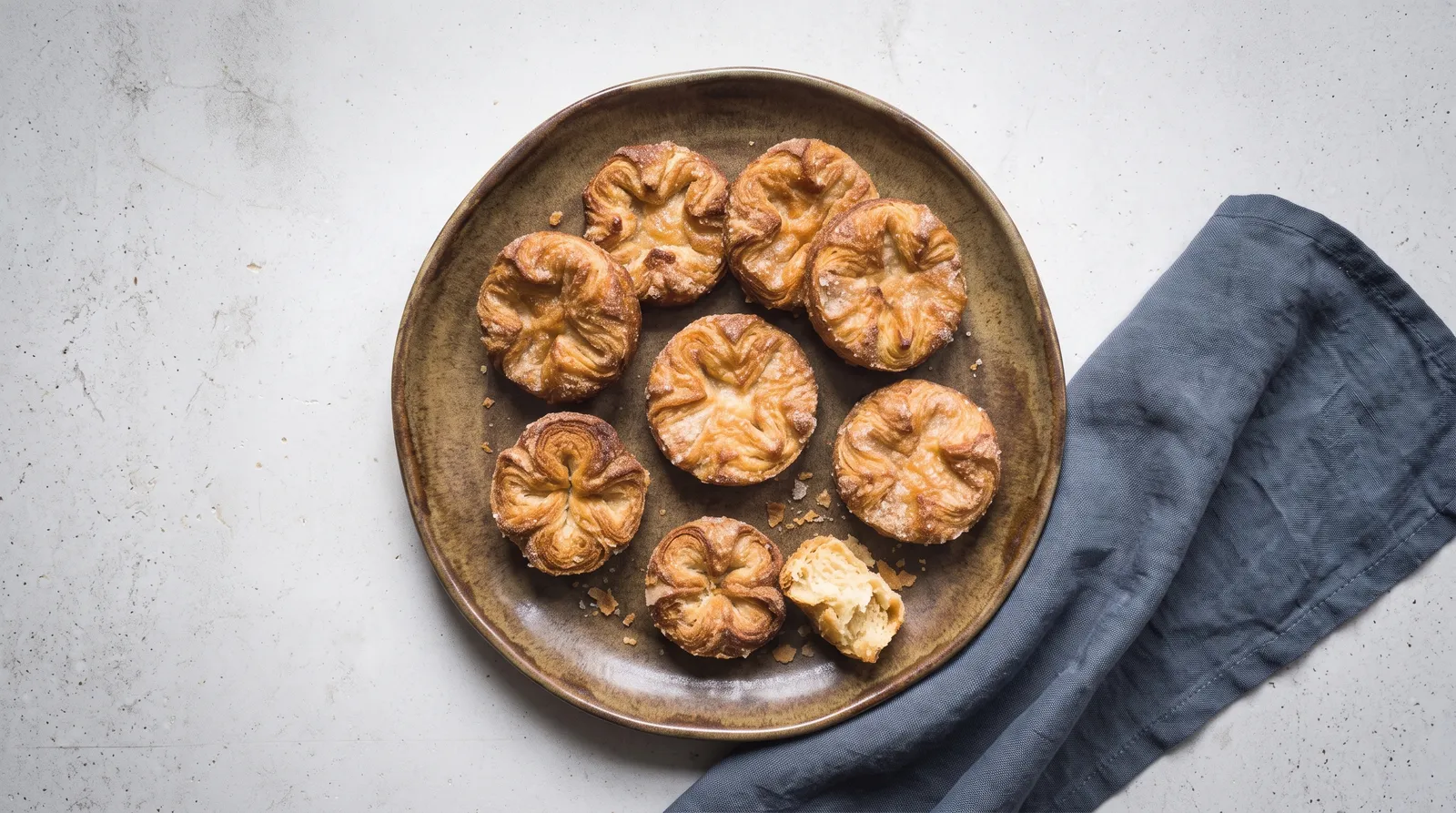
A round Breton butter cake made from yeasted bread dough laminated with salted butter and sugar, folded twice and baked until deeply amber and caramelised.

French National Dishes
Share
Kouign-amann — resting on a cooling rack
Prep 50 minutes
Cook 40 minutes
Total 260 minutes
Yield 1 round 22 cm cake, 8 wedges
Introduction and overview

Douarnenez-style kouign-amann

Kouign-amann from Douarnenez starts with bread dough, not croissant dough. The dough is yeast-raised, then wrapped around a large block of salted butter and rolled with sugar through successive folds. In the oven, that unusually high butter-and-sugar load melts through the layers and caramelises around the edge of the cake.

The challenge is temperature control rather than adding extra turns. The butter should be cool but pliable, about 14–16 °C, so it rolls with the dough instead of shattering or leaking. Sugar is divided between two folds; short chills between them keep the butter enclosed even as the sugar begins drawing moisture from the dough.

A 22 cm metal tin concentrates the syrupy butter and sugar around the pastry. Bake until the top is deeply amber and the centre is fully baked, then wait only five minutes before unmoulding. The caramel is dangerously hot at that stage, but if the cake is left to cool completely in the tin it can weld itself to the base as the sugar hardens.
Success points

Success points

  • Match cool, pliable butter to cool dough before rolling.
  • Use only two controlled sugar folds with short chills between them.
  • Unmould while the caramel is still flexible, using heatproof gloves.
Ingredients

Ingredients

Dough

  • 300 g plain wheat flour
  • 200 ml water — cool-lukewarm
  • 10 g fresh baker’s yeast
  • 4 g fine salt

Lamination and pan

  • 250 g salted butter — 230 g for lamination, 20 g for the pan; cool but pliable
  • 220 g caster sugar — 200 g for lamination, 20 g for the pan
Method

Method

Dough and first rise

  1. Mixing the flour, water. Mix the flour, water, fresh yeast and salt into a rough dough. Tool: large bowl. Time: 10 minutes. Temperature: dough about 22–24 °C. No dry flour remains and the dough holds together as one mass. A simple bread dough keeps the pastry distinct from croissant dough.

  2. Kneading until moderately smooth. Knead until moderately smooth and elastic without over-developing the dough. Tool: worktop or mixer. Time: 10 minutes. Temperature: dough about 22–24 °C. The dough stretches without tearing immediately and its surface is smoother. Moderate strength is enough to contain the butter during rolling.

  3. Resting the covered dough. Rest the covered dough for the first rise. Tool: covered bowl. Time: 90 minutes passive resting. Temperature: about 22–24 °C. The dough is visibly expanded to roughly double its starting volume. The bread-dough fermentation is part of the characteristic structure.

Lamination and bake

  1. Shaping 230 g salted. Shape 230 g salted butter into a flat square about 15 cm wide and roll the dough to a square large enough to enclose it. Tool: rolling pin and work surface. Time: 10 minutes. Temperature: butter 14–16 °C; dough cool room temperature. The butter bends without cracking and the dough fully encloses it with sealed seams. Matching butter pliability to the dough reduces breakthrough.

  2. Rolling to a rectangle. Roll to a rectangle, scatter 100 g caster sugar evenly, make one letter fold, and chill. Tool: rolling pin and tray. Time: 5 minutes active + 15 minutes passive chilling. Temperature: refrigerated rest. The butter remains enclosed and there are no wet butter leaks on the worktop. A short chill re-firms the butter before the next turn.

  3. Repeating the roll with. Repeat the roll with the remaining 100 g lamination sugar, make a second letter fold, and chill again. Tool: rolling pin and tray. Time: 5 minutes active + 15 minutes passive chilling. Temperature: refrigerated rest. The sugar is distributed across the layers and the butter is still contained without tearing the dough. Two controlled turns build layers while preserving the bread-dough character.

  4. Preparing a 22 cm. Butter a 22 cm round metal tin with the remaining 20 g butter and coat it with 20 g sugar; shape the folded dough into the tin and rest it briefly before baking. Tool: 22 cm round metal cake tin. Time: 5 minutes active + 30 minutes passive resting. Temperature: cool room temperature. The dough sits evenly in the tin and has relaxed enough that it does not spring sharply away from the sides. A short final rest relaxes the laminated dough without over-proofing.

  5. Baking at 200 °C. Bake at 200 °C until the top is deeply amber, the edges are crisp and caramelised, and the centre is fully baked rather than doughy. Tool: oven, middle rack. Heat: 200 °C oven. Time: 40 minutes. Temperature: 200 °C. The top is deeply amber, the edges are crisp and caramelised, and the centre is fully baked rather than doughy. Deep caramelisation is integral to the cake, but the centre must still cook through. Molten butter and sugar are extremely hot; protect hands and forearms.

  6. Opening in the tin. Cool in the tin for 5 minutes, unmould carefully before the caramel sets hard, then cool for another 15 minutes before cutting. Tool: heatproof gloves, rack and serving plate. Time: 5 minutes passive cooling + 5 minutes active unmoulding + 15 minutes passive cooling. Temperature: hot to warm. The cake releases while the caramel is still flexible and holds its round shape on the rack. Early unmoulding prevents the caramel bonding permanently to the tin. Hot caramel can cause severe burns; do not touch the syrupy edges.

Serving and planning

Practical

Serving and planning

Serve in eight wedges slightly warm or at room temperature. The contrast between crisp caramelised edges and a tender layered centre is strongest on the day of baking.

Serving and planning

For storage, cool completely before covering. Recrisp a wedge in a moderate oven rather than a microwave if you want to restore the edge texture.

Serving and planning

Unsalted butter plus added salt changes both water balance and salinity. It can be used only as a clearly described adaptation, not as a claim that the protected or defining salted-butter character is unchanged.

Storage

Best on the day of baking. Once fully cool, cover and keep at cool room temperature for 1 day. Recrisp wedges for a few minutes in a moderate oven; avoid microwave reheating if you want crisp caramel edges.

Make-ahead

The dough can complete its first rise earlier in the day and be chilled briefly before lamination, but the folded butter-sugar package should not sit for hours because dissolved sugar makes the layers sticky.

Substitutions

Unsalted butter plus extra salt changes butter-water balance and salinity; it can work as an adaptation but is not equivalent to good salted butter.

Substitutions

Do not substitute ready-made puff pastry or croissant dough under the same preparation identity.

Troubleshooting

Troubleshooting

  • IssueButter leaks during rolling — the butter is too warm or the dough too thin; stop and chill before continuing.
  • IssueCake welds to the tin — it cooled too long in the caramel; warm the base briefly and release cautiously.
  • IssuePale surface — bake until the stated deep amber cue rather than stopping at blond pastry colour.
Nutrition per serving

Nutrition per serving

  • Serving size1 of 8 wedges
  • Calories468 kcal
  • Carbohydrate56.4 g
  • Protein4.2 g
  • Fat25.7 g
  • Fibre1.1 g
  • Sodium399 mg
Allergens and food safety

Allergens and food safety

Allergens: Gluten; Milk

Safety: Do not taste raw yeast dough.

Safety: Hot caramelised sugar and butter can cause serious burns.

Safety: Cool before storage and keep leftovers covered.

FAQ

FAQ

Why not use croissant dough?

Kouign-amann is built from yeasted bread dough with an unusually heavy butter and sugar lamination, which gives a different crumb and caramel structure.

Why is the cake unmoulded so early?

The sugar is still flexible after a short rest; once fully cold it can set hard against the metal.

Closing

Closing

  • Result: A round Breton butter cake made from yeasted bread dough laminated with salted butter and sugar, folded twice and baked until deeply amber and caramelised.
  • Decisive technique: Match cool, pliable butter to cool dough before rolling.