French National Dishes

Kougelhopf

A tall Alsatian yeasted ring enriched with butter and eggs, studded with rum-soaked raisins and lined with whole almonds in the characteristic fluted mould.

French National Dishes
Share
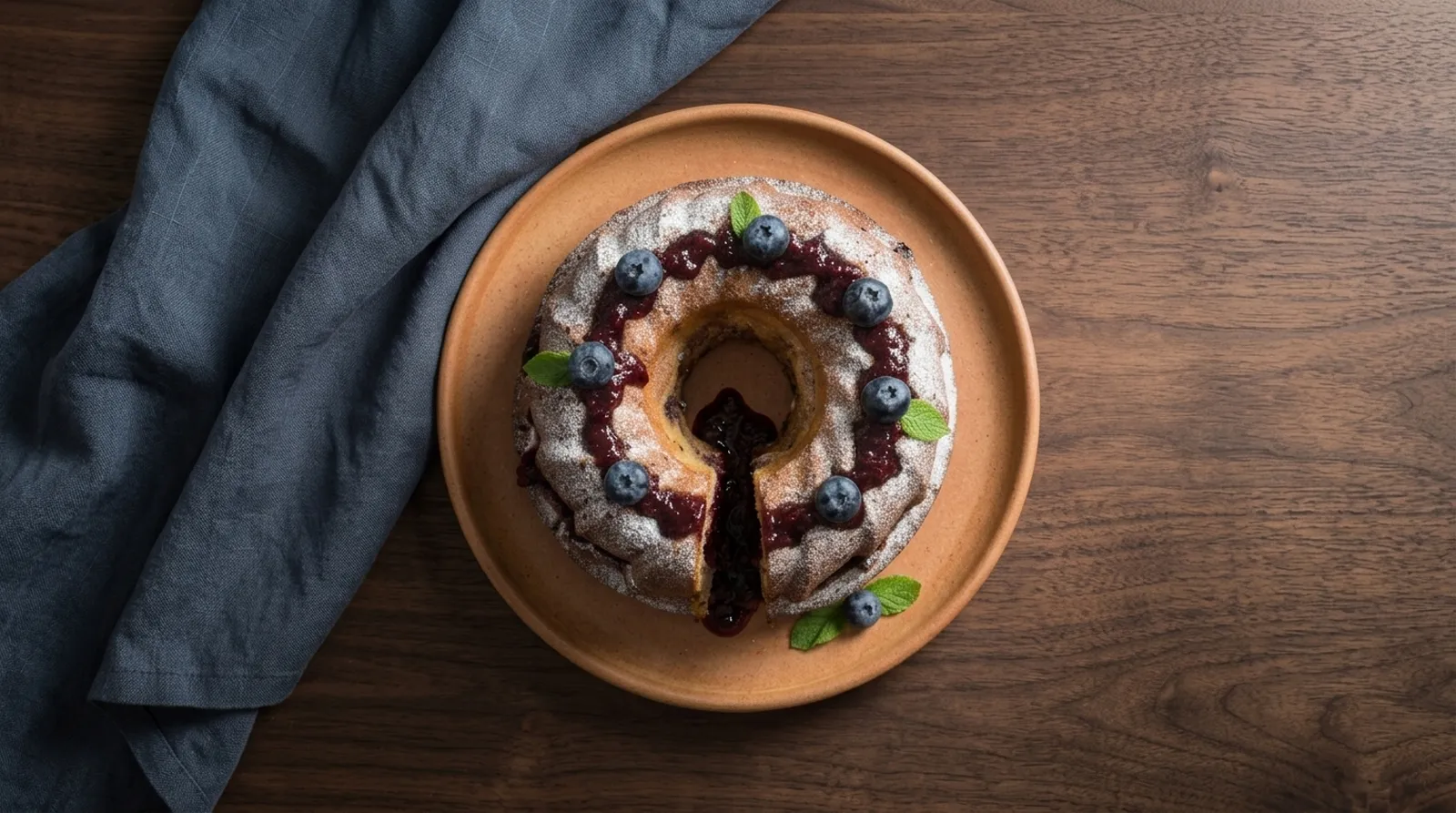
Kougelhopf — shown whole after baking
Prep 35 minutes
Cook 45 minutes
Total 310 minutes
Yield 1 tall 22 cm kougelhopf, 10 slices
Introduction and overview

Alsatian kougelhopf with rum-soaked raisins and almonds

Kougelhopf is an Alsatian yeasted cake-bread with a tall fluted ring shape, whole almonds set into the mould and raisins through the crumb. It is closer to brioche than to a Bundt cake, but the specific mould, almond placement and raisin profile give it its own identity. Fresh baker’s yeast starts in a small sponge before the enriched dough is mixed.

The dough is deliberately developed before the softened butter goes in. Flour, milk, eggs, sugar and salt first build enough gluten to stretch; butter is then added gradually so it enriches rather than smears through a weak dough. A finished dough temperature around 24–26 °C keeps fermentation active without turning the butter oily.

The raisins spend an hour in dark rum, then drain before incorporation. The loaf receives a first rise in the bowl and a second proof in a 2 litre, 22 cm mould. It bakes until deeply golden with a fully set centre, then cools on a rack before a light icing-sugar finish. The rum is not assumed to disappear completely in the oven.
Success points

Success points

  • Build gluten before adding the softened butter.
  • Drain the rum-soaked raisins before folding them through the dough.
  • Use volume and fingertip response, not the clock alone, to judge both proofs.
Ingredients

Ingredients

Dough

  • 500 g plain wheat flour
  • 25 g fresh baker’s yeast
  • 200 ml whole milk — lukewarm, divided
  • 100 g whole egg — 2 large eggs
  • 125 g unsalted butter — softened
  • 100 g caster sugar
  • 10 g fine salt

Fruit and mould

  • 80 g seedless raisins
  • 40 ml dark rum
  • 50 g whole blanched almonds
  • 15 g icing sugar — for dusting after cooling
Method

Method

Soak and build the dough

  1. Soaking the raisins in. Soak the raisins in 40 ml dark rum, then drain for 5 minutes before adding to the dough. Tool: small bowl and sieve. Time: 60 minutes passive soaking. Temperature: room temperature. The raisins are plump and fragrant and no longer sit in a pool of rum. Draining prevents a wet alcohol pocket from weakening the dough. Rum remains alcoholic; keep away from children and open flame.

  2. Resting a sponge made. Rest a sponge made from the fresh yeast, 100 ml of the lukewarm milk and 100 g of the flour. Tool: small bowl. Time: 20 minutes passive resting. Temperature: 24–26 °C. The sponge is visibly expanded and aerated. A short sponge confirms active yeast before the enriched ingredients are added.

  3. Combining the remaining flour. Combine the remaining flour, remaining 100 ml milk, eggs, sugar, salt and risen sponge; knead until the dough begins to clear the bowl and reaches 24–26 °C. Tool: stand mixer with dough hook or large bowl. Time: 15 minutes. Temperature: dough 24–26 °C. The dough is elastic, cohesive and begins to pull cleanly from the bowl. Adequate gluten development is needed before the butter is incorporated.

  4. Adding the softened butter. Add the softened butter gradually and knead until fully absorbed, then fold in the drained raisins without tearing the dough. Tool: stand mixer with dough hook. Time: 10 minutes. Temperature: dough 24–26 °C. The dough is smooth, glossy and elastic, with raisins evenly distributed and no greasy butter streaks. Adding butter after initial gluten development helps the dough hold its tall shape.

Proof and bake

  1. Resting the covered dough. Rest the covered dough for the first rise in a warm place. Tool: covered bowl. Time: 60 minutes passive resting. Temperature: 24–26 °C. The dough has roughly doubled in volume and springs back slowly when pressed lightly. The first fermentation builds volume and flavour.

  2. Preparing a 2 litre. Butter a 2 litre, 22 cm kougelhopf mould, place whole almonds in the base of the flutes, gently deflate the dough, shape it into a ring and place it in the mould. Tool: 2 l, 22 cm kougelhopf mould. Time: 10 minutes. Temperature: room temperature. The dough ring sits evenly in the mould and each flute has an almond at its base. Even shaping supports an even crown.

  3. Resting the shaped dough. Rest the shaped dough for the final proof until it rises to about 1–2 cm below the rim. Tool: kougelhopf mould. Time: 45 minutes passive resting. Temperature: 24–26 °C. The dough has risen close to the rim and a light fingertip press returns slowly. Under-proofed dough tears; over-proofed dough can collapse.

  4. Baking in a preheated. Bake in a preheated 180 °C conventional oven until deeply golden and fully baked through. Tool: oven and middle rack. Heat: 180 °C oven. Time: 45 minutes. Temperature: 180 °C. The crust is deep golden, the loaf sounds hollow when tapped, and the centre crumb is set with no gummy streak. The tall enriched loaf needs enough time for the centre to bake through. Do not taste raw dough.

  5. Cooling onto a rack. Unmould onto a rack and cool completely before dusting with the 15 g icing sugar and slicing. Tool: wire rack and small sieve. Time: 45 minutes passive cooling. Temperature: room temperature. The kougelhopf is fully cool, the crust is dry rather than sweaty, and the crumb slices cleanly. Cooling on a rack prevents condensation softening the crust.

Serving and planning

Practical

Serving and planning

Serve at room temperature in ten slices. The crust is best the day it is baked, while the crumb remains pleasant the next morning.

Serving and planning

If preparing ahead, soak and drain the raisins early and keep them covered. Cool the baked kougelhopf fully before wrapping to prevent condensation.

Serving and planning

For an alcohol-free adaptation, use 40 ml warm water instead of rum for the raisins. The flavour changes and should be described as an adaptation rather than an identical kougelhopf.

Storage

Once fully cool, wrap airtight and keep at cool room temperature for up to 2 days. Rewarm a slice briefly in a low oven if desired; do not store while warm because condensation makes the crust leathery.

Make-ahead

The rum-soaked raisins can be prepared several hours ahead and refrigerated covered. The shaped dough should not be left warm beyond the stated proof.

Substitutions

For an alcohol-free adaptation, soak the raisins in 40 ml warm water instead of rum; the flavour is different and should be labelled as an adaptation.

Substitutions

Do not replace the kougelhopf mould with a shallow cake tin if you want the characteristic tall fluted profile.

Troubleshooting

Troubleshooting

  • IssueDense crumb — the dough was under-kneaded or under-proofed; develop elasticity before butter and wait for the stated rise cues.
  • IssueGreasy streaks — butter was added too quickly or the dough became too warm; add butter gradually and keep the dough near 24–26 °C.
  • IssueRaisins sink — drain them thoroughly before folding them into the developed dough.
Nutrition per serving

Nutrition per serving

  • Serving size1 of 10 slices
  • Calories404 kcal
  • Carbohydrate58.6 g
  • Protein8.7 g
  • Fat14.8 g
  • Fibre2.5 g
  • Sodium420 mg
Allergens and food safety

Allergens and food safety

Allergens: Gluten; Egg; Milk; Almond; Alcohol from rum

Safety: Raw enriched dough contains egg and flour and must not be tasted.

Safety: Rum remains in the soaked raisins; baking reduces but does not guarantee elimination of alcohol.

Safety: Cool completely before wrapping.

FAQ

FAQ

Can I use a standard Bundt pan?

A deep fluted ring pan can work mechanically, but a tall kougelhopf mould gives the intended profile and almond placement.

Why does the butter go in late?

Fat coats flour proteins, so adding it after initial gluten development makes it easier to build a strong yet tender enriched dough.

Closing

Closing

  • Result: A tall Alsatian yeasted ring enriched with butter and eggs, studded with rum-soaked raisins and lined with whole almonds in the characteristic fluted mould.
  • Decisive technique: Build gluten before adding the softened butter.