French Recipes

Fondue savoyarde

A controlled Savoyard cheese fondue for four, combining three named Savoie cheeses with dry white Savoie wine and serving it with measured rustic bread.

French Recipes
Share
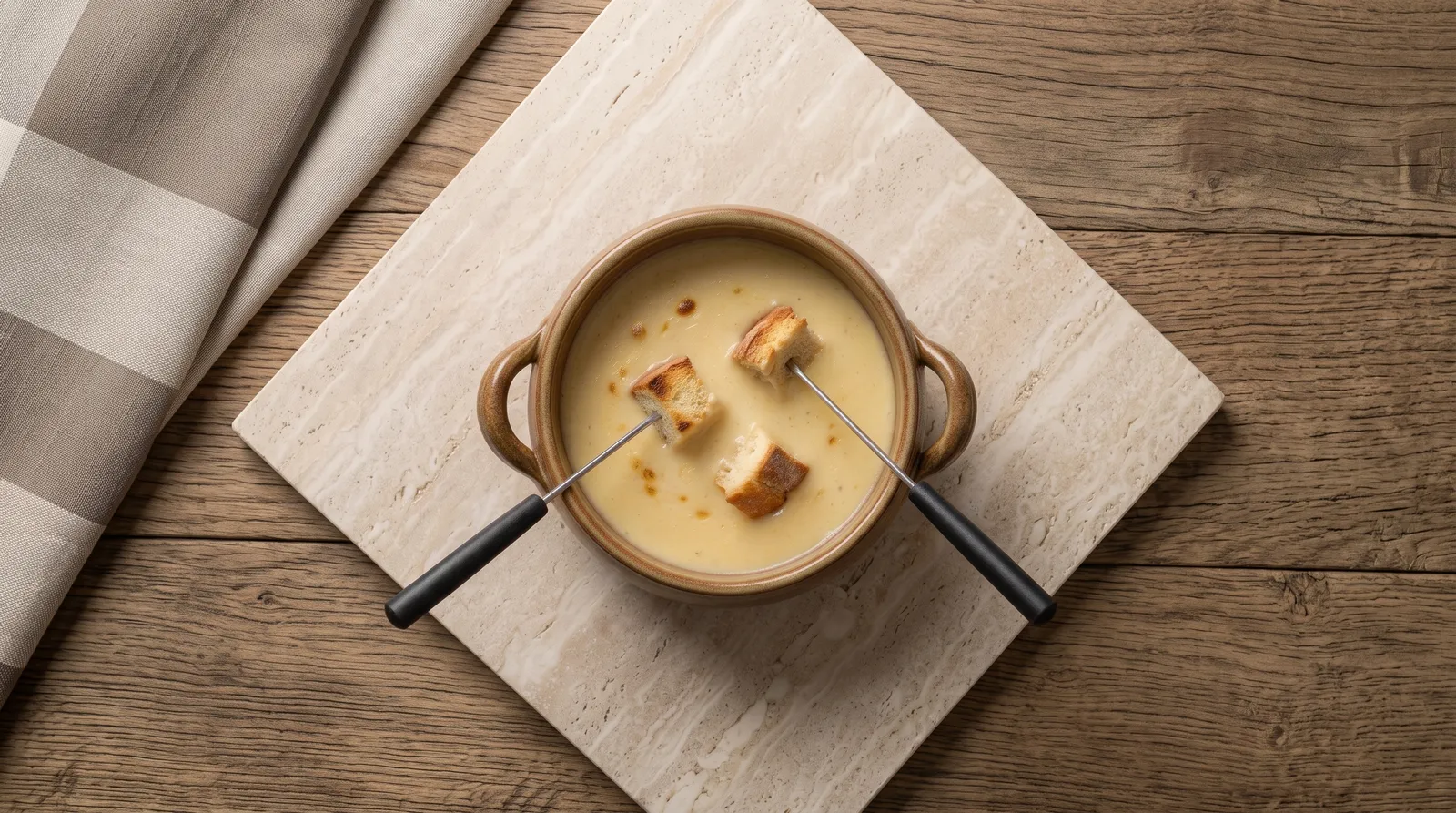
Fondue savoyarde — shown in a cooking pot
Prep 25 minutes
Cook 15 minutes
Total 70 minutes
Yield about 820 g fondue plus 500 g bread
Introduction and overview

Fondue savoyarde with Beaufort, Abondance and Emmental de Savoie

Fondue savoyarde is defined here by a Savoie cheese blend rather than by a generic pool of melted cheese. Beaufort brings a firm alpine depth, Abondance adds a supple nutty character, and Emmental de Savoie helps give the pot a long, cohesive melt. Dry local white wine supplies the liquid phase and acidity that let those cheeses come together into a spoon-coating emulsion.

The practical challenge is heat control. Cheese proteins tighten and fat separates when the pot is driven into a hard boil, so the wine is warmed first and the grated cheeses are incorporated gradually over low heat. Cornstarch is used in a small measured amount at the end; it should support the emulsion rather than turn the fondue into a thick sauce.

Bread is part of the measured recipe, not a casual extra. Five hundred grams of rustic wheat bread are cut into 2.5 cm cubes and air-dried briefly so the surfaces grip the cheese while the centres remain chewy. Potatoes or charcuterie can be served at the table, but they are outside this yield and nutrition calculation.
Success points

Success points

  • Add cheese gradually over low heat rather than boiling the mixture.
  • If the fondue tightens, first lower the heat and stir steadily; add measured wine only if a specific correction is needed.
Ingredients

Ingredients

Cheese fondue

  • 220 g Beaufort — purchased wedge; rind trimmed to 200 g and grated
  • 220 g Abondance — purchased wedge; rind trimmed to 200 g and grated
  • 215 g Emmental de Savoie — purchased wedge; rind trimmed to 200 g and grated
  • 300 ml dry white Savoie wine
  • 5 g garlic — halved
  • 8 g cornstarch
  • 1 g black pepper — freshly ground
  • 0.5 g ground nutmeg

For dipping

  • 500 g rustic wheat bread — edible crumb and crust, cut into 2.5 cm cubes
Method

Method

Bread

  1. Dry the bread cubes. Spread the 2.5 cm bread cubes on a clean tray for 30 minutes. The cube surfaces feel dry while the centres remain chewy.

Fondue

  1. Prepare the cheeses. Trim the rinds to leave 200 g edible Beaufort, 200 g Abondance and 200 g Emmental de Savoie, then grate them finely. Rub the inside of the 1.5–2 litre caquelon with the garlic. All three cheeses are finely grated and the caquelon smells lightly of garlic.

  2. Warm the wine gently. Pour in the 300 ml wine and warm it over medium-low heat for about 3 minutes. The wine is hot and steaming with small bubbles at the edge, not boiling hard.

  3. Build the emulsion. Add the grated cheeses a handful at a time, stirring each addition into the wine before adding the next. Keep the heat low for about 10 minutes. The mixture becomes smooth, glossy and cohesive without a scorched layer on the base.

  4. Finish the fondue. Whisk the cornstarch with a small spoonful of the hot fondue until smooth, return it to the pot, and stir for 2 minutes with the pepper and nutmeg. The fondue lightly coats the spoon yet still flows in a continuous ribbon.

  5. Move to the table safely. Transfer the caquelon to its stable tabletop stand and maintain only enough heat to keep the cheese fluid. The fondue stays fluid enough to coat bread without separating into oil and solids.

Serving, storage and planning

Practical

Serving, storage and planning

Bring the caquelon to the table only when the fondue is fully smooth. Use the burner at the lowest setting that keeps the cheese fluid and stir through the base from time to time so no hot spot develops.

Serving, storage and planning

Grate the cheese and cut the bread in advance if helpful, keeping the cheese refrigerated. Leftovers should be cooled promptly, covered and refrigerated at 4 °C or below within 2 hours. Reheat gently with constant stirring; a reheated fondue can be slightly less silky than the first service.

Serving, storage and planning

Do not replace all three cheeses with a processed melting cheese and retain the same name. Other alpine cheeses can make a good fondue, but the flavour, salt level and regional character change. Likewise, simply removing the wine does not leave enough liquid and acidity for this exact balance.

Troubleshooting

If a slick of fat appears, the pot is too hot. Move it off the heat briefly and stir steadily until the emulsion tightens again.

Troubleshooting

If the fondue becomes too thick to coat bread, reduce the burner first. If it still needs loosening, incorporate a small measured spoonful of the same wine rather than pouring in an unmeasured quantity.

Nutrition per serving

Nutrition per serving

  • Serving size1 of 4 servings: about 190 g eaten fondue plus 125 g bread
  • Calories920 kcal
  • Carbohydrate68 g
  • Protein52 g
  • Fat48 g
  • Fibre4.2 g
  • Sodium1550 mg
Allergens and food safety

Allergens and food safety

Allergen: Milk from the cheeses.

Allergen: Gluten from the measured wheat bread.

Allergen: Sulphites and alcohol from the wine.

Safety: Keep the communal burner stable and attended; protect children and diners from flame, hot metal and trailing cords.

Safety: Cool any leftovers promptly and refrigerate at 4 °C or below within 2 hours.

Safety: Wine alcohol is reduced during cooking but is not assumed to disappear completely.

FAQ

FAQ

Does all the wine alcohol evaporate?

No. The wine is heated, but a short cook does not remove all alcohol, so this fondue should still be treated as containing alcohol.

Can I use only Beaufort?

You can make a different cheese fondue that way, but this measured Savoyard version relies on the balance of Beaufort, Abondance and Emmental de Savoie.

Closing

Closing

  • Result — a glossy fondue that clings to dry-edged bread cubes while remaining fluid in the communal pot.
  • Decisive technique — melt the grated cheeses gradually over low heat and never drive the emulsion to a hard boil.