French Recipes

Crème brûlée

Six shallow cream-and-yolk custards baked gently in a water bath to 72 °C, fully chilled, then capped with a thin glassy sugar crust immediately before serving.

French Recipes
Share
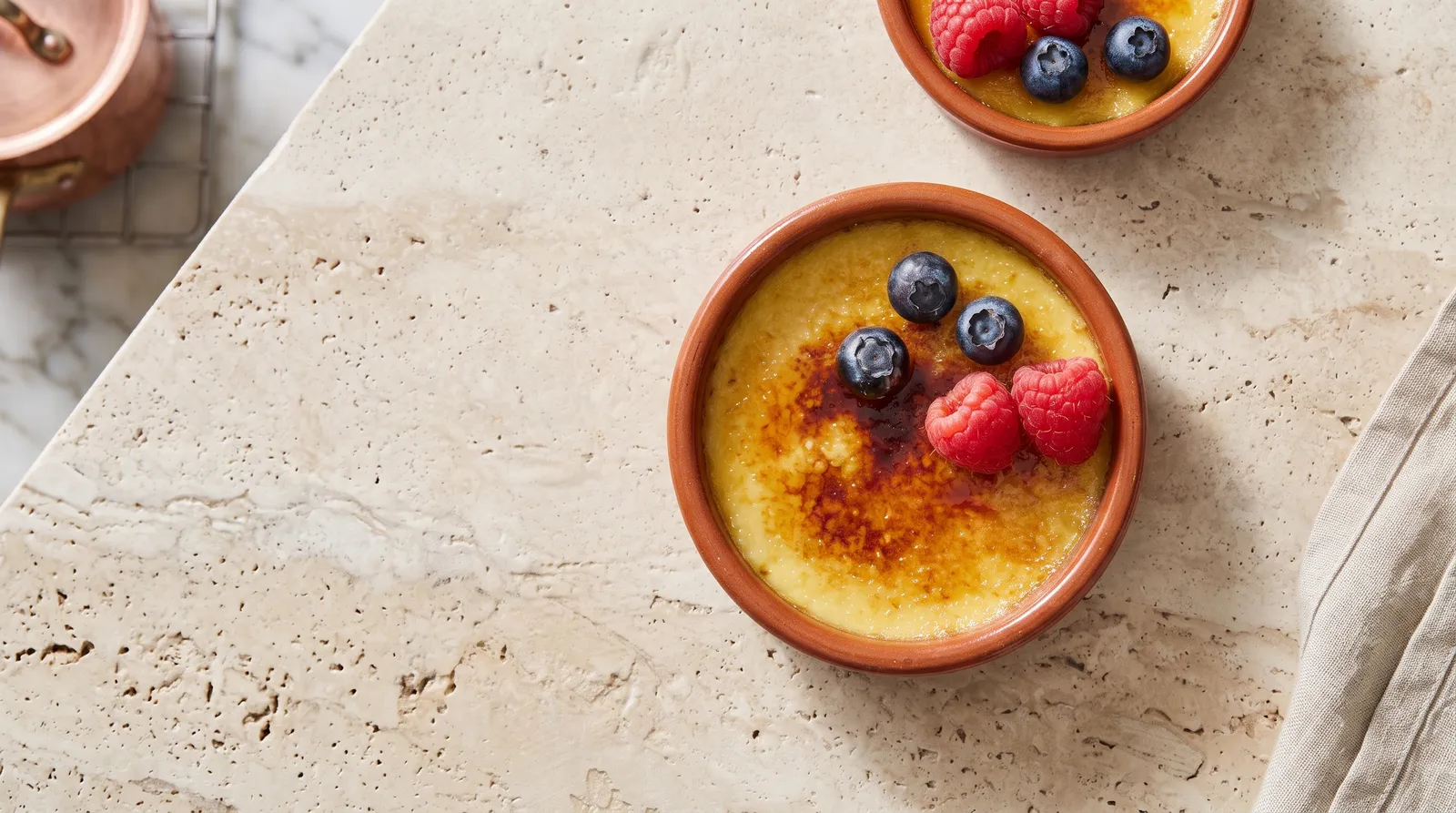
Crème brûlée — shown in a small ceramic baking dish
Prep 15 minutes
Cook 50 minutes
Total 345 minutes
Yield 6 ramekins
Introduction and overview

Crème brûlée — baked vanilla cream custard with a brittle caramel top

Crème brûlée is built on a very short ingredient list—cream, egg yolks, sugar and vanilla—so texture depends on temperature control rather than starch. The custard is deliberately shallow: six 9 cm ramekins are filled to about 2 cm, giving a broad surface for caramel while keeping the interior softly set.

The cream is heated to about 82 °C, briefly infused with vanilla, then tempered into the yolks and strained. Baking takes place at 120 °C in a water bath made with roughly 80 °C water reaching halfway up the ramekin sides. The centre is removed at 72 °C, above the 71 °C safety minimum but still soft enough to tremble as one mass instead of curdling.

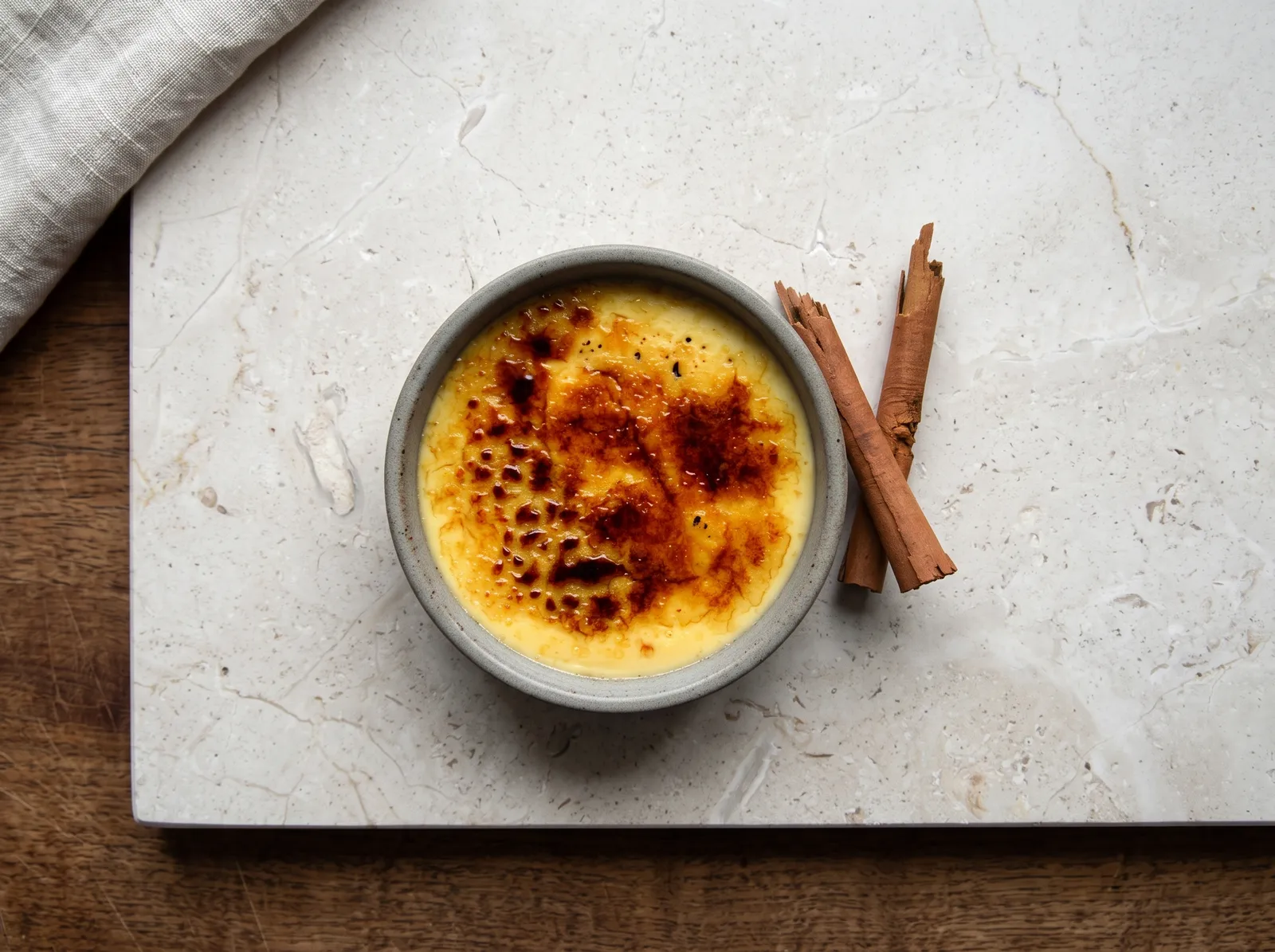
Cooling and caramelising are separate stages. The ramekins cool uncovered for 30 minutes, then chill for four hours at 4 °C or below. Only just before service does each receive 5 g sugar and a moving torch flame. The target is a thin amber lid that cracks cleanly while the custard underneath remains cold—precisely the contrast that separates crème brûlée from a warm baked custard.
Success points

Success points

  • Keep air out of the yolk mixture.
  • Use 80 °C bath water halfway up the ramekins.
  • Remove the custards at 72 °C with a soft central tremble.
  • Caramelize only when fully chilled and immediately before service.
Ingredients

Ingredients

Custard

  • 500 ml 35% fat whipping cream, cold
  • 108 g egg yolks, about 6 large yolks
  • 80 g caster sugar
  • 2 g vanilla bean seeds or pure vanilla paste, measured
  • 1500 ml hot water, about 80 °C, for the water bath only

Caramel top

  • 30 g caster sugar
Method

Method

Custard

  1. Scald the vanilla cream. Heat the cream with vanilla for 5 minutes until it reaches about 82 °C; do not boil hard. Tool or vessel: medium saucepan. Heat: medium-low. Temperature: about 82 °C. Readiness: The cream is steaming and small bubbles appear around the edge without a rolling boil. Why it matters: Scalding extracts vanilla and prepares tempering.

  2. Infuse the vanilla. Remove the cream from the heat, cover and leave to infuse for 10 minutes. Tool or vessel: covered saucepan. Heat: none. Temperature: warm. Readiness: The cream remains hot and carries a clear vanilla aroma without a cooked-milk skin being stirred into the custard. Why it matters: A short covered infusion develops vanilla before tempering.

  3. Mix the yolks and sugar. Whisk the yolks with 80 g sugar for 2 minutes just until smooth, without deliberately aerating them. Tool or vessel: mixing bowl + whisk. Heat: none. Temperature: room temperature. Readiness: The yolk and sugar mixture is smooth and evenly coloured without a thick foam cap. Why it matters: Low aeration keeps the custard surface fine.

  4. Temper and strain the custard. Pour the hot cream into the yolks in a thin stream while whisking continuously for 2 minutes, then strain into a jug. Tool or vessel: bowl, whisk, fine sieve, jug. Heat: none. Temperature: hot mixture about 70–75 °C. Readiness: The strained custard is fluid and free of cooked egg flecks. Why it matters: Gradual tempering and straining reduce curdling and surface bubbles.

Bake and chill

  1. Set up the shallow water bath. Divide the custard among six 9 cm wide × 3 cm deep ramekins to a fill depth of about 2 cm; place them in a roasting dish and add 1500 ml water at about 80 °C to reach halfway up the ramekin sides. Tool or vessel: six ramekins + roasting dish. Heat: none. Temperature: water about 80 °C. Readiness: The ramekins contain equal shallow layers and the bath reaches halfway up their sides without water entering the custard. Why it matters: A shallow, even fill supports uniform baking. Safety: Handle hot water carefully to avoid scalds.

  2. Bake to the measured endpoint. Bake at 120 °C conventional heat for about 42 minutes; check the centre with a clean food thermometer and remove when it reaches 72 °C. Tool or vessel: water bath in oven + food thermometer. Heat: 120 °C conventional oven. Temperature: 120 °C oven; 72 °C custard centre. Readiness: The edges are set, the centre still trembles softly as one mass, and the thermometer reads 72 °C without signs of curdling. Why it matters: The measured endpoint clears the 71 °C safety minimum while preserving a soft set. Safety: Do not rely on wobble alone; verify at least 71 °C.

  3. Cool and chill completely. Lift the ramekins from the water bath, cool uncovered for 30 minutes, then cover and refrigerate for 240 minutes at 4 °C or below. Tool or vessel: cooling rack + refrigerator. Heat: none. Temperature: ≤4 °C after initial cooling. Readiness: The custards are fully cold and firm enough to support a sugar crust while remaining creamy underneath. Why it matters: Full chilling sets the custard before caramelizing. Safety: Refrigerate at 4 °C or below after the initial cool.

Caramelize

  1. Caramelise the cold custards. Just before serving, spread 5 g of the remaining sugar over each cold custard and caramelize with a kitchen torch for about 3 minutes total, moving the flame continuously. Tool or vessel: kitchen torch. Heat: direct torch heat. Temperature: surface caramelization. Readiness: The sugar forms a thin, glassy amber crust that cracks cleanly with a spoon, while the custard beneath stays cold. Why it matters: A thin sugar layer gives brittle contrast without reheating the custard excessively. Safety: keep the torch away from flammable materials and never torch alcohol.

Serving and practical guidance

Practical

Substitutions

- Vanilla bean seeds: Pure vanilla paste may be used at the stated measured weight. It keeps the vanilla profile without changing custard structure.

Troubleshooting

Troubleshooting

  • Problem 1Check the cause and correction. If the custard is grainy, it was overheated or tempered too abruptly; use low oven heat and stop at 72 °C.
  • Problem 2Check the cause and correction. If the sugar crust is patchy, the sugar layer was uneven; weigh 5 g per ramekin and spread it to the edges.
Nutrition per serving

Nutrition per serving

  • Serving size1 ramekin
  • Calories415 kcal
  • Carbohydrate21.3 g
  • Protein4.6 g
  • Fat34.8 g
  • Fibre0.0 g
  • Sodium42 mg
Allergens and food safety

Allergens and food safety

Allergen: Egg.

Allergen: Milk.

Safety: Use pasteurized cream and sound eggs.

Safety: Bake the custard to at least 71 °C; this preparation targets 72 °C.

Safety: After cooling, keep at 4 °C or below and consume within 24 hours.

Closing

Closing

  • Result: Six shallow cream-and-yolk custards baked gently in a water bath to 72 °C, fully chilled, then capped with a thin glassy sugar crust immediately before serving.
  • Decisive technique: Keep air out of the yolk mixture.