French Recipes

Coq au vin

Classic red-wine coq au vin with a 12-hour chilled marinade, mature rooster, lardons, mushrooms and pearl onions, braised until safe and connective-tissue tender.

French Recipes
Share
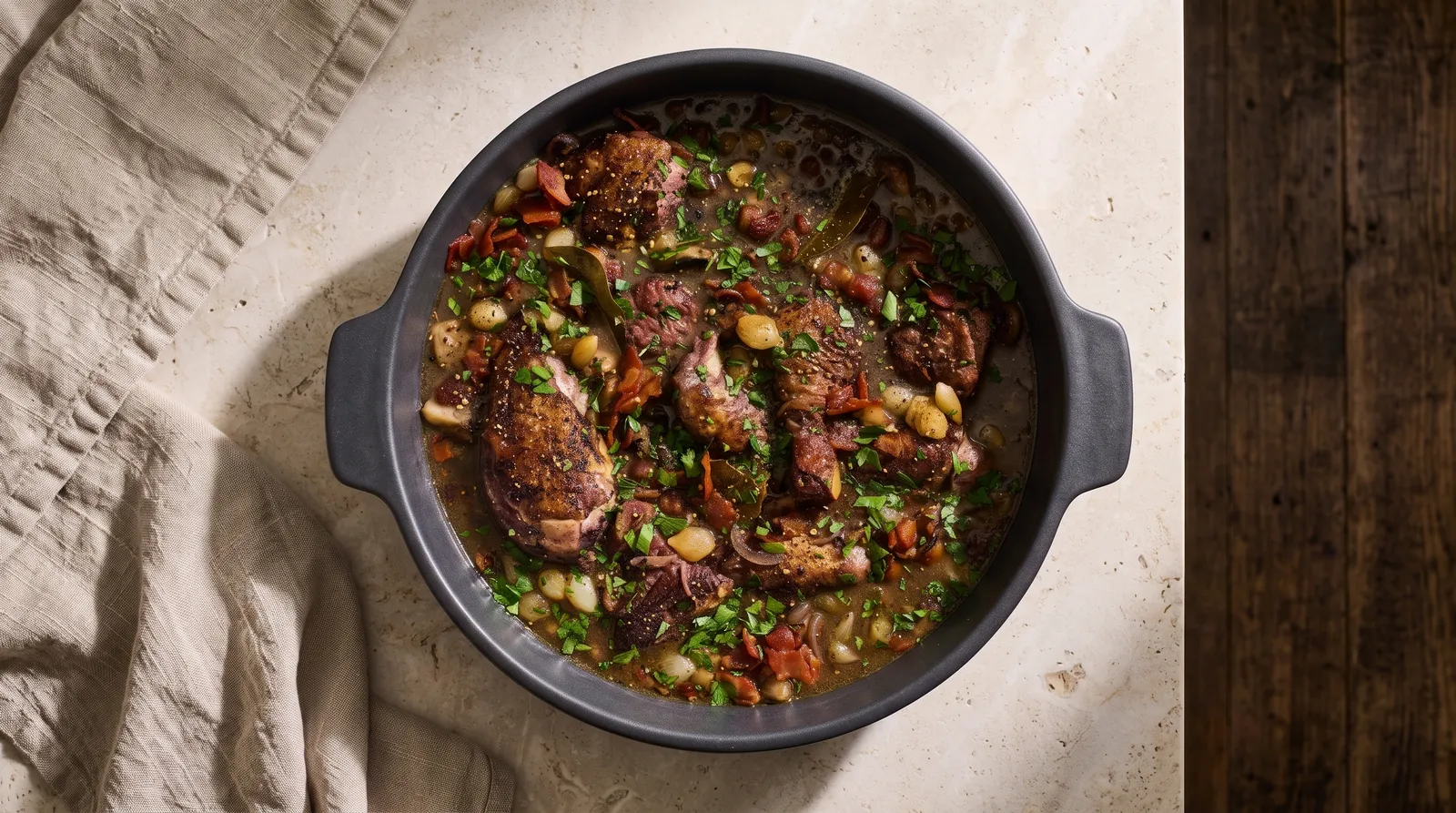
Coq au vin — shown in a cooking pot
Prep 45 minutes
Cook 195 minutes
Total 960 minutes
Yield 6 main-course portions
Introduction and overview

Coq au vin — classic red-wine braised rooster

Coq au vin stands apart from the beer, Riesling and Vin Jaune poultry braises through red wine, a cold marinade and a deep, flour-bound sauce. A mature rooster is used deliberately, because the connective tissue and stronger flavour justify the long covered cooking that the name historically implies.

The marinade is active flavouring but raw-poultry contact. After 12 refrigerated hours, the wine is strained and saved, then brought to a full boil once the browned coq and aromatics are back in the cocotte. The safety endpoint of 74 °C is checked before the meat is fully tender; the braise continues because texture, not safety, is now the limiting factor.

Classic garnish elements enter late. Lardons bring pork richness, button mushrooms keep a savoury bite, and pearl onions should become tender without dissolving. Removing the finished meat before the last sauce reduction is the easiest way to reach a glossy coating consistency without drying an already tender coq.
Success points

Success points

  • Keep the 12-hour wine marinade continuously refrigerated.
  • Boil the raw poultry marinade before the long braise.
  • Add mushrooms and pearl onions late enough that they stay intact.
Ingredients

Ingredients

Marinade and coq

  • 2600 g mature rooster (coq), jointed into serving pieces — Nutrition assumes about 55% cooked edible meat-and-skin yield, about 1,430 g.
  • 750 ml dry red Burgundy-style wine
  • 200 g carrot, thick slices
  • 200 g yellow onion, sliced
  • 80 g shallots, sliced
  • 10 g garlic, crushed
  • 60 g celery stalk, sliced
  • 1 bouquet garni, thyme, bay and parsley
  • 2 g black peppercorns, cracked

Braise and garnish

  • 40 ml olive oil
  • 40 g unsalted butter
  • 45 g plain wheat flour
  • 500 ml unsalted poultry stock
  • 200 g cured pork belly or thick lardons, 2 cm pieces — Use a lightly salted cured pork product; nutrition includes its sodium.
  • 250 g button mushrooms, halved
  • 250 g small pearl onions, peeled
  • 7 g fine salt
Method

Method

Marinate

  1. Build the red-wine marinade. Combine coq, wine, carrot, onion, shallot, garlic, celery, bouquet garni and peppercorns in a non-reactive container and cover. The coq pieces are fully surrounded by wine and aromatics. Keep raw poultry and wine marinade at 4 °C or below.

  2. Marinate cold. Refrigerate for 12 hours. Target temperature: 4 °C or below. The coq has marinated for 12 hours while remaining at 4 °C or below. The marinade remains raw until boiled in the sauce.

Cook

  1. Drain and dry. Strain the coq, reserving both wine and vegetables separately, then dry the poultry thoroughly. The poultry surface is dry and the wine and aromatic vegetables are separated for later use. Treat the marinade as raw poultry contact.

  2. Brown the coq. Heat olive oil and half the butter and brown the rooster pieces in batches. The coq has a deep even brown crust without burnt butter solids. Do not taste undercooked poultry.

  3. Sweat and flour the aromatics. Remove the coq, cook the drained vegetables until softened, then stir in the flour until it coats the vegetables. The vegetables are softened and the flour is lightly cooked with no dry white patches.

  4. Boil the wine and begin braising. Return the coq, pour in the reserved wine and stock, bring to a full boil, then cover and reduce to a gentle simmer. The raw marinade has reached a full boil before the covered braise. Alcohol does not completely evaporate.

  5. Slow-braise the mature coq. Keep at a quiet simmer for 90 minutes before adding the garnish components. Target temperature: 74 °C. The thickest coq pieces reach at least 74 °C without touching bone. The meat is beginning to relax from the bone but still needs the final garnish stage. All poultry must reach at least 74 °C.

  6. Add lardons, mushrooms and onions. Brown the lardons, mushrooms and pearl onions in the remaining butter, then add them to the cocotte and continue the covered braise. Target temperature: 74 °C. The pearl onions are tender but intact. The mushrooms are cooked through and the lardons are tender. The coq is fork-tender and still at least 74 °C.

  7. Finish the sauce. Transfer the coq and garnish to a warm dish and simmer the sauce uncovered until glossy and lightly coating. Target temperature: 74 °C. The red-wine sauce coats the back of a spoon in a smooth layer. The meat and garnish remain hot for service at 74 °C or above.

Practical guidance

Practical

Practical guidance

Serving: buttered noodles or boiled potatoes are useful because they absorb the sauce without competing with it.

Practical guidance

Make-ahead: marinate overnight and consider cooking the whole dish a day ahead; slow braises reheat well when handled safely.

Practical guidance

Storage: refrigerate promptly at 4 °C or below for up to 3 days.

Practical guidance

Reheating: bring meat and sauce to 74 °C over low heat; add a spoonful of water if the chilled sauce is too tight.

Practical guidance

Substitution: young chicken shortens the required tenderizing cook, so the timing and edible-yield calculation must change.

Troubleshooting

Troubleshooting

  • Issue 1Thin sauce after the bird is tender: reduce it without the meat. Floury taste: the flour was not cooked briefly with the vegetables before wine was added.
Nutrition per serving

Nutrition per serving

  • Serving size1 of 6 portions, about 240 g cooked edible coq plus garnish and sauce
  • Calories640 kcal
  • Carbohydrate17 g
  • Protein58 g
  • Fat31 g
  • Fibre3 g
  • Sodium980 mg
Allergens and food safety

Allergens and food safety

Allergens: Sulphites from red wine; Gluten from wheat flour; Celery; Milk from butter

Keep the raw poultry and wine marinade at 4 °C or below.

Fully boil any marinade reused in the braise.

Coq must reach at least 74 °C in the thickest meat without touching bone.

Red wine contains sulphites and alcohol; some alcohol may remain after the long cook.

Reheat leftovers to 74 °C.

FAQ

FAQ

Must the wine marinade be discarded because it touched raw poultry?

No, but it must be brought fully to the boil and thoroughly cooked before it can be part of the sauce.

Does the long braise remove all wine alcohol?

No. The nutrition calculation uses a low retained fraction rather than assuming zero.

Closing

Closing

  • Result: Classic garnish elements enter late.
  • Decisive technique: Keep the 12-hour wine marinade continuously refrigerated.