French Recipes

Colombo de cabri

Martinican-style colombo de cabri with a 24-hour lime-and-garlic marinade, Antillean colombo spice and a two-hour goat braise that separates the safety minimum from the tenderness endpoint.

French Recipes
Share
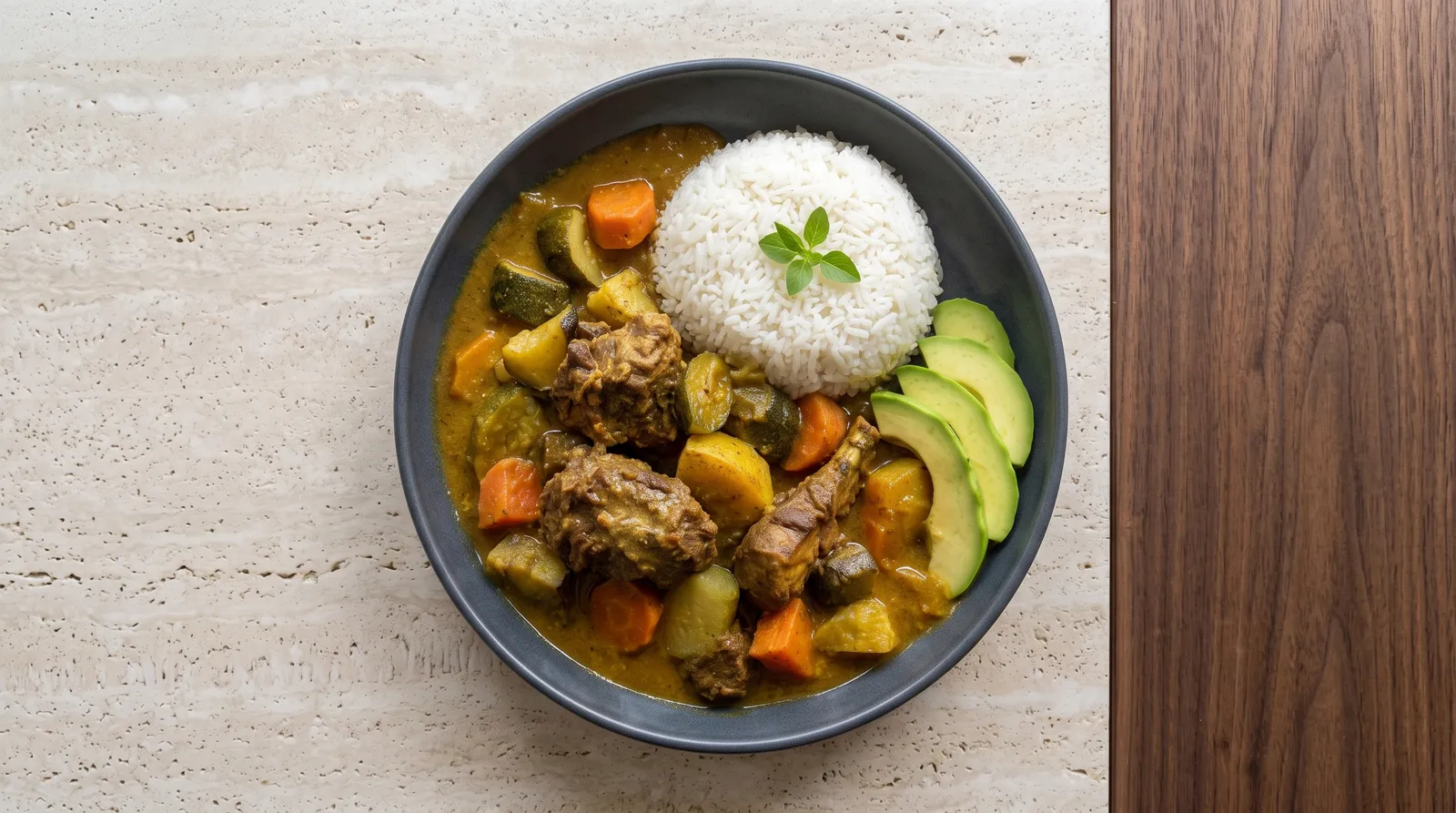
Colombo de cabri — served in a bowl
Prep 25 minutes
Cook 145 minutes
Total 1610 minutes
Yield 4 main-course portions
Introduction and overview

Colombo de cabri — Martinican goat colombo

Colombo de cabri belongs to the French Antillean family of dishes shaped by Indian spice traditions, but it should not be reduced to the label “goat curry.” The Martinican treatment here starts with lime, vinegar, garlic, cives and chilli, then uses a distinct colombo spice blend during cooking.

Goat shoulder is deliberately kept bone-in because that is a natural stewing form, but the nutrition arithmetic does not pretend the bone is edible. The 1,200 g purchased weight is converted to an estimated 840 g edible raw meat before composition values are applied. The long simmer does double duty: it fully cooks the raw marinade and softens a cut that would remain chewy at its minimum safe temperature.

The finished sauce should be aromatic and spoonable, not thickened like a flour gravy. Most of its body comes from reduction and the meat’s cooking juices. Rice is a straightforward accompaniment, while plantain, yam or christophine keeps the plate within a recognizable Martinican service context.
Success points

Success points

  • Use a real Antillean colombo blend rather than a generic curry powder.
  • Give the goat the full refrigerated marinade and the full tenderness braise; neither is interchangeable with the chicken timing.
  • Keep the final sauce loose enough to spoon but concentrated enough to coat the meat.
Ingredients

Ingredients

Goat and marinade

  • 1200 g bone-in young-goat shoulder, cut into 5 cm stewing pieces — Nutrition uses an estimated 70% raw edible-meat yield, about 840 g; bone is not consumed.
  • 90 ml fresh lime juice
  • 30 ml white wine vinegar
  • 15 g garlic, crushed
  • 120 g yellow onion, sliced
  • 60 g cives or spring-onion greens, chopped
  • 1 small fresh chilli, split but left whole for easier removal
  • 30 ml sunflower oil
  • 4 g fine salt
  • 2 g black pepper

Braise

  • 30 g Antillean colombo spice blend — A turmeric-forward colombo blend; generic curry powder is not identity-equivalent.
  • 1 bay or bois d’Inde leaf
  • 10 g fresh thyme and parsley, tied or coarsely chopped
  • 800 ml water
Method

Method

Marinate

  1. Marinate the cabri. Combine the goat with lime juice, vinegar, garlic, onion, cives, chilli, 15 ml oil, salt and pepper, cover, and turn the pieces so the seasoning reaches all sides. The goat pieces are evenly coated with citrus, aromatics and seasoning. Raw goat and marinade must stay away from ready-to-eat foods.

  2. Chill for 24 hours. Refrigerate the covered goat for the full marinade period. Target temperature: 4 °C or below. The goat has marinated for 24 hours while remaining at 4 °C or below. Marinade is not a substitute for cooking.

Cook

  1. Drain and prepare. Lift the goat from the marinade, reserve the marinade, and pat the pieces dry. The goat surfaces are dry enough to brown cleanly. Treat reserved marinade as raw until thoroughly cooked.

  2. Brown the goat. Heat the remaining 15 ml oil and brown the goat pieces on several sides. The goat is browned in patches without burning the marinade solids. Do not taste undercooked goat.

  3. Bloom the colombo spices. Add the drained aromatics and colombo spice, stirring over moderate heat until fragrant. The aromatics are softened and the colombo spice smells toasted rather than raw. Avoid scorching the spice powder.

  4. Braise gently. Add the reserved marinade, bay or bois d’Inde, herbs and 800 ml water, bring to a boil, then cover and simmer gently. Target temperature: 63 °C. The liquid has reached a boil before the long simmer. The goat reaches at least 63 °C, rests in the hot braise well beyond 3 minutes, and continues cooking until fork-tender. The meat pulls from the bone with light fork pressure. Whole-cut goat must reach at least 63 °C with at least a 3-minute rest; this stew continues cooking far longer.

  5. Concentrate the sauce. Remove the lid and simmer until the sauce is reduced enough to cling to the goat. Target temperature: 63 °C. The sauce lightly coats a spoon and the goat remains moist and tender. Keep the goat hot while reducing the sauce.

Practical guidance

Practical

Practical guidance

Serving: spoon the goat and sauce alongside rice, plantain, yam or another supported Antillean starch.

Practical guidance

Make-ahead: the 24-hour marinade is planned work; the cooked stew may also be made a day ahead.

Practical guidance

Storage: cool in shallow containers and refrigerate at 4 °C or below for up to 3 days.

Practical guidance

Reheating: bring leftovers to 74 °C while stirring the sauce gently around the pieces.

Practical guidance

Substitution: if using boneless goat, buy about 840 g and shorten only as tenderness dictates; do not replace the colombo blend with generic curry powder and claim the same identity.

Troubleshooting

Troubleshooting

  • Issue 1Tough goat: continue the covered simmer; the safety temperature does not guarantee tenderness. Bitter spice: the colombo powder or aromatics were scorched during blooming.
Nutrition per serving

Nutrition per serving

  • Serving size1 of 4 portions, about 330 g stew including bone-in pieces and sauce
  • Calories360 kcal
  • Carbohydrate18 g
  • Protein43 g
  • Fat12 g
  • Fibre4 g
  • Sodium680 mg
Allergens and food safety

Allergens and food safety

Allergens: No major regulated allergen is intrinsic to the listed ingredients; verify the commercial colombo blend for undeclared allergens.

Keep the lime-garlic goat marinade at 4 °C or below.

Fully cook any marinade that returns to the casserole.

Whole-cut goat has a 63 °C minimum with a 3-minute rest; this stew cooks much longer for tenderness.

Prevent raw-goat cross-contamination and reheat leftovers to 74 °C.

FAQ

FAQ

Why is the goat cooked long after it reaches 63 °C?

The thermometer threshold addresses safety for a whole cut; collagen-rich shoulder still needs extended moist heat to become tender.

Is colombo powder the same as curry powder?

No. Antillean colombo blends have their own spice balance, and a generic curry mix changes the dish’s profile.

Closing

Closing

  • Result: The finished sauce should be aromatic and spoonable, not thickened like a flour gravy.
  • Decisive technique: Use a real Antillean colombo blend rather than a generic curry powder.