French Recipes

Brochet au beurre blanc

Gently cooked pike served with a true shallot, white-wine and vinegar beurre blanc, with an honest Y-bone check, a 63 °C fish endpoint and careful low-temperature emulsification.

French Recipes
Share
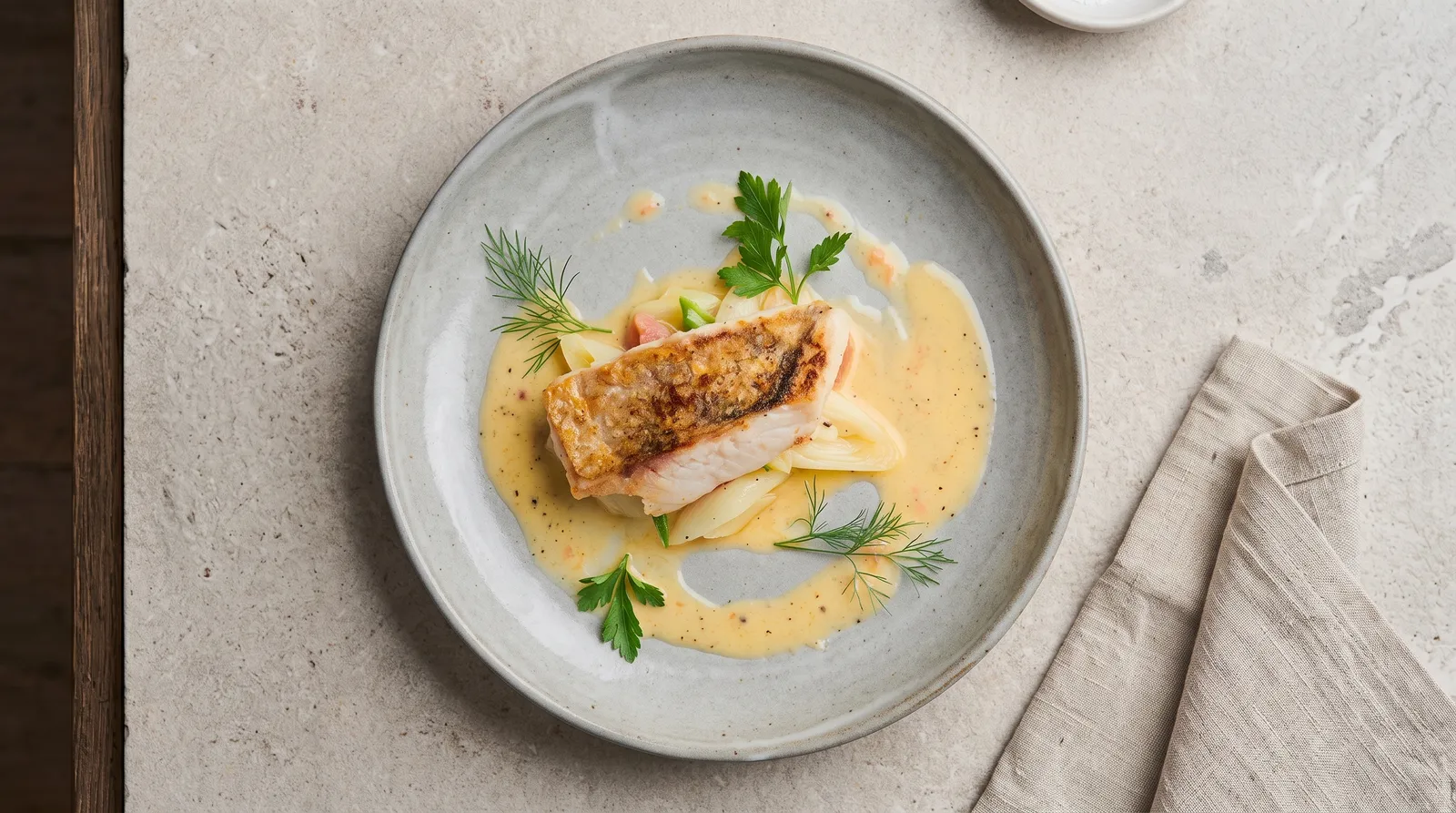
Brochet au beurre blanc — served on a plate
Cook 35 minutes after 30 minutes of active preparation
Passive 0 minutes, in addition to 35 minutes of cooking
Calories per serving 607 kcal; total elapsed time 65 minutes
Yield 4 pike portions with beurre blanc
Introduction and overview

Brochet au Beurre Blanc: Pike with Nantais-Style Butter Sauce

Brochet au beurre blanc brings together a Loire river fish and the butter sauce strongly associated with the Nantes area. The pike is deliberately handled as a lean fish that can dry out if boiled hard. It also has a practical complication: Y-shaped bones can remain in the flesh even after filleting. Careful trimming with tweezers reduces them, but the recipe still warns diners rather than promising a completely boneless result.

The fish is cooked in a light wine-and-aromatic liquor at gentle heat until the thickest point reaches 63 °C. That temperature is the safety control; moist opaque flakes are a quality cue. The beurre blanc is made separately from shallot, dry white wine and white wine vinegar reduced to a very small volume. Cold butter is then whisked in gradually so water and butterfat stay dispersed as an emulsion.

Temperature discipline is decisive for the sauce. The butter should melt into the reduction without the mixture boiling, and the finished sauce is kept roughly between 50 and 60 °C. At that point it should be opaque, glossy and just thick enough to coat the back of a spoon. It is not a sauce to prepare hours ahead or hold on a buffet: pair it with the fish and serve immediately.
Success points

Success points

  • Check every pike portion for Y-bones while it is cold and easy to handle.
  • Poach gently; a hard boil tightens the lean fish and makes the portions fragile.
  • Reduce the wine-vinegar base to a shallow syrupy amount, then whisk in cold butter below boiling.
Ingredients

Ingredients

Pike

  • 720 g pike fillet portions, skinless; obvious Y-bones removed as far as practical
  • 200 ml dry white wine, for the fish cooking liquor
  • 300 ml water
  • 80 g carrot, thinly sliced
  • 80 g onion, thinly sliced
  • 4 g thyme and bay, tied together
  • 3 g fine salt

Beurre blanc

  • 100 ml dry white wine
  • 40 ml white wine vinegar
  • 60 g shallot, very finely chopped
  • 200 g unsalted butter, very cold, cut into 2 cm cubes
  • 2 g fine salt
Method

Method

Fish

  1. Check the pike for bones. Inspect every pike portion carefully with fingertips and tweezers and remove any palpable Y-bones; keep the fish chilled while the cooking liquor is prepared. Continue for about 10 minutes. Temperature target: 4 °C. No obvious hard Y-bone can be felt along the exposed flesh, although diners should still be warned that fine bones can remain. Pike's Y-bones cannot be ignored simply by calling a fillet boneless. Keep raw fish at 4 °C or below.

  2. Poach gently. Bring the 200 ml wine, water, carrot, onion, herbs and 3 g salt to a gentle simmer, then lower the pike into the liquor and cook without a vigorous boil. Continue for about 12 minutes. Temperature target: 82 °C. The fish turns opaque and separates into moist flakes with gentle pressure. The thickest part of each portion reaches 63 °C. Gentle heat limits tightening and breakage of the lean pike. Cook fish to 63 °C at the thickest point.

Beurre blanc

  1. Concentrate the shallot reduction. Boil the 100 ml wine, vinegar and shallot until the liquid is reduced to roughly 25 ml and the shallots are fully softened. Continue for about 8 minutes. Only a shallow, syrupy acidic reduction remains around the softened shallot. A concentrated acidic base supplies enough water and acidity to disperse the butterfat.

  2. Mount the beurre blanc. Take the pan off direct heat and whisk in the cold butter a few cubes at a time, returning to very low heat only as needed to keep the sauce between 50 and 60 °C; add the remaining 2 g salt. Continue for about 10 minutes. The beurre blanc is glossy, opaque and lightly coats the back of a spoon without visible melted butter pooling. Cold butter and restrained heat build and preserve the emulsion. Do not let the finished sauce exceed about 65 °C or boil.

  3. Sauce and serve. Drain the pike briefly, spoon the beurre blanc over it and serve at once. Continue for about 5 minutes. Temperature target: 55 °C. The fish is still hot and moist and the sauce remains glossy rather than oily or split. Beurre blanc is at its best immediately after emulsifying. Do not hold the sauce warm for an extended period; keep any brief hold near 55 °C and serve promptly.

Practical guidance

Practical

Practical guidance

Warm the plates before the final sauce step so the beurre blanc does not chill instantly on contact. Spoon sauce over the fish rather than leaving it standing in a deep pool.

Practical guidance

Pike can be portioned and checked for bones earlier in the day if it remains refrigerated at 4 °C or below. The acidic shallot reduction can also be prepared shortly ahead, but mount the butter only immediately before service.

Practical guidance

Cooked fish can be refrigerated promptly for later use, but beurre blanc does not reheat reliably: its emulsion can split. If leftovers remain, store fish and sauce cold and expect a changed sauce texture rather than repeatedly reheating it.

Practical guidance

Another firm white fish can use the same beurre blanc technique, but changing the fish means the dish is no longer brochet au beurre blanc and the cooking time must follow the new fillet thickness.

Troubleshooting

Troubleshooting

  • The beurre blanc turns oily.The sauce became too hot or the butter was added too quickly. Remove it from the heat and whisk steadily; prevention is more reliable than trying to recover a fully split sauce.
  • The pike becomes dry.The poaching liquid boiled vigorously or the fish was held too long. Maintain gentle heat and stop when the thickest part reaches 63 °C.
Nutrition per serving

Nutrition per serving

  • Serving size1 of 4 fish-and-sauce portions
  • Calories607 kcal
  • Carbohydrate8 g
  • Protein36 g
  • Fat42 g
  • Fibre1 g
  • Sodium608 mg
Allergens and food safety

Allergens and food safety

Allergen note: Fish

Allergen note: Milk

Allergen note: Sulphites from white wine

Safety: Keep raw pike at 4 °C or below and avoid cross-contact with ready-to-eat food.

Safety: Cook fish to 63 °C at the thickest point.

Safety: Refrigerate cooked fish promptly; do not treat beurre blanc as shelf-stable.

Frequently asked questions

Frequently asked questions

Why did my beurre blanc split?

Excess heat or adding butter too quickly leaves visible fat. Keep the pan off direct heat for most of the addition and return it to very low heat only when necessary.

Can pike be guaranteed bone-free?

No. Y-bones are a known practical issue. Remove palpable bones carefully and still alert diners that fine bones may remain.

Closing

Closing

  • Result — moist pike with a bright, glossy shallot beurre blanc that lightly coats each portion.
  • Decisive technique — keep both the fish cooking and the butter emulsion gentle, and serve the sauce as soon as it is mounted.