French National Dishes

Bûche de Noël

A French Christmas log made from a thin rolled sponge and one coherent chocolate French buttercream, with warm rolling, controlled filling temperature and a two-hour final chill.

French National Dishes
Share
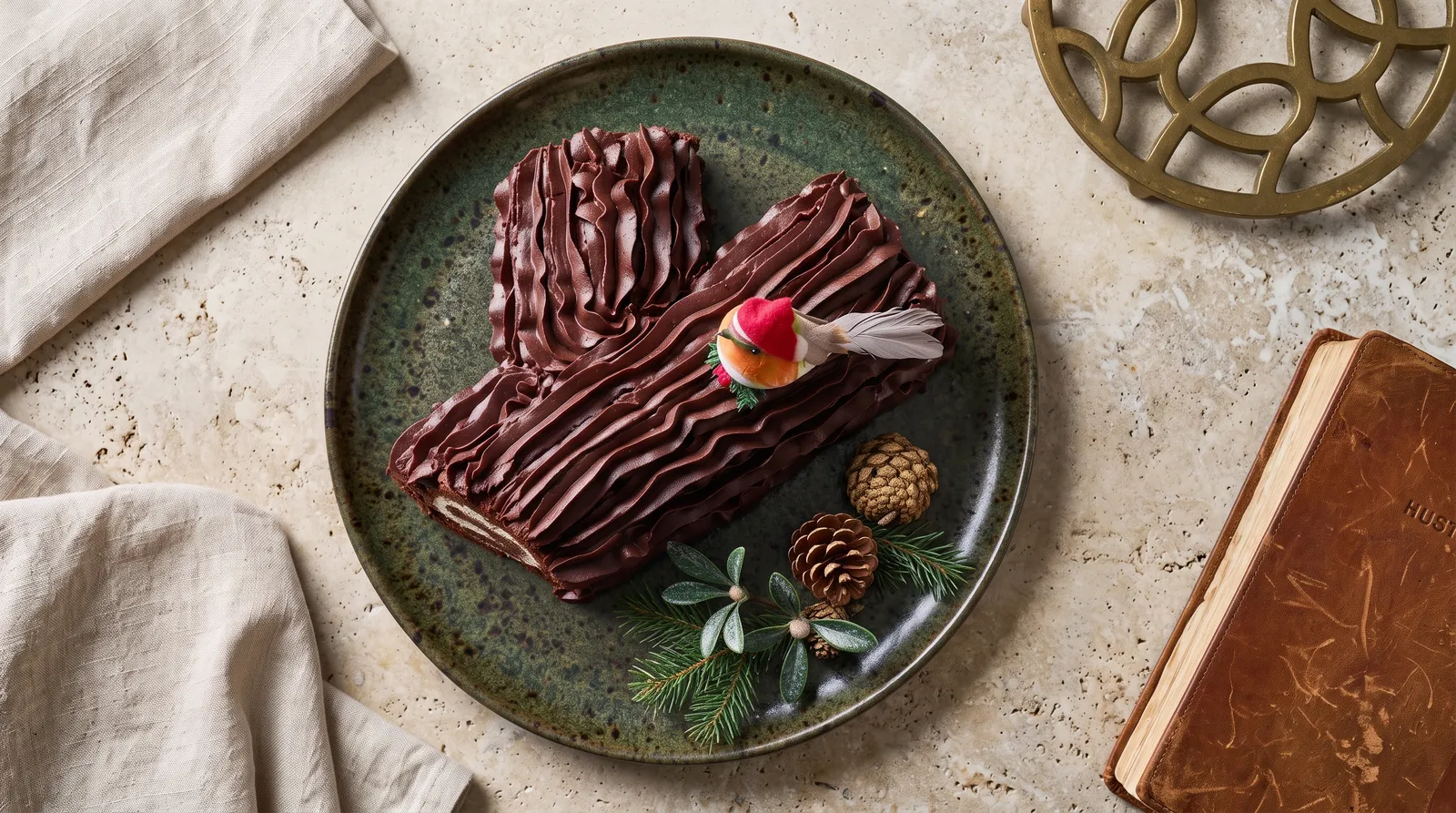
Bûche de Noël — shown whole after baking
Cook 20 minutes after 60 minutes of active preparation
Passive 150 minutes, in addition to 20 minutes of cooking
Calories per serving 372 kcal; total elapsed time 230 minutes
Yield 1 rolled log, about 10 slices
Introduction and overview

Classic Rolled Bûche de Noël with Chocolate Buttercream

A rolled Bûche de Noël is built around a simple visual idea: a thin sponge is rolled into a log and coated so its surface resembles bark. The success of that shape depends less on decoration than on the relationship between sponge flexibility, filling temperature and timing. Here the cake is baked on a 30 × 40 cm tray, rolled while warm, cooled in that curve and filled only after the sponge is completely cool.

The sponge is aerated with whipped whole eggs and sugar rather than chemical leavening. It bakes for only about 10 minutes at 180 °C, just until springy and lightly coloured. Overbaking is the common route to cracking because the thin sheet loses moisture quickly. Rolling it immediately in clean paper teaches the sponge its spiral while it is still flexible, then a 30-minute cooling period prevents the buttercream from melting on contact.

The filling and exterior are the same chocolate French buttercream. A sugar syrup cooked to 118 °C is streamed into pasteurized egg yolks, then softened butter and lukewarm dark chocolate are incorporated once the mixture is no longer hot. This keeps one consistent cream from centre to bark. After rerolling and scoring the coating with a fork, a two-hour chill firms the log enough for clean slices without turning the buttercream permanently hard.
Success points

Success points

  • Bake the sponge only until springy; colour is secondary to flexibility.
  • Roll the sheet while warm, but never spread buttercream on a warm sponge.
  • Keep the butter, chocolate and whipped yolk base close enough in temperature to emulsify smoothly.
Ingredients

Ingredients

Sponge

  • 200 g whole egg, room temperature
  • 120 g caster sugar
  • 100 g plain wheat flour, sifted
  • 20 g unsalted butter, melted and cooled

Chocolate buttercream

  • 220 g unsalted butter, soft, about 20–22 °C
  • 120 g caster sugar
  • 40 ml water
  • 60 g pasteurized egg yolk, cool
  • 80 g dark chocolate, melted and cooled to lukewarm
Method

Method

Sponge

  1. Build the egg foam. Whisk the 200 g whole egg and 120 g sugar until very pale, thick and voluminous, then fold in the sifted flour and finally the cooled melted butter without deflating the foam. Continue for about 15 minutes. The egg foam falls from the whisk in a broad ribbon that remains visible on the surface for several seconds. The finished batter is even with no dry flour pockets. The aerated egg foam supplies most of the sponge's lift.

  2. Bake the thin sponge. Spread the batter evenly in the lined 30 × 40 cm tray and bake just until the thin sponge is set and lightly coloured. Continue for about 10 minutes. Temperature target: 180 °C. The sponge springs back lightly when touched and the edges are just beginning to colour without becoming crisp. A flexible sponge must not be overbaked.

  3. Roll while warm. Turn the hot sponge onto clean baking paper, peel away the baking liner and roll it up from a short side while still warm. Continue for about 5 minutes. The warm sponge forms a compact spiral without broad surface cracks. Rolling while warm trains the sponge into the final curve before it sets.

  4. Cool in the spiral. Cool the rolled sponge completely in its rolled shape. Leave it for 30 minutes. The roll is fully cool to the touch before any buttercream is applied. Warm cake would melt the buttercream.

Buttercream and assembly

  1. Cook the sugar syrup. Boil the 120 g sugar with 40 ml water to 118 °C; while whisking the pasteurized yolks, pour in the syrup in a thin stream and continue whipping until the mixture is thick and no longer hot. Continue for about 10 minutes. The yolk mixture becomes pale and thick and the mixer bowl feels only slightly warm rather than hot. The hot syrup creates a stable pâte-à-bombe-style base; pasteurized yolks add an extra safety margin. Avoid splashing hot syrup and keep it away from skin.

  2. Emulsify the chocolate buttercream. Beat in the softened butter gradually, then mix in the melted chocolate once both components are close to room temperature. Continue for about 10 minutes. Temperature target: 22 °C. The buttercream is smooth, glossy and spreadable with no greasy puddles or curdled grains. Similar ingredient temperatures reduce the chance of splitting.

  3. Fill and coat the log. Unroll the cooled sponge gently, spread a level layer of buttercream over it, reroll without crushing, then coat the outside with the remaining buttercream and score bark lines with a fork. Continue for about 20 minutes. The log holds a tight spiral, the filling stays inside the roll and the outer coating is even enough to mark with bark-like lines. An even filling limits bulges and cracking during rerolling.

  4. Chill for clean slices. Refrigerate the finished log until the buttercream is firm enough to slice cleanly. Leave it for 120 minutes. Temperature target: 4 °C. The coating is firm but not rock-hard and a chilled knife cuts defined slices without smearing the spiral. Chilling stabilizes the buttercream and the rolled structure. Keep the dairy-and-egg buttercream at 4 °C or below.

Practical guidance

Practical

Practical guidance

Remove the log from the refrigerator about 15 minutes before slicing. The coating should soften slightly while the inner spiral remains defined.

Practical guidance

The whole cake can be assembled one day ahead and kept covered at 4 °C or below. This is preferable to making the buttercream far in advance and reheating it.

Practical guidance

Store refrigerated and use within 3 days. The dessert is intended to be served chilled to cool room temperature; reheating would melt the buttercream and distort the roll.

Practical guidance

Dark chocolate around 60–70% cocoa keeps the buttercream balanced. A much darker chocolate makes the cream firmer and less sweet, so the texture will not be identical.

Troubleshooting

Troubleshooting

  • The sponge cracks badly.It was overbaked, allowed to cool flat or rolled after it had set. Bake only to springy doneness and roll immediately while warm.
  • The buttercream looks curdled.The components were at very different temperatures. Let the mixture move toward a moderate room temperature and continue beating until it emulsifies.
Nutrition per serving

Nutrition per serving

  • Serving size1 of 10 slices
  • Calories372 kcal
  • Carbohydrate36 g
  • Protein5 g
  • Fat24 g
  • Fibre1 g
  • Sodium41 mg
Allergens and food safety

Allergens and food safety

Allergen note: Wheat (gluten)

Allergen note: Egg

Allergen note: Milk

Safety: Use pasteurized egg yolks for the buttercream.

Safety: Keep the finished cake at 4 °C or below and limit unrefrigerated display time.

Safety: Handle the 118 °C sugar syrup with care; it can cause severe burns.

Frequently asked questions

Frequently asked questions

How do I stop the sponge cracking?

Avoid overbaking and roll the sponge while it is still warm and flexible. Cooling it flat first makes a tight spiral much harder to form.

Why does buttercream look curdled?

The components are usually at incompatible temperatures. Let the mixture move toward moderate room temperature and continue beating until the emulsion smooths out.

Closing

Closing

  • Result — a neat spiral of tender sponge and chocolate buttercream under a firm, fork-textured bark coating.
  • Decisive technique — roll the sponge warm, cool it in shape, then fill only when cake and buttercream temperatures are compatible.