French National Dishes

Bugnes lyonnaises

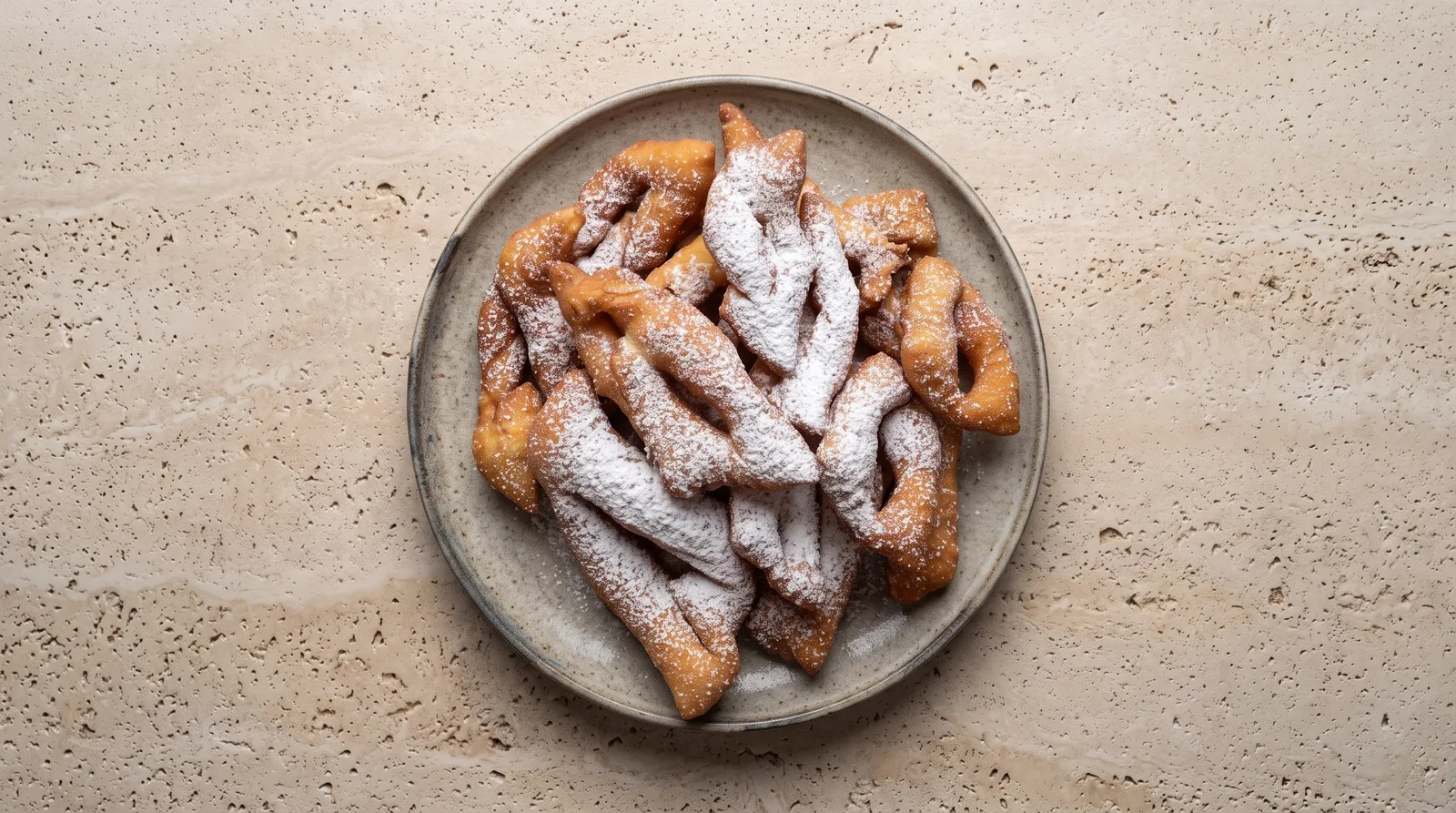
Lyonnais bugnes in the thin, crisp style: citrus-and-rum dough rested cold, rolled to about 1 mm, slit and twisted, then fried at 170 °C and dusted after cooling.

French National Dishes
Share
Bugnes lyonnaises — served in a bowl
Cook 24 minutes after 40 minutes of active preparation
Passive 75 minutes, in addition to 24 minutes of cooking
Calories per serving 445 kcal; total elapsed time 139 minutes
Yield about 40 thin bugnes, 10 servings of 4
Introduction and overview

Thin and Crisp Bugnes Lyonnaises

Bugnes have more than one recognised texture, and the distinction matters before the dough is mixed. This recipe follows the thin, crisp Lyonnais style rather than a soft yeast-raised version. The dough is rich with butter and egg, scented with citrus zest and a small amount of dark rum, then rested cold and rolled until the edges are almost translucent. That thinness is what gives the fried pastry its brittle snap.

The traditional-looking shape is practical as well as decorative. Pieces are cut into diamonds or rectangles, a slit is made through the centre and one end is pulled through to form a loose twist. Very thick pieces stay cakier and can brown before the centre dries. About 1 mm is the target thickness, and the pieces should be reasonably uniform so a small frying load can finish at the same time.

Frying is controlled at 170 °C. The bugnes are cooked in modest loads, turned once and removed when blistered and pale golden rather than dark brown. The 2 litres of peanut oil listed are fryer supply, not an ingredient assumed to be eaten in full. Nutrition therefore uses a stated 70 g retained-oil estimate for the whole batch, which is far more defensible than assigning the entire fryer to the pastries.
Success points

Success points

  • Choose the thin crisp style and roll close to 1 mm; do not combine it with yeast-raised bugne instructions.
  • Return the oil to 170 °C before each frying load.
  • Drain and cool before icing sugar so the finish stays dry instead of dissolving into hot oil.
Ingredients

Ingredients

Dough

  • 500 g plain wheat flour
  • 200 g unsalted butter, soft
  • 200 g whole egg, beaten
  • 40 g caster sugar
  • 10 g baking powder
  • 15 ml dark rum
  • 10 g lemon and orange zest, finely grated
  • 4 g fine salt

Frying and finish

  • 2000 ml peanut oil, for the fryer; only an estimated 70 g is retained in nutrition
  • 30 g icing sugar, for dusting
Method

Method

Dough and shaping

  1. Mix the crisp-style dough. Mix the flour, baking powder, sugar, salt and citrus zest; add the egg, rum and butter and work just until the dough is uniform. Continue for about 15 minutes. The dough is smooth enough to hold together and shows no streaks of butter or dry flour. Overworking is unnecessary for a thin, crisp result.

  2. Rest it cold. Rest the dough covered in the refrigerator before rolling. Leave it for 60 minutes. Temperature target: 4 °C. The dough is cool and firm enough to roll very thin without sticking excessively. Chilling firms the butter and relaxes the dough. Keep the egg-rich dough refrigerated during the rest.

  3. Roll, cut and twist. Roll the dough in portions to about 1 mm thick, cut roughly 10 cm diamonds or rectangles, make a central slit in each and pull one end through the slit. Continue for about 25 minutes. The pieces are thin enough to look slightly translucent at the edges and the central twist holds its shape. Thin, even pieces fry crisp instead of staying bready.

Frying

  1. Fry at controlled heat. Heat the peanut oil to 170 °C and fry the bugnes in small batches, turning once, for about 3 minutes per batch; repeat with the remaining pieces while returning the oil to temperature between batches. Continue for about 24 minutes total frying sequence. Each bugne is blistered and pale golden with crisp edges rather than dark brown. The oil returns to 170 °C before each new batch. Small loads limit temperature drop and greasy absorption. Keep water away from the hot oil and never leave the fryer unattended.

  2. Drain, cool and dust. Drain the fried bugnes on a rack or absorbent paper and cool before dusting with icing sugar. Leave it for 15 minutes. The surface feels dry and crisp and the sugar stays powdery instead of dissolving into hot oil. Cooling before dusting gives a cleaner finish.

Practical guidance

Practical

Practical guidance

Bugnes are best the day they are fried, after enough cooling for the shell to crisp. Dust just before serving if a clean white surface is wanted.

Practical guidance

The rested dough can wait covered in the refrigerator for several hours. Roll only as much as can be cut and fried without leaving thin raw pieces drying on the worktop for a long period.

Practical guidance

Cool completely before placing in an airtight container. They can be kept at room temperature for up to 2 days; a short low-oven refresh can dry a softened surface, but let them cool again before adding fresh icing sugar.

Practical guidance

A neutral high-heat frying oil can replace peanut oil if peanut is unsuitable. Flavour and allergen status change, so the result should not be described as nutritionally identical.

Troubleshooting

Troubleshooting

  • The bugnes are soft and bready.The dough was rolled too thick. Roll the next portion close to 1 mm before cutting.
  • The pastries feel greasy.The oil temperature dropped too far or the pan was overcrowded. Return the oil to 170 °C and fry fewer pieces at once.
Nutrition per serving

Nutrition per serving

  • Serving size4 bugnes (1 of 10 servings)
  • Calories445 kcal
  • Carbohydrate45 g
  • Protein8 g
  • Fat25 g
  • Fibre2 g
  • Sodium190 mg
Allergens and food safety

Allergens and food safety

Allergen note: Wheat (gluten)

Allergen note: Egg

Allergen note: Milk

Allergen note: Peanut if peanut oil is used

Safety: Keep the egg-rich dough refrigerated during the rest.

Safety: Hot frying oil can cause severe burns; use a deep stable pan and keep moisture away.

Safety: Cool completely before sealing for storage.

Frequently asked questions

Frequently asked questions

Why are my bugnes soft rather than crisp?

The dough is usually too thick or the pastries were sealed before cooling. Roll close to 1 mm and let steam escape before storage.

Why are they greasy?

Cold oil and overcrowding increase absorption. Fry smaller loads and wait for the oil to return to 170 °C before continuing.

Closing

Closing

  • Result — thin, blistered, pale-golden bugnes with crisp edges, citrus aroma and a dry veil of icing sugar.
  • Decisive technique — roll very thin and protect the 170 °C frying temperature from one load to the next.