French Recipes

Brioche vendéenne

A tender Vendée-style braided brioche scented with orange-blossom water and a small measure of grape eau-de-vie, with careful mixing, proofing and three-strand shaping.

French Recipes
Share
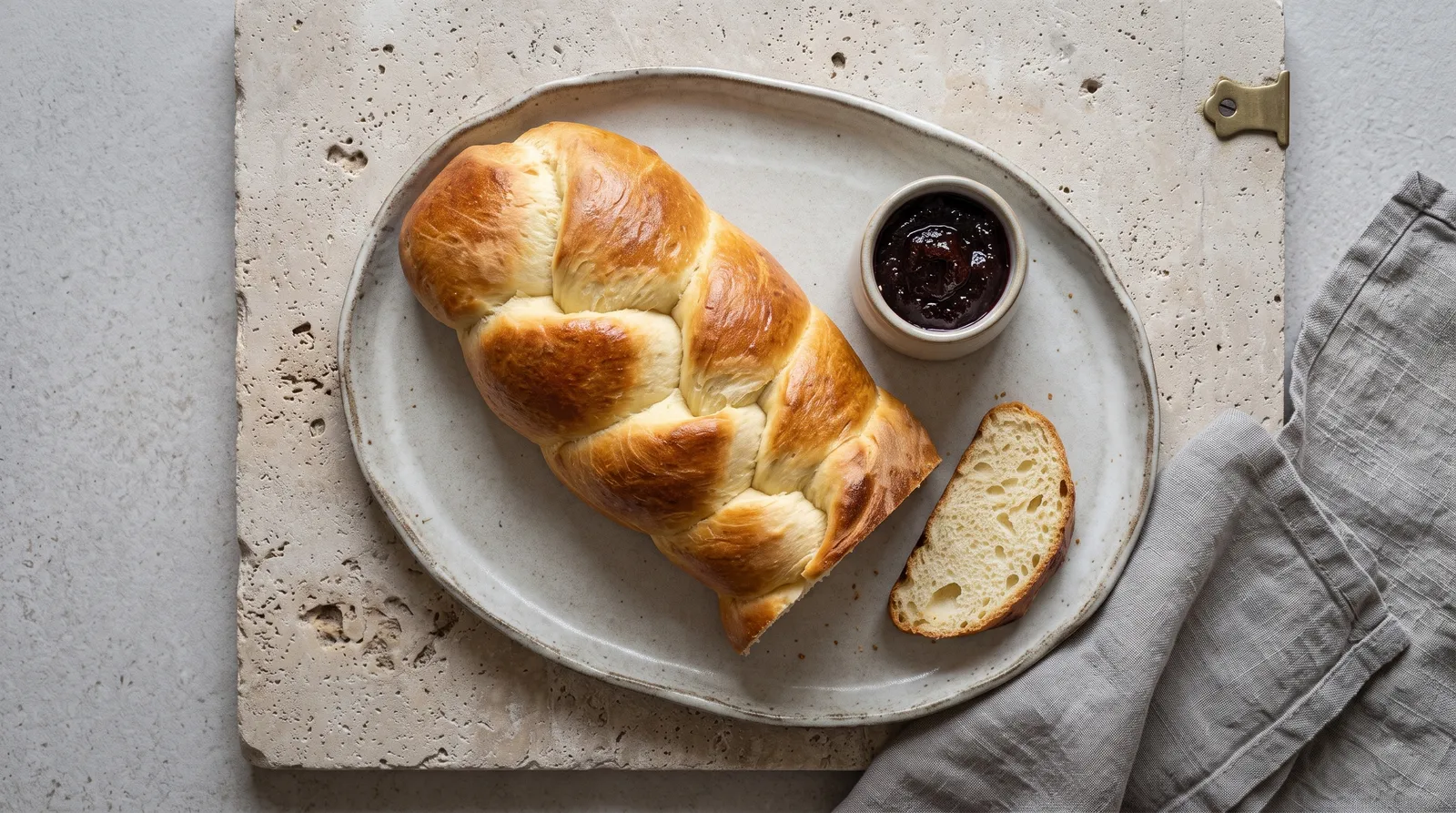
Brioche vendéenne — resting on a cooling rack
Cook 35 minutes after 45 minutes of active preparation
Passive 225 minutes, in addition to 35 minutes of cooking
Calories per serving 322 kcal; total elapsed time 305 minutes
Yield 1 large three-strand braid, about 12 slices
Introduction and overview

Brioche Vendéenne-Style Three-Strand Braid

Brioche vendéenne belongs to the baking traditions of Vendée and is also the name of a protected IGP product when it is made under the registered specification. A home loaf can respect the recognisable character of the regional bread without implying certification. The visual cue is a generous braid with a glossy golden surface; the aromatic profile is richer than a plain breakfast loaf, with dairy, egg, butter and restrained floral and spirit notes.

This home dough combines strong white flour with eggs, butter, milk and crème fraîche, then adds orange-blossom water and a modest amount of grape eau-de-vie. The butter goes in only after the dough has begun to gain elasticity. That sequence matters because the braid needs enough internal strength to rise upward rather than relax into a flat, greasy loaf. The first rise builds gas; the second takes place after three equal strands have been braided.

Braiding is intentionally simple: three strands of equal length and thickness, crossed with enough slack for expansion. Pulling the braid tight creates weak points that can tear as the enriched dough proofs. The loaf is ready for the oven when it is close to doubled and a gentle fingertip press returns slowly. Baking at 170 °C gives the centre time to set before the sugar-and-egg glaze becomes too dark.
Success points

Success points

  • Develop the dough before adding the butter in stages.
  • Make all three strands as equal as possible and braid with moderate slack.
  • Treat IGP status as a certification boundary: a household loaf is not automatically a certified Brioche vendéenne product.
Ingredients

Ingredients

Dough and glaze

  • 500 g strong white wheat flour, about 11.5–13% protein
  • 200 g whole egg, beaten
  • 150 g unsalted butter, soft but not oily
  • 100 g whole milk, lukewarm
  • 100 g caster sugar
  • 30 g crème fraîche, full-fat
  • 20 g fresh baker's yeast, crumbled
  • 15 g orange-blossom water
  • 15 g eau-de-vie, plain grape brandy or Cognac-style spirit
  • 8 g fine salt
  • 50 g whole egg, beaten, for glaze
Method

Method

Dough

  1. Bring the dough together. Mix the flour, 200 g egg, milk, crème fraîche, yeast, sugar, orange-blossom water, eau-de-vie and salt into a cohesive dough. Continue for about 8 minutes. The mixture forms one cohesive, sticky dough with no dry flour. A uniform dough is needed before the butter is incorporated.

  2. Build strength and add butter. Knead to build elasticity, then add the butter in several additions and continue until smooth and strong. Continue for about 17 minutes. The dough stretches thinly without tearing at once and looks satiny rather than greasy. Strong gluten supports the long braided loaf.

  3. Complete the first rise. Rest the dough covered until clearly expanded but not collapsed. Leave it for 90 minutes. Temperature target: 24 °C. The dough is about one and a half times its starting volume and feels aerated when pressed gently. A controlled first rise develops gas without over-softening the braid.

Braid and bake

  1. Form three equal strands. Divide the dough into three equal pieces, roll each into an even strand and braid loosely enough to leave room for expansion; tuck both ends underneath. Continue for about 15 minutes. The three strands are similar in thickness and the braid has even crossings from end to end. Even strands bake at the same rate.

  2. Complete the final rise. Rest and proof the braid until puffy and visibly enlarged, then brush gently with the 50 g beaten egg. Leave it for 90 minutes. Temperature target: 24 °C. The braid is close to doubled in volume and a light press returns slowly without leaving a deep dent. The glaze is added after proofing so the surface is not torn by handling.

  3. Bake evenly. Bake until the braid is glossy golden-brown and baked through. Continue for about 35 minutes. Temperature target: 170 °C. The crust is a deep even gold and the loaf feels light for its size when lifted carefully. The thickest central section is set rather than doughy. Moderate heat protects the rich sweet crust from darkening before the centre is done.

  4. Cool the loaf. Cool completely on a rack before slicing. Leave it for 45 minutes. The centre has cooled enough to slice cleanly without compressing the crumb. Cooling preserves the tender fibrous crumb.

Practical guidance

Practical

Practical guidance

Slice only after the braid has cooled. The tender crumb is suited to breakfast or afternoon service and does not need a heavy topping.

Practical guidance

The dough can be mixed earlier in the day, but the stated rise schedule should remain tied to volume and dough feel rather than the clock alone.

Practical guidance

Wrap the cooled braid closely and keep it at room temperature for up to 2 days. It also freezes well once fully cool; thaw wrapped and warm only briefly if a softer crust is wanted.

Practical guidance

A neutral grape eau-de-vie may stand in for a Cognac-style spirit at the same amount. The exact aroma changes, and the substitution does not create or preserve any certification claim.

Troubleshooting

Troubleshooting

  • The braid spreads instead of rising.The dough is too warm or underdeveloped. Build stronger gluten and keep the dough cool enough to hold distinct strands.
  • The surface tears during proofing.The braid was pulled too tight. Form even strands and braid with modest slack.
Nutrition per serving

Nutrition per serving

  • Serving size1 of 12 slices
  • Calories322 kcal
  • Carbohydrate41 g
  • Protein8 g
  • Fat14 g
  • Fibre1 g
  • Sodium299 mg
Allergens and food safety

Allergens and food safety

Allergen note: Wheat (gluten)

Allergen note: Egg

Allergen note: Milk

Safety: Raw egg and raw flour require normal raw-baking hygiene; do not taste the uncooked dough.

Safety: Cool the loaf before wrapping so trapped condensation does not make the surface wet.

Frequently asked questions

Frequently asked questions

Does a home-baked loaf count as IGP Brioche vendéenne?

No certification claim should be made unless the product was made under the registered scheme. The home loaf can instead be described accurately as Vendée-style.

Why did the braid split?

A tight braid, uneven strands or underdeveloped gluten can concentrate stress. Give the strands room to expand and proof until puffy rather than forcing the crossings.

Closing

Closing

  • Result — a glossy, soft three-strand brioche with a fine enriched crumb and measured floral-spirit aroma.
  • Decisive technique — build elasticity before adding butter, then proof an evenly formed braid with enough slack to expand.