French Recipes

Bréchets de poulet à la persillade

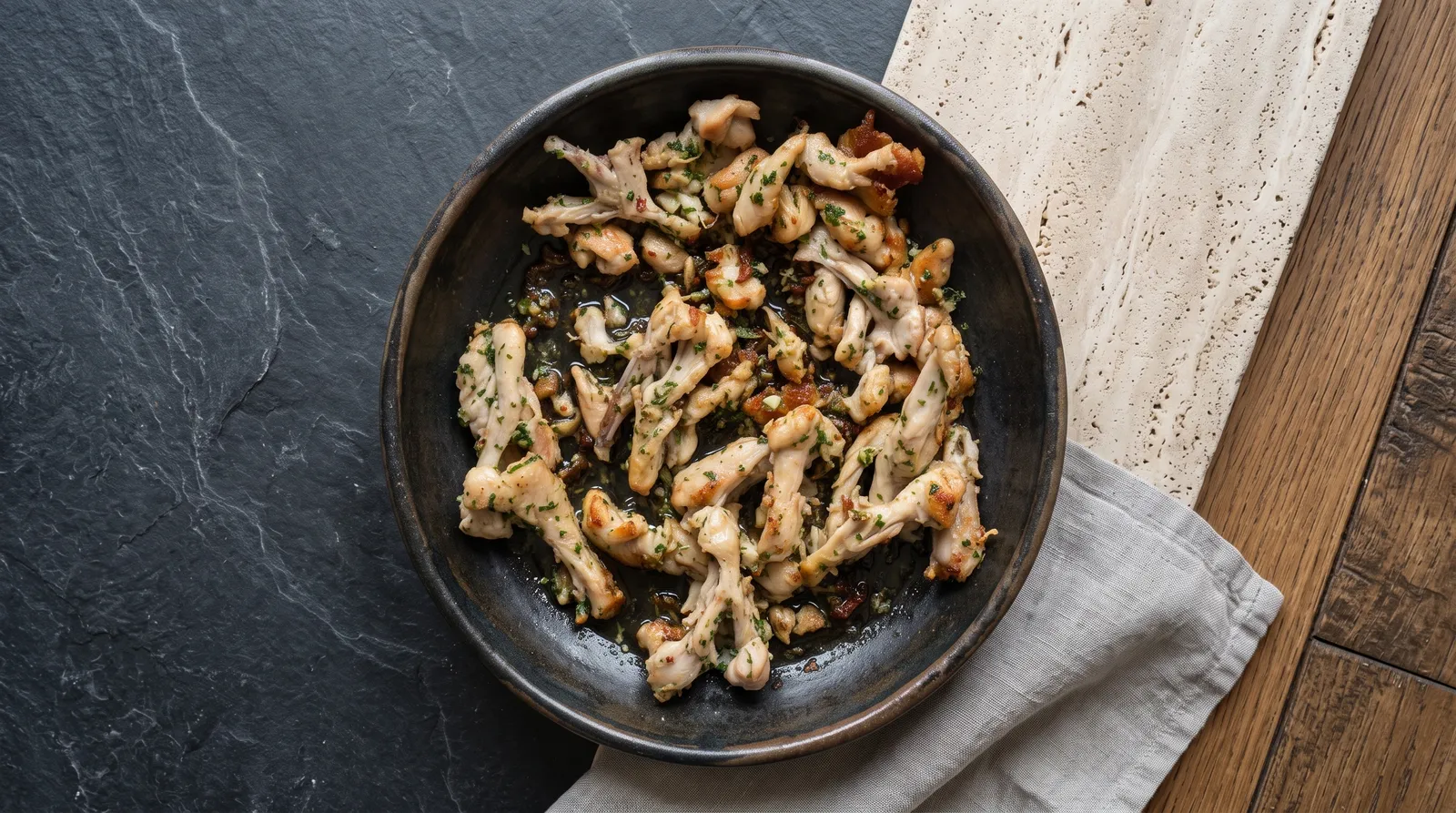
Real chicken bréchets—the small V-shaped wishbone/clavicle cut—lightly floured, browned in butter in two counted batches to 74 °C and finished with fresh garlic-parsley persillade.

French Recipes
Share
Bréchets de poulet à la persillade — shown in a pan
Prep 20 minutes
Cook 25 minutes
Total 45 minutes
Yield 4 main-course servings
About this dish

Bressan chicken bréchets with garlic-parsley butter

The defining ingredient in this Bressan speciality is anatomical, not merely stylistic. A bréchet is the V-shaped wishbone or clavicle above the chicken breast. It carries a small amount of meat and is traditionally cooked and eaten around the bone. Boneless chicken chunks may be easier to buy, but relabelling them as bréchets would erase the very feature that makes the dish distinctive.

The local method is direct: dry the pieces, give them a light flour coating, and sauté them in butter until well browned. A full kilogram will crowd an ordinary pan, so this recipe uses two batches and counts both in the cooking time. Check the meaty portions of each batch for 74 °C rather than trusting brown colour alone, then move them to a warm platter so they do not continue drying while the second batch cooks.

Persillade comes last. Melt the final butter until foamy, add finely chopped garlic and parsley just long enough to release their aroma, then pour it over the hot bréchets. Garlic that browns hard becomes bitter and parsley that fries for minutes loses its freshness, so the finish is deliberately short. The result should taste of browned poultry, butter and a vivid garlic-herb coating rather than a long-cooked sauce.

Success points

Success points

  • Source real chicken bréchets/wishbones rather than relabelling another cut.
  • Dry and flour them lightly.
  • Use two uncrowded sautéing batches and count both in cook time.
  • Add garlic and parsley only in the final foaming butter.
Ingredients

Ingredients

  • 1000 g chicken bréchets, meaty wishbone/clavicle cuts, trimmed and dry
  • 80 g wheat flour
  • 350 g unsalted butter, 240 g for sautéing, 110 g for persillade
  • 20 g garlic, finely chopped
  • 30 g flat-leaf parsley, finely chopped
  • 4 g fine salt
  • 2 g black pepper, ground
Method

Method

Prepare and sauté

  1. Flour the bréchets lightly. Coat the dry bréchets lightly and evenly with the flour, then shake off excess. Time: 5 minutes. Continue until the bréchets carry a thin dry flour film with no thick clumps.

  2. Prepare fresh persillade. Chop the garlic and parsley for the persillade and keep them ready beside the stove. Time: 5 minutes. Continue until the garlic and parsley are finely chopped and evenly mixed.

  3. Sauté the first batch. Melt part of the 240 g sautéing butter and cook the first half of the bréchets over medium-high heat, turning to brown all sides. Maintain 74 °C. Time: 10 minutes. Continue until the first batch is well browned on all accessible sides and the meaty portions register 74 °C. Cook poultry to 74 °C.

  4. Sauté the second batch. Cook the second half in the remaining sautéing butter, again turning until fully cooked. Maintain 74 °C. Time: 10 minutes. Continue until the second batch is well browned on all accessible sides and the meaty portions register 74 °C. Cook poultry to 74 °C.

  5. Finish with persillade. Melt the final 110 g butter until foamy, add garlic and parsley briefly, then pour the fresh persillade over all the hot bréchets. Time: 5 minutes. Continue until the butter is foamy, the garlic smells fragrant without browning darkly and the parsley remains green.

Practical guidance

Practical

Serving

Serve very hot. White rice, steamed potatoes or a green salad are compatible accompaniments; they are not included in nutrition.

Make-ahead

Trim and dry the bréchets ahead and refrigerate them, but flour only shortly before sautéing. Persillade is best chopped near cooking time.

Storage and reheating

Cool leftovers promptly, refrigerate at 4 °C or below for up to 3 days, and reheat to 74 °C. Reheat gently so the small meaty portions do not dry out.

Valid substitutions

- chicken bréchets: Small bone-in chicken pieces can use the same garlic-parsley flavouring. They are not bréchets and should not be presented as this Bressan speciality. - white wheat flour: Maize gaudes flour appears in regional versions. It changes the crust flavour and regional expression.

Troubleshooting

Troubleshooting

  • Bréchets steam instead of brownthe pan is crowded or the pieces are damp; dry them and maintain two separate batches.
  • Garlic tastes bitterthe persillade stayed over heat too long; add it only to foaming butter and stop before dark browning.
  • Meat dries outsmall pieces continued cooking after reaching 74 °C; move each batch to the warm platter as soon as it is safely cooked.
Nutrition per serving

Nutrition per serving

  • Serving size1 serving of bréchets with persillade
  • Calories870 kcal
  • Carbohydrate16 g
  • Protein49 g
  • Fat68 g
  • Fibre1 g
  • Sodium760 mg
Allergens and food safety

Allergens and food safety

Allergens: Wheat/gluten, Milk.

Treat bréchets as raw poultry and avoid cross-contamination.

Cook the meaty portions of every batch to 74 °C.

Refrigerate leftovers at 4 °C or below and reheat to 74 °C.

FAQ

FAQ

What exactly is a bréchet?

It is the chicken’s V-shaped clavicle or wishbone, a small bone-in cut above the breast.

Can I substitute chicken wings or breast pieces?

You can use similar flavours on other chicken cuts, but they are not bréchets and should not be presented as this exact speciality.

Closing

Closing

  • Result: Brown, juicy wishbone cuts coated at the last moment in foamy garlic-parsley butter.
  • Decisive technique: Cook in two uncrowded batches to 74 °C, then add the persillade only at the finish.