French National Dishes

Brioche parisienne

A rich French brioche shaped with a distinct centred head, built on strong gluten, gradual butter incorporation, an overnight cold rest and a controlled warm proof.

French National Dishes
Share
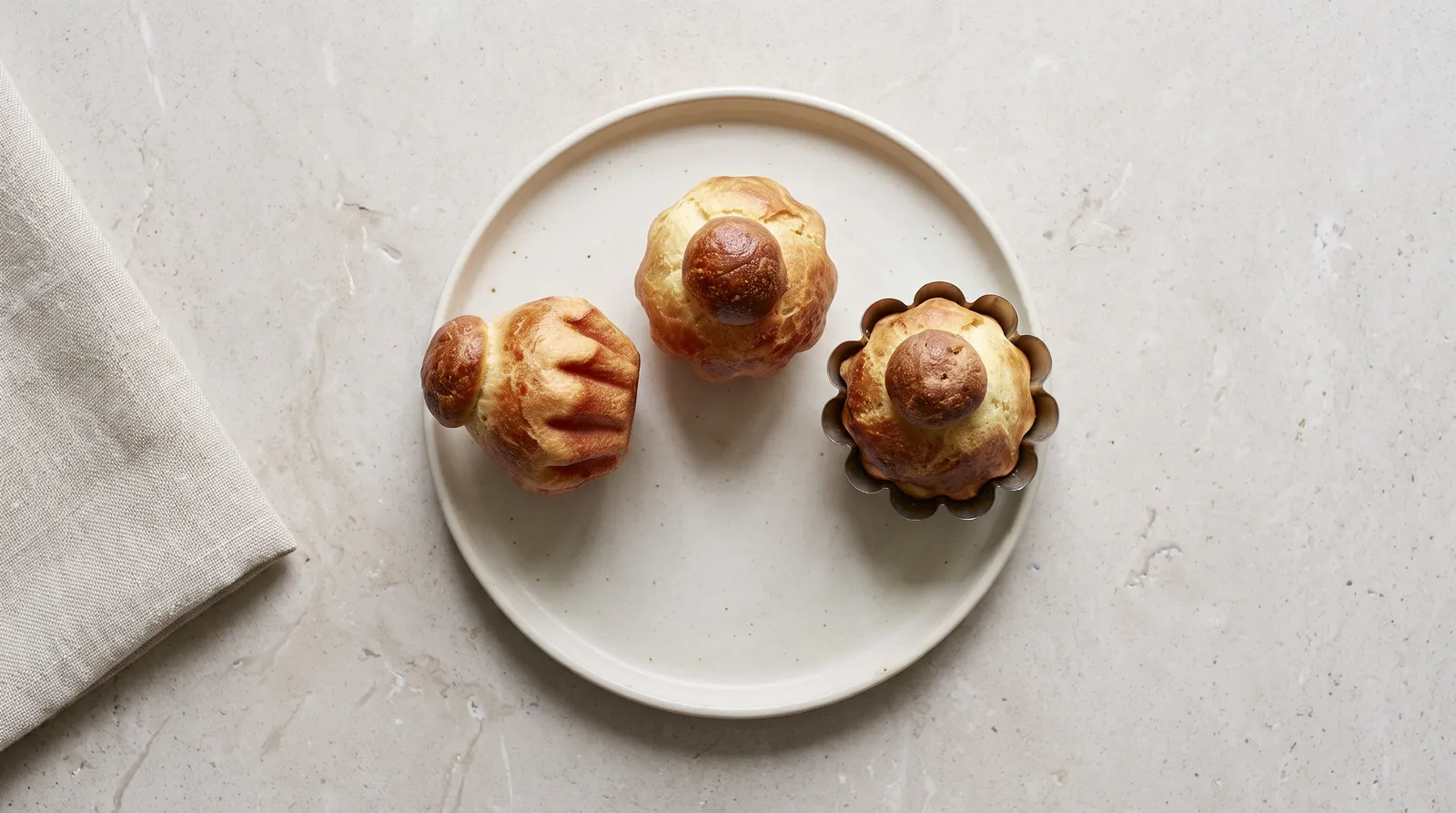
Brioche parisienne — shown in close-up
Cook 30 minutes after 50 minutes of active preparation
Passive 930 minutes, in addition to 30 minutes of cooking
Calories per serving 316 kcal; total elapsed time 1010 minutes
Yield 1 large 18 cm brioche, about 10 slices
Introduction and overview

Brioche Parisienne (Brioche à Tête) for an 18 cm Mould

Brioche parisienne is recognised by its fluted body and smaller top knot, often called the head. The shape looks decorative, but it also exposes whether the dough has enough strength to support a large butter load. A successful loaf should have a thin, deeply golden crust and a tender, shreddable crumb rather than a cake-like interior. The 18 cm mould fixes the scale here, so the amount of dough, proof height and baking time work together rather than relying on a professional bakery mould.

The dough uses strong white flour, 60% whole egg and just over 50% butter relative to flour weight. That enrichment makes mixing sequence important. Gluten is developed before the butter is fully absorbed, then the dough is kept near 24 °C so the butter stays pliable rather than melting into a greasy film. A short room-temperature fermentation starts the yeast, while the long 4 °C rest firms the fat and gives the dough enough body for precise shaping.

The head stays centred through geometry rather than luck. About one fifth of the cold dough is shaped into a pear with a narrow neck. The larger piece is rounded tightly, opened deeply at the centre and the neck is pushed down into that opening, anchoring the top knot inside the body. A moderate proof at 25 °C lets the structure expand without softening the butter too much; the loaf is baked only after the head remains distinct and the body has risen close to the mould edge.
Success points

Success points

  • Finish mixing near 24 °C; warmer dough becomes harder to shape cleanly.
  • Do not rush butter incorporation before the dough can stretch into a thin membrane.
  • Anchor the narrowed neck of the head deep into the body and stop proofing before the structure becomes fragile.
Ingredients

Ingredients

Brioche dough and finish

  • 350 g strong white wheat flour, about 12–13% protein
  • 210 g whole egg, cold; beaten for the dough, about 60% of flour weight
  • 180 g unsalted butter, cool and pliable, cut into cubes, about 51% of flour weight
  • 50 g caster sugar
  • 20 g whole milk, cool
  • 14 g fresh baker's yeast, crumbled
  • 8 g fine salt
  • 50 g whole egg, beaten, for egg wash
Method

Method

Mixing and cold fermentation

  1. Hydrate the dough. Mix the flour, 210 g whole egg, milk, yeast, sugar and salt until no dry flour remains. Continue for about 5 minutes. The dough has no dry flour pockets and forms a rough cohesive mass. Early mixing hydrates the flour before the butter is added.

  2. Develop gluten and absorb the butter. Knead until the dough is elastic, then add the butter gradually and continue kneading until the dough is smooth and extensible; finish at about 24 °C. Continue for about 15 minutes. A thin piece of dough stretches into a translucent window without tearing immediately. The dough is glossy and releases cleanly from much of the bowl. Gluten must be established before the large butter load is fully incorporated.

  3. Start the first rise. Rest the dough covered at room temperature, then gently press out excess gas. Leave it for 30 minutes. The dough is slightly expanded and supple rather than fully doubled. A short first fermentation starts yeast activity without exhausting the dough.

  4. Chill overnight. Refrigerate the covered dough until thoroughly cold and firm. Leave it for 720 minutes. Temperature target: 4 °C. The butter-rich dough is firm enough to handle cleanly and no longer feels soft or greasy. Cold dough is easier to shape and supports the head. Keep the dough refrigerated at 4 °C or below during the long rest.

Shaping, proofing and baking

  1. Build the body and head. Reserve about one fifth of the cold dough for the head; round the larger piece tightly, place it seam-side down in the greased 18 cm fluted mould, make a deep central opening and anchor the pear-shaped head through the opening into the body. Continue for about 15 minutes. The body is taut and centred, and the head sits upright with its narrow neck anchored well inside the body. Anchoring the neck helps the head remain centred as the dough expands.

  2. Proof without losing the shape. Rest and proof the shaped brioche in a warm place until airy and visibly expanded, then brush carefully with the 50 g beaten egg. Leave it for 120 minutes. Temperature target: 25 °C. The dough rises close to the upper edge of the mould and a light fingertip press springs back slowly. The head remains distinct and centred rather than sliding to one side. A moderate proofing temperature limits butter leakage.

  3. Bake to a set crumb. Bake the brioche until deeply golden and structurally set. Continue for about 30 minutes. Temperature target: 180 °C. The crust is an even deep gold and the centre feels set rather than soft or wet. A probe in the central crumb reads about 93 °C as a quality endpoint. The core temperature confirms that the enriched crumb has set.

  4. Cool before slicing. Cool the brioche on a rack before slicing. Leave it for 60 minutes. The brioche is no longer hot at the centre and the crumb cuts without compressing into a gummy line. Cooling allows the rich crumb to finish setting.

Practical guidance

Practical

Practical guidance

Serve only after the centre has cooled enough to slice without compressing. The brioche is rich enough to eat plain, although a thin spread of butter or preserve can be added at the table.

Practical guidance

The overnight refrigeration is part of the preparation, not optional waiting. It makes shaping much easier, so schedule the dough one day before you plan to bake.

Practical guidance

Wrap the completely cooled loaf and keep it at room temperature for up to 2 days. For longer keeping, freeze well wrapped in slices or as part of the loaf; thaw wrapped so the crumb does not dry out.

Practical guidance

If using instant dry yeast instead of fresh yeast, follow the manufacturer's fresh-to-dry equivalence and expect the proofing clock to shift. Expansion and fingertip response remain more reliable than a fixed time.

Troubleshooting

Troubleshooting

  • The head leans or detaches.The neck was not anchored deeply enough or the dough was overproofed. Shape a pronounced neck, press it deep into the body and bake once the proof cue is reached.
  • Butter smears from the dough.The dough became too warm. Chill the dough until firm before continuing.
Nutrition per serving

Nutrition per serving

  • Serving size1 of 10 slices
  • Calories316 kcal
  • Carbohydrate32 g
  • Protein7 g
  • Fat18 g
  • Fibre1 g
  • Sodium356 mg
Allergens and food safety

Allergens and food safety

Allergen note: Wheat (gluten)

Allergen note: Egg

Allergen note: Milk

Safety: Raw egg dough and egg wash should be handled as raw egg products; wash hands and tools after contact.

Safety: Keep the long cold rest at 4 °C or below.

Safety: Do not eat raw brioche dough.

Frequently asked questions

Frequently asked questions

Why did the brioche head slide sideways?

The head is usually under-anchored, the dough is too warm, or the proof has gone too far. Build a pronounced neck and press it deeply into the central opening.

Can the cold rest be skipped?

Skipping it makes the butter-rich dough much softer and the head harder to centre. The long cold rest also belongs in the stated total time.

Closing

Closing

  • Result — a deeply golden fluted brioche with a tender, shreddable crumb and a distinct centred head.
  • Decisive technique — develop gluten before adding all the butter, chill thoroughly, then anchor the head by its neck before proofing.