French Recipes

Bourride sétoise

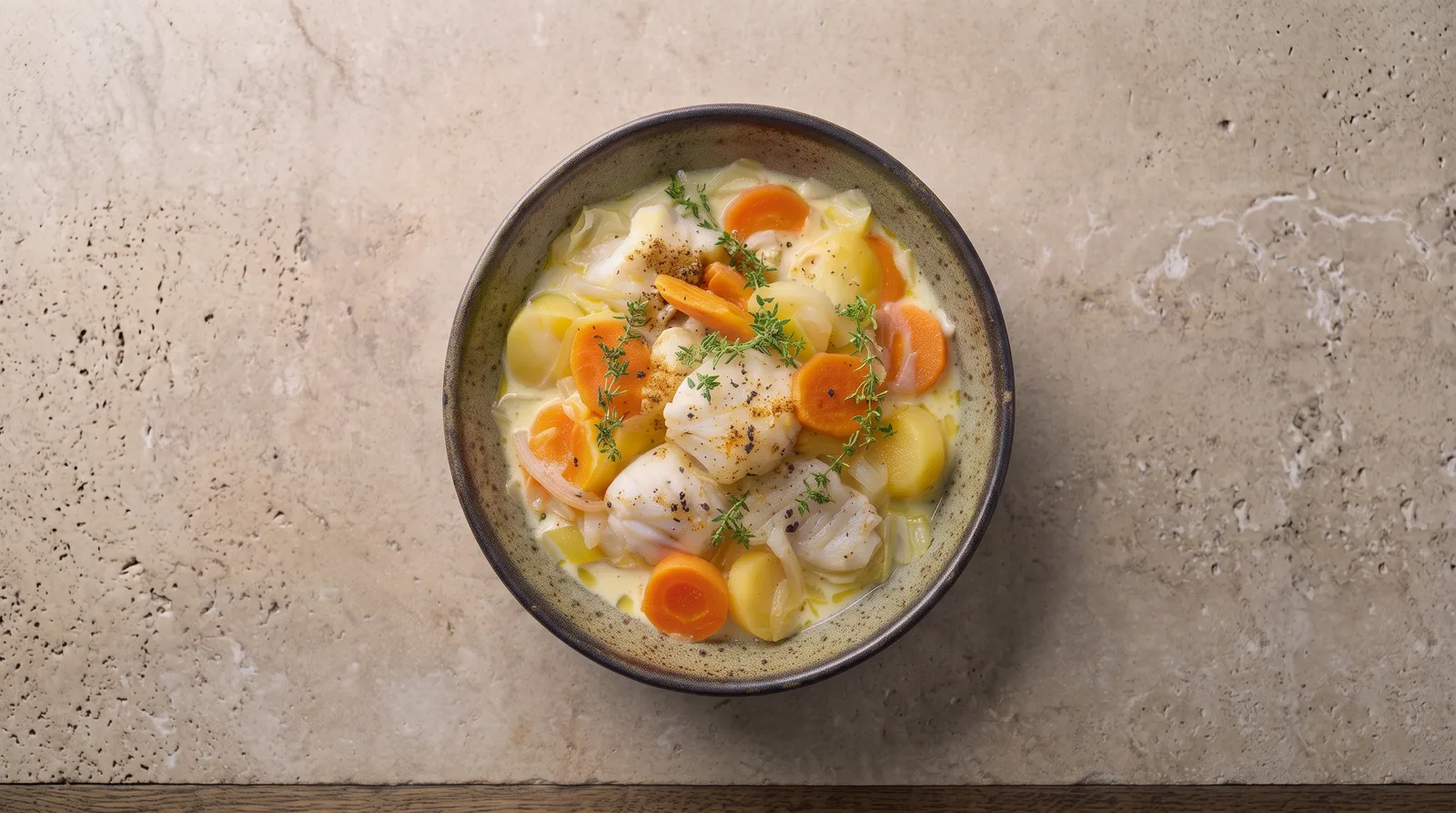
A specifically Sétoise monkfish bourride with slowly softened vegetables, white wine and a pasteurized-yolk garlic aïoli whisked into the cooking liquid over very low heat without boiling.

French Recipes
Share
Bourride sétoise — served in a bowl
Prep 35 minutes
Cook 47 minutes
Total 82 minutes
Yield 4 main-course servings
About this dish

Bourride sétoise — monkfish with vegetables and aïoli liaison

Bourride sétoise should not be flattened into a generic Mediterranean fish stew. In Sète, the defining fish is monkfish—baudroie or lotte—and the cooking liquid is finished with aïoli. That combination separates it from Marseille bouillabaisse, which depends on a broader rockfish and serving tradition. Here the vegetables and potatoes cook first so the monkfish can be added late and remain firm rather than sitting through a long simmer.

The fish stage is deliberately short: 15 minutes at a gentle simmer, only until the thickest pieces reach 63 °C and the flesh is opaque and firm without turning rubbery. The fish is then lifted out while the vegetable liquid reduces. This is not busywork; it protects a dense, lean fish that can become chewy when held hot after it is cooked.

The final liaison is the most fragile part. Prepare aïoli from pasteurized yolk, garlic, lemon and olive oil, keep it at 4 °C or below, then whisk it into the hot reduced liquid over the lowest heat. Stop before any boil develops. A smooth sauce with no curds or beads of free oil is the finishing cue, and the monkfish goes back only long enough to be coated and served.
Success points

Success points

  • Use monkfish as the primary fish for the Sétoise identity.
  • Cook vegetables substantially before adding the fish.
  • Remove the monkfish while reducing the liquid.
  • Incorporate aïoli over very low heat and never let the liaison boil.
Ingredients

Ingredients

Fish and vegetables

  • 1000 g monkfish tail meat, trimmed and cut into large pieces
  • 300 g leeks, sliced
  • 150 g yellow onion, sliced
  • 300 g carrots, thinly sliced
  • 400 g waxy potatoes, 2 cm pieces
  • 80 g celery stalk, sliced
  • 120 ml dry white wine
  • 30 ml olive oil
  • 8 g fine salt
  • 2 g black pepper

Aïoli liaison

  • 36 g pasteurized egg yolk, about 2 yolks
  • 15 g garlic, crushed to a paste
  • 150 ml olive oil
  • 10 ml lemon juice
Method

Method

Cook vegetables and fish

  1. Soften the vegetables. Cook the leeks, onion, carrots, potatoes and celery gently in the 30 ml olive oil, stirring regularly. Time: 25 minutes. Continue until the vegetables are softened and the potatoes are almost tender without browning deeply.

  2. Cook the monkfish gently. Add the monkfish and white wine, cover and simmer gently until the fish reaches its safe endpoint. Maintain 63 °C. Time: 15 minutes. Continue until the monkfish is opaque, firm but not rubbery and reaches 63 °C in the thickest pieces. Cook monkfish to 63 °C.

Aïoli liaison

  1. Make a cold aïoli. Whisk the pasteurized yolk, garlic and lemon, then stream in the 150 ml olive oil until thick. Hold at 4 °C or below. Time: 10 minutes. Continue until the aïoli is thick, glossy and shows no free oil around the edges. Keep the aïoli at 4 °C or below until it is used.

  2. Reduce without the fish. Lift out the monkfish, reduce the vegetable cooking liquid slightly, then turn the heat to its lowest setting. Time: 5 minutes. Continue until the liquid is concentrated enough to lightly coat the vegetables while the monkfish remains intact off heat.

  3. Liaise over very low heat. Whisk the aïoli into the hot liquid over the lowest heat, then return the fish and stop before boiling. Time: 2 minutes. Continue until the sauce is creamy and unified with no curds or beads of separated oil. Do not boil the aïoli liaison.

Practical guidance

Practical

Serving

Serve immediately, spooning the aïoli-enriched vegetable sauce around the monkfish. The potatoes already provide the principal starch in this version.

Make-ahead

Vegetables may be prepared ahead, but the monkfish and aïoli liaison are best cooked close to service. Prepare the aïoli with pasteurized yolk and keep it cold until needed.

Storage and reheating

Refrigerate leftovers promptly at 4 °C or below and use within 1 day for best fish texture. Reheat very gently to 74 °C; the emulsion may loosen, so avoid hard boiling.

Valid substitutions

- monkfish: A firm white fish may be used where monkfish is unavailable. It becomes a practical bourride variation but weakens the specifically Sétoise bourride de baudroie identity.

Troubleshooting

Troubleshooting

  • Sauce curdlesthe liaison boiled; remove from heat and whisk gently, accepting that a fully split emulsion may not return to the original texture.
  • Monkfish is rubberyit stayed in the casserole during reduction or cooked past the endpoint; lift it out as soon as it reaches 63 °C.
  • Potatoes remain firm when fish is readythe vegetable stage was shortened; cook the potatoes nearly tender before the monkfish goes in.
Nutrition per serving

Nutrition per serving

  • Serving size1 main-course serving
  • Calories885 kcal
  • Carbohydrate38 g
  • Protein50 g
  • Fat61 g
  • Fibre7 g
  • Sodium980 mg
Allergens and food safety

Allergens and food safety

Allergens: Fish, Egg, Sulphites from white wine.

Keep raw monkfish and prepared aïoli at 4 °C or below.

Cook monkfish to 63 °C.

Use pasteurized egg yolk in the aïoli because the liaison is not boiled.

Refrigerate leftovers at 4 °C or below and reheat to 74 °C, using gentle heat to limit splitting.

FAQ

FAQ

Is bourride sétoise the same as bouillabaisse?

No. This Sétoise form is centred on monkfish and an aïoli liaison, while Marseille bouillabaisse follows a different multi-fish broth and service logic.

Can I boil the sauce after adding aïoli?

No. Boiling can curdle the egg-yolk emulsion; keep the heat very low and stop once the sauce is smooth and unified.

Closing

Closing

  • Result: Firm, just-cooked monkfish with tender vegetables in a creamy garlic-aïoli sauce that stays smooth rather than curdled.
  • Decisive technique: Remove the fish before reduction and add the aïoli only over very low heat, never at a boil.