French Recipes

Bouillabaisse

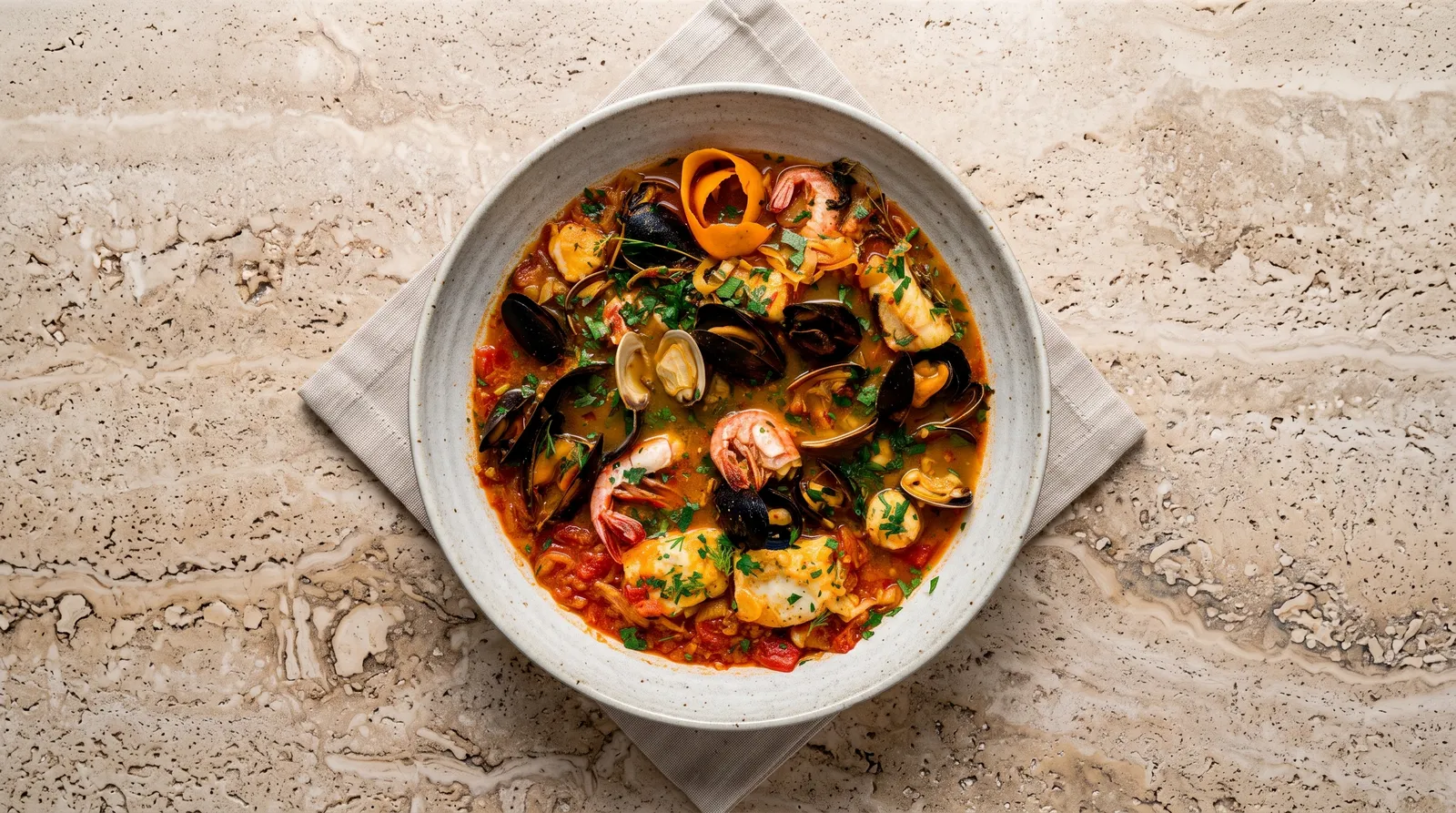
A household-scale Marseille-style bouillabaisse with a long-extracted rockfish broth, potatoes, four staged serving fish, cold pasteurized-yolk rouille and toasted baguette served as distinct components.

French Recipes
Share
Bouillabaisse — shown in a cooking pot
Prep 60 minutes
Cook 120 minutes
Total 180 minutes
Yield 6 generous servings
About this dish

Marseille-style bouillabaisse with rouille and toasted bread

Bouillabaisse is not simply any mixed fish stew. Marseille practice centres on a broth extracted from small rockfish, followed by the controlled cooking of larger fish intended to be eaten, with potatoes, rouille and bread alongside. The distinction matters in a home kitchen: fish that gives up its structure to build broth has a different job from the pieces that should arrive at the table intact.

This household preparation uses a kilogram of small rockfish for a one-hour broth extraction, then strains the liquid before the serving fish enters. Monkfish, red scorpionfish, John Dory and conger are staged rather than dropped in together. The potatoes and firmer fish start first; more delicate pieces get only the final minutes. Every serving piece should reach 63 °C, but the quality cue is equally important: the flesh should flake under light pressure while remaining in recognisable pieces.

Rouille is made as a cold emulsion with pasteurized yolk, garlic, olive oil, lemon and cayenne, then held at 4 °C or below. Toasted baguette gives it a firm carrier. At service, lift the fish and potatoes to a warm platter instead of breaking them up in the soup, and serve the broth separately. That two-part presentation keeps the meal closer to the Marseille identity described by local culinary guidance.
Success points

Success points

  • Use small fish for broth extraction and reserve larger pieces for eating.
  • Stage the serving fish by firmness.
  • Do not boil delicate fish violently.
  • Use pasteurized yolk and keep rouille cold until the moment of service.
Ingredients

Ingredients

Broth and fish

  • 1000 g small whole rockfish, cleaned; for broth only
  • 300 g monkfish, cut into large chunks
  • 300 g red scorpionfish, large pieces
  • 300 g John Dory, large pieces
  • 300 g conger eel, large pieces
  • 900 g waxy potatoes, peeled and thickly sliced
  • 500 g ripe tomatoes, chopped
  • 200 g yellow onion, sliced
  • 30 g garlic, sliced
  • 250 g fennel bulb, sliced
  • 30 g flat-leaf parsley
  • 60 ml olive oil
  • 2500 ml water
  • 0.4 g saffron threads
  • 10 g fine salt
  • 2 g black pepper

Rouille and bread

  • 36 g pasteurized egg yolk, about 2 yolks
  • 10 g garlic, finely crushed
  • 180 ml olive oil
  • 10 ml lemon juice
  • 0.5 g cayenne pepper
  • 300 g baguette, sliced for toasting
Method

Method

Broth

  1. Sweat the aromatics. Sweat the onion, fennel and 30 g garlic in the 60 ml olive oil, then add tomato and parsley. Time: 15 minutes. Continue until the onion and fennel are soft and the tomato has begun to collapse.

  2. Extract the rockfish broth. Add the small rockfish, water, saffron, salt and pepper, bring to a strong simmer and cook to extract the broth. Time: 60 minutes. Continue until the small fish have broken down substantially and the broth smells strongly of fish and saffron.

  3. Strain and concentrate. Press and strain the broth, then return it to a clean pot and adjust the level by brief reduction if needed. Time: 12 minutes. Continue until the strained broth is full-flavoured with no large bones or coarse fish fragments.

Fish and potatoes

  1. Start with potatoes and firm fish. Cook the potatoes and the firmest serving fish pieces in the simmering broth. Maintain 63 °C. Time: 20 minutes. Continue until the potatoes are nearly tender and the firm fish is opaque at the edges while reaching 63 °C. Cook fish to 63 °C.

  2. Add the delicate fish. Add the more delicate fish pieces and continue just until they are cooked through. Maintain 63 °C. Time: 5 minutes. Continue until the delicate fish flakes under light pressure yet the pieces still hold their shape and reach 63 °C. Cook all serving fish to 63 °C.

Rouille and service

  1. Make the rouille. Crush the 10 g garlic with the pasteurized yolk, lemon and cayenne, then stream in the 180 ml olive oil to form a thick rouille. Hold at 4 °C or below. Time: 10 minutes. Continue until the rouille holds a soft peak and does not show separated oil. Use pasteurized yolk and keep the finished rouille at 4 °C or below until serving.

  2. Toast the bread. Toast the baguette slices until dry at the surface and lightly browned. Maintain 180 °C. Time: 8 minutes. Continue until the bread is lightly browned and dry enough to stay intact when spread with rouille.

  3. Serve in two parts. Lift the fish and potatoes to a warm platter, serve the hot broth separately, and offer rouille and toasted bread alongside. Time: 5 minutes. Continue until the fish remains in distinct pieces and the broth reaches the table separately with rouille and toast.

Practical guidance

Practical

Serving

Serve the broth first or alongside the fish and potatoes, with toasted baguette and rouille at the table. The fish should remain identifiable rather than being broken into the soup.

Make-ahead

The strained broth can be prepared one day ahead, cooled rapidly and refrigerated. Reheat it to a full simmer before cooking the fresh serving fish. Rouille is best made the same day and kept cold.

Storage and reheating

Refrigerate cooked seafood and broth promptly at 4 °C or below and use within 2 days. Reheat leftovers to 74 °C, understanding that fish texture will be softer. Discard rouille that has been left warm for extended service.

Valid substitutions

- Mediterranean fish species: Firm and delicate local fish can be substituted when the named Mediterranean species are unavailable. The soup remains a practical fish soup but should not be described as reproducing Marseille’s local catch exactly.

Troubleshooting

Troubleshooting

  • Cloudy coarse broththe extraction fish was not strained thoroughly; press and strain through a fine sieve before the serving fish is added.
  • Fish falls apartdelicate pieces entered too early or boiled too hard; add them only for the final minutes at a gentle simmer.
  • Rouille splitsoil was added too quickly or ingredients were not emulsifying; stop adding oil and rebuild the emulsion slowly with a fresh spoonful of pasteurized yolk if needed.
Nutrition per serving

Nutrition per serving

  • Serving size1 soup-and-fish serving with rouille and bread
  • Calories810 kcal
  • Carbohydrate55 g
  • Protein61 g
  • Fat38 g
  • Fibre7 g
  • Sodium1200 mg
Allergens and food safety

Allergens and food safety

Allergens: Fish, Egg, Wheat/gluten.

Keep raw fish at 4 °C or below before cooking.

Cook serving fish to 63 °C.

Use pasteurized egg yolk for rouille and keep it at 4 °C or below until service.

Cool leftovers promptly and reheat cooked leftovers to 74 °C.

FAQ

FAQ

Do I have to use these exact fish species?

Local Marseille practice depends on Mediterranean fish, but availability varies. Substitutions can make a good household fish soup; they should not be presented as reproducing the local catch exactly.

Why use pasteurized yolk in the rouille?

The emulsion is not cooked to a safety temperature, so pasteurized yolk provides a conservative raw-egg basis.

Closing

Closing

  • Result: A saffron-scented rockfish broth with tender potatoes and distinct, just-cooked fish pieces, served with garlic rouille and crisp toast.
  • Decisive technique: Extract the broth first, strain it, then stage the eating fish by firmness instead of boiling every species together.