French National Dishes

Bouillon d’awara

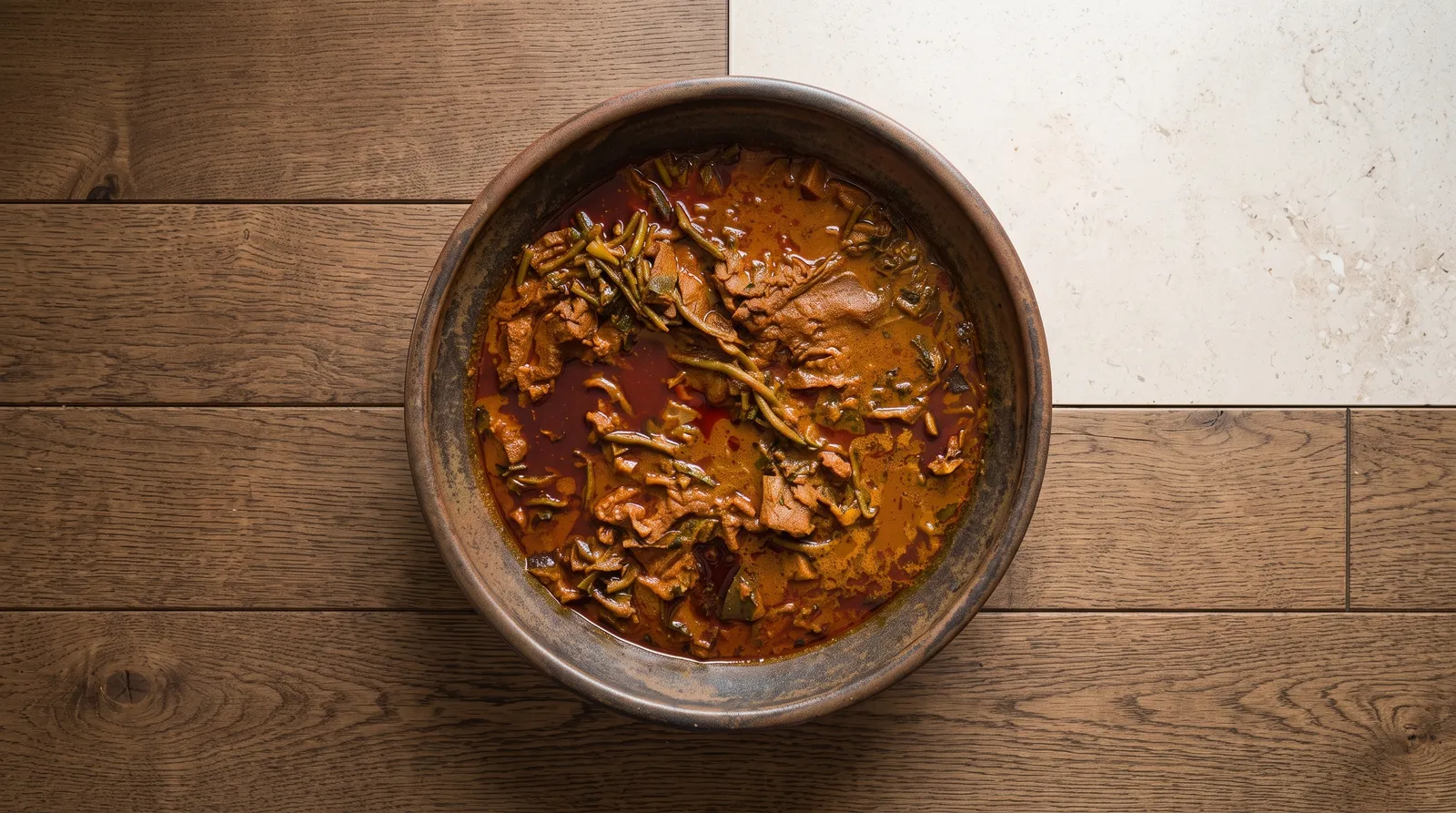
A French Guianese communal awara-pulp stew built over hours, with pork belly, chicken, refrigerated-desalted salt cod, shrimp and vegetables added in stages so each protein reaches its proper endpoint.

French National Dishes
Share
Bouillon d’awara — served in a bowl
Prep 50 minutes
Cook 373 minutes
Total 1155 minutes
Yield 8 substantial servings
About this dish

Bouillon d’awara — French Guianese awara stew

Bouillon d’awara belongs to French Guiana’s Creole food culture and is closely linked with Easter-time communal eating. Despite the word bouillon, the finished dish is not a light broth. Awara palm pulp cooks for hours into a dense, rich base that carries meat, cured fish, shrimp and vegetables. The long pot is therefore built in stages: ingredients that need prolonged cooking go in early, while seafood enters only after the foundation is already developed.

Salt cod requires its own schedule before the pot begins. Soak it for 12 hours under refrigeration, changing the water several times, then add it only with the vegetables. Chicken and pork have already spent two hours in the reduced awara base by that point. The final shrimp need only a brief simmer. This order protects texture and also makes food-safety controls explicit: chicken reaches 74 °C, while fish and shrimp reach 63 °C.

The chilli is left whole so it can perfume the stew without making the heat level unpredictable; remove it intact before serving. Because the pot is dense and contains several perishable proteins, cooling deserves as much attention as cooking. Divide leftovers into shallow containers, refrigerate at 4 °C or below and reheat to 74 °C. The full schedule includes the 12-hour desalting period rather than hiding it outside the displayed total.
Success points

Success points

  • Keep the awara base at a gentle simmer and stir regularly so the dense pulp does not scorch.
  • Stage meats before fish, vegetables and shrimp.
  • Keep the Scotch bonnet whole if using it for aroma rather than intense heat.
  • Desalt the cod cold, never on the counter.
Ingredients

Ingredients

Awara base and proteins

  • 750 g prepared awara palm pulp
  • 12000 ml cold water, for desalting in four 3 litre fills
  • 1500 ml water, hot, for the awara base
  • 300 g salt cod, cut into large pieces
  • 400 g pork belly, cut into 4 cm pieces
  • 800 g bone-in chicken thighs
  • 300 g raw peeled shrimp

Vegetables and aromatics

  • 400 g green cabbage, roughly chopped
  • 200 g green beans, trimmed
  • 300 g aubergine, large dice
  • 300 g cucumber, seeded and large dice
  • 200 g yellow onion, chopped
  • 20 g garlic, chopped
  • 6 g fresh thyme
  • 8 g whole Scotch bonnet chilli, left whole and intact
  • 10 g fine salt
Method

Method

Desalt and build the base

  1. Desalt the cod cold. Soak the salt cod in 3000 ml cold water in the refrigerator, then replace it with fresh 3000 ml water three times during the 12-hour soak. Hold at 4 °C or below. Time: 12 hours refrigerated soaking. Continue until the salt cod is pliable and tastes notably less salty at a tiny cooked test flake. Keep the fish at 4 °C or below throughout desalting.

  2. Reduce the awara base. Combine the awara pulp with the 1500 ml hot water, bring to a gentle simmer and cook uncovered, stirring regularly. Time: 180 minutes. Continue until the awara base has thickened substantially and looks glossy rather than watery.

  3. Render and colour the pork. Brown the pork belly in a dry frying pan, turning the pieces so all sides colour, and reserve the rendered fat with the pork. Time: 20 minutes. Continue until the pork belly is browned on several faces and has rendered a visible layer of fat.

  4. Cook the meats. Add the browned pork and its rendered fat, chicken, onion, garlic, thyme, whole Scotch bonnet chilli and 10 g salt to the awara base and continue the slow simmer. Maintain 74 °C. Time: 120 minutes. Continue until the pork is tender, the chicken meat loosens easily from the bone and the thickest chicken pieces register 74 °C. Cook chicken to at least 74 °C.

Finish in stages

  1. Add vegetables and cod. Add cabbage, green beans, aubergine, cucumber and the desalted salt cod, keeping the whole chilli intact. Maintain 63 °C. Time: 45 minutes. Continue until the vegetables are tender without dissolving and the salt cod flakes while reaching 63 °C. Cook fish to 63 °C.

  2. Finish with shrimp. Add the shrimp only at the end and simmer briefly. Maintain 63 °C. Time: 8 minutes. Continue until the shrimp are opaque and firm, register 63 °C and the stew is thick enough to mound slightly in the ladle. Cook shrimp to 63 °C.

  3. Rest before serving. Remove the whole chilli without breaking it and rest the pot off heat briefly before serving. Time: 12 minutes. Continue until the surface has settled and the thick stew can be ladled without the oil and solids separating abruptly. Discard any chilli that split and made the stew excessively hot rather than fishing fragments out by hand.

Practical guidance

Practical

Serving

Serve hot in deep bowls as a communal main dish. The stew should be thick and crowded with distinct meat, fish and vegetables rather than thin like soup.

Make-ahead

The awara base can be cooked partway ahead, cooled safely and refrigerated, but mixed proteins should not remain warm for extended holding. The complete stew can be made one day ahead and reheated once.

Storage and reheating

Divide the dense stew into shallow containers for faster cooling, refrigerate at 4 °C or below for up to 3 days, and reheat to 74 °C throughout.

Valid substitutions

- protein and vegetable mix: French Guianese household versions vary, but changes should respect the long awara base and staged cooking logic. Changing the mix changes flavour, salt and nutrition and should be described as a variant rather than the same fixed formula.

Troubleshooting

Troubleshooting

  • Awara base scorchesthe pot is too hot or has not been stirred enough; lower the heat and scrape the bottom regularly with a flat spoon.
  • Cod dominates with saltdesalting was too short; use the full cold soak and water changes before the cod enters the stew.
  • Shrimp are rubberythey went in with the long-cooking meats; add them only for the final brief simmer.
Nutrition per serving

Nutrition per serving

  • Serving size1 substantial bowl
  • Calories760 kcal
  • Carbohydrate22 g
  • Protein52 g
  • Fat50 g
  • Fibre9 g
  • Sodium1250 mg
Allergens and food safety

Allergens and food safety

Allergens: Fish, Crustaceans.

Desalt salt cod under refrigeration at 4 °C or below.

Cook chicken to 74 °C and fish and shrimp to 63 °C.

Cool the mixed stew rapidly in shallow containers, refrigerate at 4 °C or below and reheat to 74 °C.

FAQ

FAQ

Why is the dish called a bouillon if it is thick?

The name is traditional, while the long-cooked awara pulp produces a dense stew-like consistency rather than a clear broth.

Can all the proteins go in at once?

No. Chicken and pork need long cooking, while salt cod and especially shrimp would become dry and fragmented if they stayed in the pot for hours.

Closing

Closing

  • Result: A dense, glossy awara stew with tender meat, intact vegetables, flaky salt cod and just-cooked shrimp.
  • Decisive technique: The decisive technique is staged addition over a long awara simmer, with the seafood kept out until the end.