French Recipes

Azinat

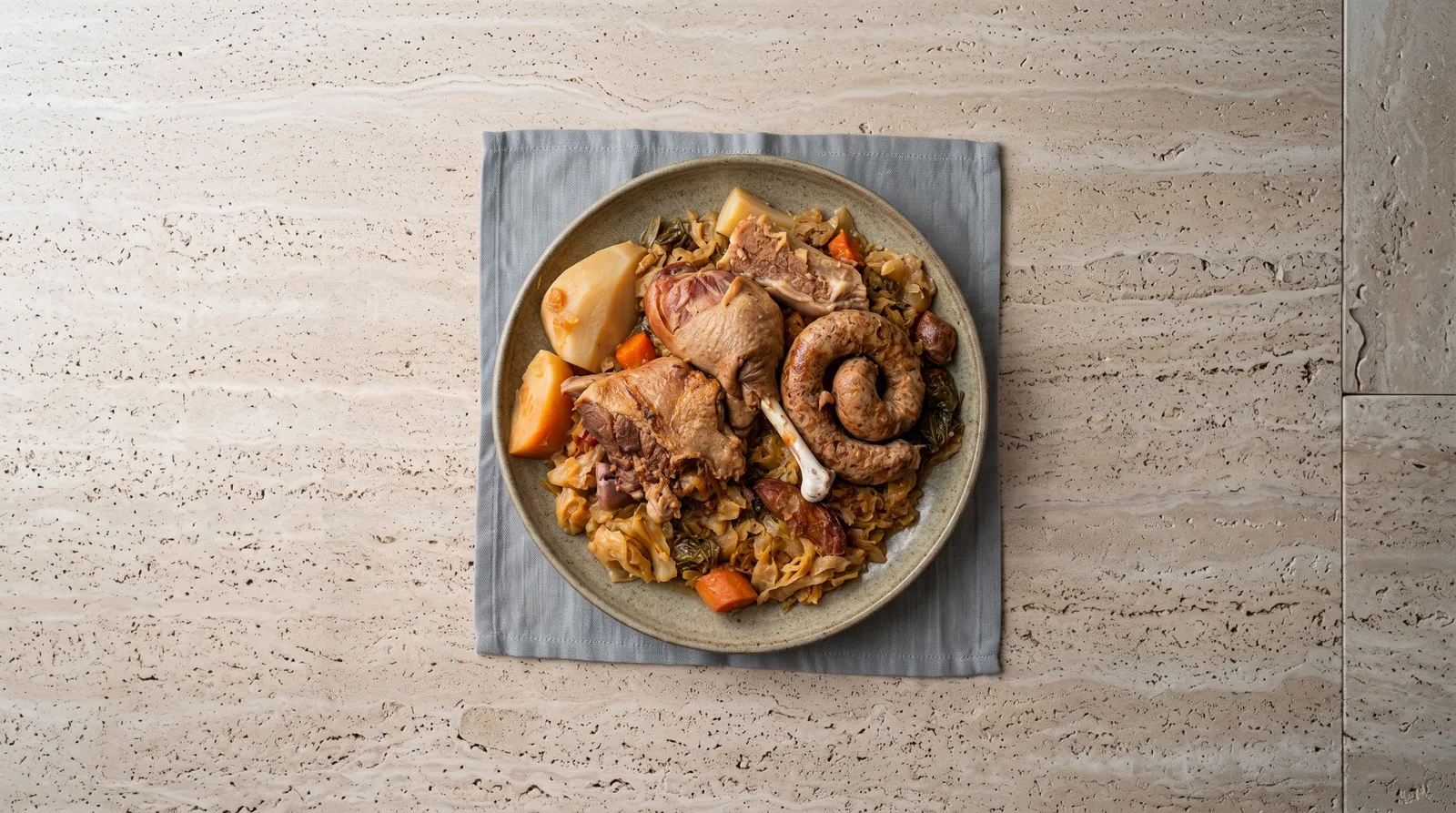
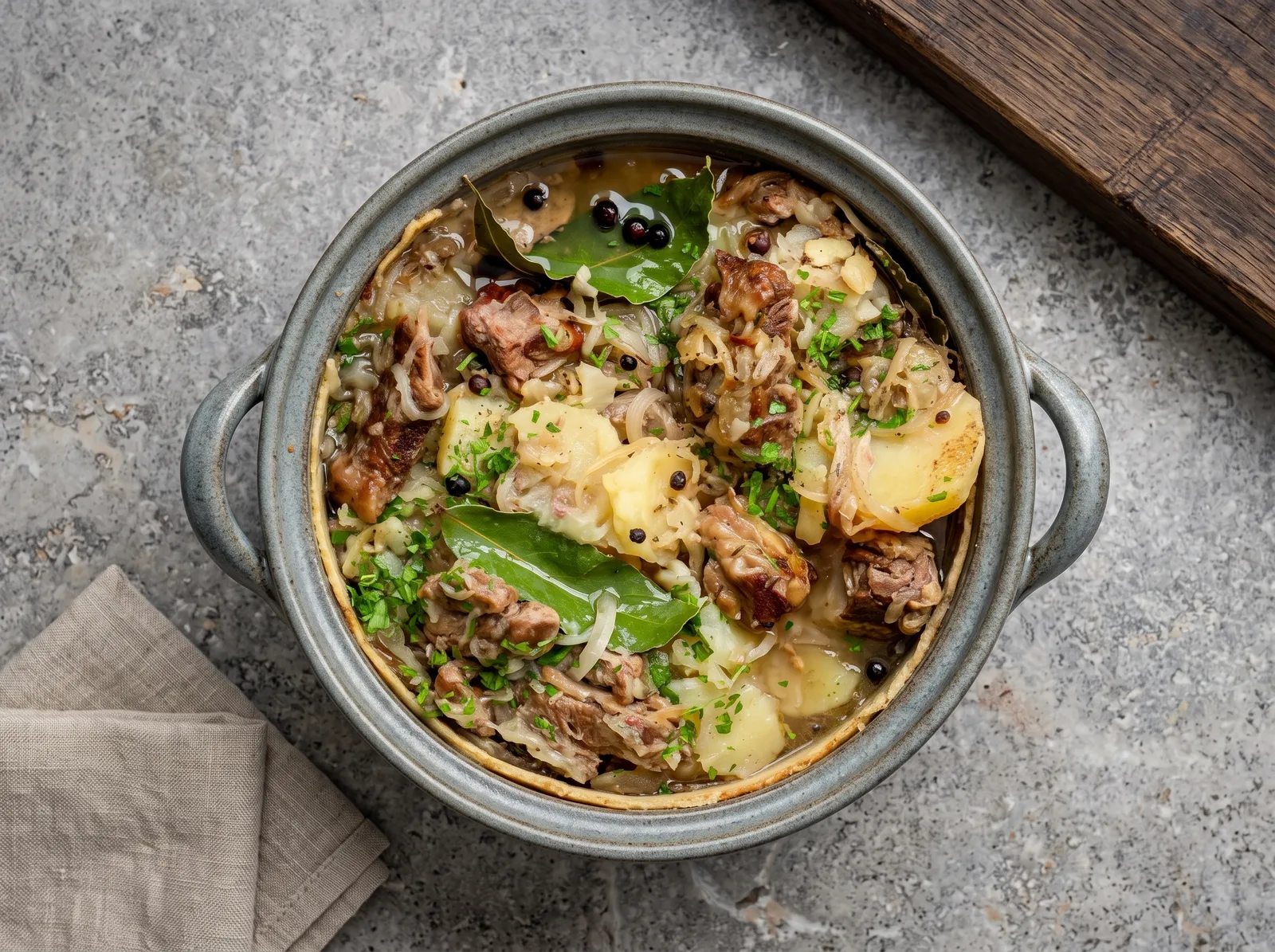
A rich Ariège azinat of cabbage, pork, potatoes, carrots and duck confit, finished with a browned pork rouzole and a separate gratinée made from the pot broth, bread and cheese.

French Recipes
Share
Azinat — large pieces of cooked meat in orange-red sauce in a deep pot
Prep 55 minutes
Cook 225 minutes
Total 285 minutes
Yield 8 generous portions plus gratinée broth
Introduction and overview

Azinat — Ariège cabbage potée with rouzole

Azinat is an Ariège potée whose exact contents change from village to village and from modest everyday versions to richer festive pots. Ariège tourism explicitly distinguishes a richer style by the addition of rouzole, a pork-based stuffing or galette browned in a pan and then finished in the cabbage broth. This recipe follows that richer branch rather than pretending there is one universal formula.

The pot is deliberately staged. Pork knuckle and rind sausage begin first, cabbage follows for a long gentle cook, and potatoes plus duck confit are held back until the final phase so they remain recognisable. The rouzole is mixed separately from sausage meat, country ham, egg, bread, milk, parsley and garlic, browned as a thick galette and then laid into the azinat to finish cooking.

The broth is not waste. A portion is ladled over country bread, covered with grated cheese and baked into the gratinée that can start the meal. The long total cooking time is real and should not be compressed in the display. Because the pot contains cured and processed pork, salt is deliberately not added; taste the finished broth before deciding it needs anything more.
Success points

Success points

  • Keep the stockpot at a gentle simmer for the long cabbage cook.
  • Brown the rouzole until firm enough to turn, then finish its centre in the pot.
  • Add potatoes and duck confit only for the final stage.
Ingredients

Ingredients

Azinat pot

  • 1500 g Savoy cabbage, 1 large head, quartered and thick core trimmed
  • 600 g carrots, peeled and cut into large pieces
  • 800 g waxy potatoes, peeled, left whole if small or halved if large
  • 900 g pork knuckles, bone-in
  • 400 g pork rind sausage, 2 sausages
  • 800 g duck confit legs, 4 legs, excess surface fat removed
  • 300 g yellow onions, sliced
  • 30 g duck fat, from the confit or measured separately
  • 2 bay leaves
  • 3500 ml water, measured pot liquid
  • 2 g ground black pepper

Rouzole

  • 350 g pork sausage meat
  • 150 g country ham, finely diced
  • 3 l arge eggs
  • 150 g stale bread crumb
  • 180 ml whole milk, for soaking bread
  • 15 g flat-leaf parsley, finely chopped
  • 10 g garlic, finely chopped
  • 15 ml neutral oil, for browning rouzole

Gratinée

  • 240 g country bread, thinly sliced and stale or lightly toasted
  • 120 g Gruyère-style cheese, grated
Method

Method

Start the pot

  1. Blanch the cabbage. Lower the quartered Savoy cabbage into boiling water at about 100 °C for 5 minutes, then drain well. The cabbage should brighten and soften at the outer leaves while the quarters remain firm enough to handle. Blanching removes some raw harshness before the long pot cooking. Lift the heavy hot cabbage carefully and drain away from the body.

  2. Soften the onions and carrots. Melt the 30 g duck fat in a very large stockpot; cook the sliced onions and carrots for 10 minutes without dark browning. The onions should be translucent and the carrots lightly glossy, with no scorched edges. A gentle fat base starts the pot without making it taste roasted. Keep raw pork separate until this base is ready.

  3. Simmer the pork base. Add pork knuckles, rind sausage, bay, pepper and the 3500 ml water; bring to a boil, skim, reduce to a very gentle simmer and cook for 45 minutes. The broth should be lightly cloudy and savoury, with gentle surface movement rather than a rolling boil. A slow start begins tenderising the pork and seasoning the broth. Raw pork juices must not contact ready-to-eat foods; wash tools and hands after handling.

Cook cabbage and make rouzole

  1. Add cabbage for the long cook. Nestle the blanched cabbage into the pot, cover partly and simmer gently for 90 minutes. The cabbage should become very tender and the pork knuckle meat should begin pulling away from the bone. Long gentle cooking gives azinat its potée character. Maintain an active simmer and keep the pot hot throughout.

  2. Hydrate the rouzole bread. Pour the 180 ml milk over the 150 g bread crumb and let it stand for 5 minutes, then squeeze lightly. The bread should be evenly moistened and soft, with no pool of free milk after light squeezing. Brief hydration softens the bread so it can bind the rouzole without leaving dry pieces. Keep the milk refrigerated until needed and do not leave it warm for extended periods.

  3. Mix the rouzole. Mix the softened bread with the sausage meat, ham, eggs, parsley and garlic to a cohesive thick mass. The rouzole mixture should hold together in a thick 3–4 cm galette without free milk pooling in the bowl. Bread and egg bind the chopped pork filling. After raw pork and egg are mixed, cook promptly and wash hands and utensils.

  4. Brown the rouzole. Heat the neutral oil in a 28–30 cm frying pan; shape one thick galette and cook about 10 minutes per side, 20 minutes total, until firmly browned on both faces. Both faces should be well browned and the galette should be firm enough to turn in one piece. Browning gives the rouzole its characteristic crust before it finishes in the pot. The centre does not need to be fully cooked yet because it will finish in the simmering azinat.

Finish and make the gratinée

  1. Add potatoes, confit and rouzole. Add the potatoes and duck confit to the pot, lay the browned rouzole on top, cover and simmer gently for 45 minutes. The potatoes should be tender to the centre, the duck should be heated through and the rouzole centre should reach at least 71 °C. The final simmer finishes the rouzole while warming confit and cooking potatoes without disintegrating them. Ground pork/sausage and egg mixture should reach at least 71 °C; reheat cooked confit thoroughly.

  2. Make the broth gratinée. Heat the oven to 220 °C. Arrange the 240 g bread in a heatproof soup dish, ladle over enough very hot broth to saturate it, cover with the 120 g grated cheese and bake for 10 minutes. The cheese should be bubbling and browned in patches while the bread underneath is fully soaked with broth. The gratinée forms the traditional soup course from the pot liquor. Serve the gratinée hot and avoid holding it lukewarm for extended periods.

  3. Serve the azinat. Lift the meats, cabbage, carrots, potatoes and rouzole onto a large platter, portion the rouzole and serve after or alongside the gratinée. The pork should pull easily from the knuckle bones, the cabbage should be spoon-tender and the rouzole should cut into moist, fully cooked wedges. Separating the solid components makes portioning the dense potée practical. Serve promptly; refrigerate leftovers within 2 hours.

Serving, storage and planning

Practical

Serving, storage and planning

Serve the gratinée first or alongside the large platter of cabbage, carrots, potatoes, pork, duck and sliced rouzole. This is suitable for advance cooking, but a large pot must be cooled safely: divide leftovers or a make-ahead batch into shallow containers, refrigerate within 2 hours at 4 °C or below, and reheat the food to 74 °C. Use within 3 days. Make the gratinée close to serving so the cheese browns while the bread underneath remains saturated rather than stale. Small individual rouzoles are also made and can be easier to turn, while the method here cooks one large browned galette.

Troubleshooting

Troubleshooting

  • Broth reduces too muchThe simmer is too hard or the lid is too open. Lower the heat and close the lid more fully before considering any extra liquid.
  • Rouzole cracks when turnedLet the first side set longer and use a wide turner or plate to support the 3–4 cm thick galette.
Nutrition per serving

Nutrition per serving

  • Serving sizeone-eighth of meats, vegetables and rouzole plus gratinée
  • Calories980 kcal
  • Carbohydrate58 g
  • Protein61 g
  • Fat56 g
  • Fibre9 g
  • Sodium2350 mg
Allergens and food safety

Allergens and food safety

Allergens: Milk, Egg, Gluten/wheat.

Cook pork and the egg-bound sausage-meat rouzole thoroughly; the rouzole centre must reach at least 71 °C.

Refrigerate leftovers within 2 hours at 4 °C or below.

Reheat leftovers to 74 °C.

Processed pork and ham make sodium high; do not add extra salt without tasting the finished broth.

FAQ

FAQ

What makes this the richer style of azinat?

Substantial meats, duck confit and especially rouzole distinguish this richer Ariège preparation from simpler cabbage potées.

Why is there no added salt?

Country ham, rind sausage, confit and other processed meats already supply substantial sodium; the finished broth should be tasted first.

Closing

Closing

  • Result: a deeply savoury Ariège cabbage potée with tender pork, potatoes, duck confit, sliced rouzole and a broth-based cheese gratinée.
  • Decisive technique: stage the long pot correctly and finish the browned rouzole in the simmering azinat.