French Recipes

Aziminu

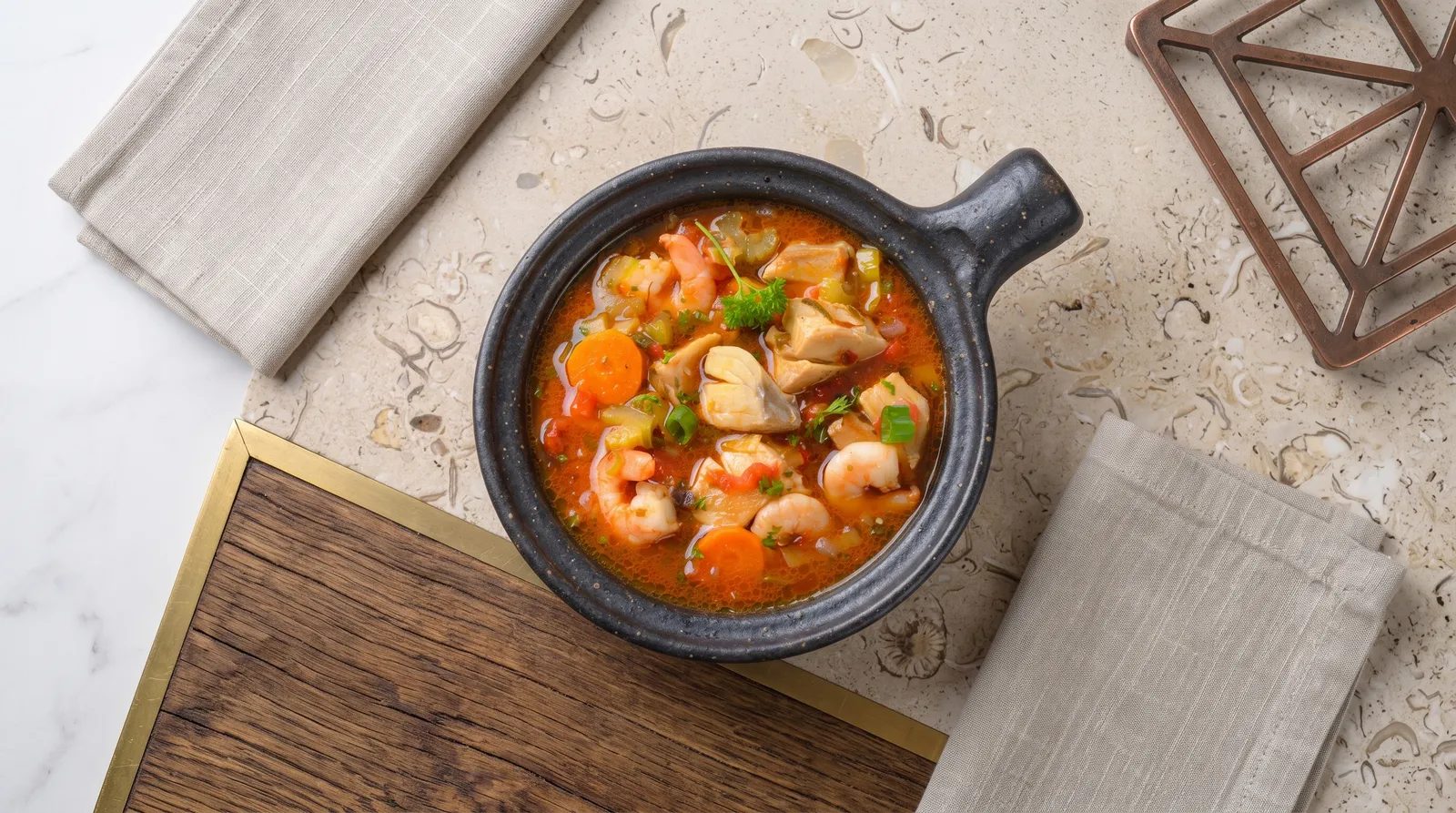
A Corsican fish soup built from a strained rock-fish broth, then finished with firm and delicate fish in sequence and mussels cooked only until their shells open.

French Recipes
Share
Aziminu — fish and vegetables in broth in a terracotta bowl beside bread slices
Prep 50 minutes
Cook 65 minutes
Total 115 minutes
Yield 6 main-course bowls
Introduction and overview

Aziminu — Corsican rock-fish soup

Aziminu is a Corsican fish soup rooted in rock fish and the day’s catch. It is often compared with bouillabaisse because both belong to the Mediterranean fish-soup family, but treating it merely as a renamed Marseille dish erases the Corsican context and the broad range of fish used in Corsican aziminu. The combination below uses separate broth fish, serving fish and mussels so each component can be handled at the right stage.

The recipe is built in two layers. Small cleaned rock fish simmer with tomato, fennel, onion, potato, wine, saffron and aromatics to create the broth, then the whole mixture is pressed through a sturdy sieve so bones and coarse solids stay out of the serving pot. Only after that do the fish pieces intended for the bowl enter the liquid.

Firm fish goes in before delicate fish, and mussels are last. That sequence matters more than a single clock time because the seafood has different structures. The broth should simmer rather than thrash, and the pot should be shaken instead of stirred aggressively once tender fish is present. Fish safety is checked at 63 °C or by full opacity and easy flaking; mussels are cooked until open and unopened shells are discarded.
Success points

Success points

  • Strain the broth before adding the fish that will be served.
  • Add firm fish first, then delicate fish, then mussels.
  • Use a gentle simmer and discard mussels that do not open.
Ingredients

Ingredients

Broth base

  • 800 g small cleaned rock fish, heads and bones retained; gills removed; for broth
  • 30 ml olive oil
  • 150 g yellow onion, sliced
  • 200 g fennel bulb, sliced
  • 15 g garlic, sliced
  • 500 g ripe tomatoes, chopped
  • 250 g potato, peeled and diced
  • 250 ml dry white wine
  • 1500 ml water
  • 5 g orange peel, wide strip, no white pith
  • 2 g fresh thyme
  • 2 bay leaves
  • 0.2 g saffron threads
  • 8 g fine salt
  • 1 g ground black pepper

Fish and shellfish

  • 500 g firm white fish, monkfish or comparable firm Mediterranean fish, cut in 5 cm pieces
  • 700 g mixed tender fish, sea bream, red mullet or comparable fish, cut in large pieces
  • 400 g mussels, scrubbed and debearded; discard cracked or dead mussels before cooking

Bread for serving

  • 300 g country bread, sliced and toasted
  • 5 g garlic, halved for rubbing toast
Method

Method

Build the broth

  1. Soften the aromatics. Heat the olive oil in a stockpot; cook onion and fennel for 8 minutes, then add the sliced garlic for 1 minute. The onion and fennel should be soft and translucent with no dark browning, and the garlic should smell fragrant. A pale aromatic base keeps the broth clean-tasting. Avoid scorching the garlic.

  2. Simmer the rock-fish broth. Add tomatoes, potato, rock fish, wine, water, orange peel, thyme, bay, saffron, salt and pepper; bring to a boil, lower the heat and simmer for 30 minutes. The rock fish should be breaking down and the broth should smell deeply marine and aromatic, with softened tomato and potato. A full simmer extracts flavour before the serving fish is added. Handle raw fish with dedicated utensils and wash hands after contact.

  3. Strain the broth. Press the broth through a sturdy fine sieve into a clean pot, extracting liquid while keeping bones, fins and coarse solids out. The strained broth should be free of visible fish bones and large solids while remaining opaque and full-bodied. Straining separates the flavouring fish from the serving fish and reduces bone hazard. Check the clean pot and sieve area for stray bones before proceeding.

Cook the serving seafood

  1. Cook the firm fish first. Return the broth to a simmer, add the 500 g firm fish and cook for 7 minutes. The firm fish pieces should stay intact and turn opaque through the centre. Firmer fish needs a head start before delicate pieces. Fish should reach 63 °C or be opaque and separate easily.

  2. Add the tender fish. Add the 700 g tender fish and simmer for 5 minutes without vigorous stirring. The tender fish should be opaque and just beginning to flake while still holding large pieces. Short gentle cooking limits breakage. Verify representative fish pieces reach 63 °C.

  3. Finish with mussels. Add the scrubbed mussels, cover and cook for 5 minutes, shaking the pot once; discard any mussels that do not open. The mussel shells should open and the meat should look plump and opaque; unopened shells must be discarded. Mussels cook quickly at the end and contribute briny liquor without becoming tough. Cook live mussels until shells open; discard those that remain closed.

Serve

  1. Toast and rub the bread. Heat the oven or grill to 200 °C and toast the country bread for about 4 minutes until crisp at the edges, then rub the hot slices with the 5 g halved garlic. The bread should be dry and crisp at the surface while still sturdy enough to hold broth. Sturdy toast provides the traditional soup accompaniment without dissolving immediately. Avoid burning the toast or garlic.

  2. Ladle carefully. Divide fish and opened mussels among warm bowls and ladle over the hot broth, checking once more for bones or broken shell. Each bowl should contain intact fish pieces, opened mussels and enough broth to surround rather than bury the seafood. Gentle final handling preserves the staged fish textures. Serve promptly; do not leave cooked seafood at room temperature for more than 2 hours.

Serving, storage and planning

Practical

Serving, storage and planning

Serve aziminu immediately in warm bowls with garlic-rubbed toasted country bread. The strained broth is the component that can be made ahead: cool it quickly, refrigerate for one day, then bring it back to a full simmer before fresh fish and mussels are added. Finished seafood soup should be refrigerated within 2 hours at 4 °C or below and used within 2 days. Reheat only once to 74 °C; repeated reheating will toughen and fragment the fish. Different local fish can replace the named examples if their firmness is considered when deciding cooking order.

Troubleshooting

Troubleshooting

  • Broth tastes thinReduce the strained broth briefly before adding serving fish; do not solve a weak broth by overcooking the fish.
  • Tender fish breaks apartThe simmer is too vigorous or the pot is being stirred. Lower the heat and shake the pot gently instead.
Nutrition per serving

Nutrition per serving

  • Serving sizeone-sixth of soup with fish, mussels and 50 g toast
  • Calories440 kcal
  • Carbohydrate36 g
  • Protein48 g
  • Fat13 g
  • Fibre5 g
  • Sodium900 mg
Allergens and food safety

Allergens and food safety

Allergens: Fish, Molluscs, Gluten/wheat.

Keep raw fish and mussels cold at 4 °C or below before cooking.

Cook finfish to 63 °C or until opaque and separating easily.

Cook mussels until their shells open and discard any that remain closed.

Refrigerate leftovers within 2 hours and reheat to 74 °C.

FAQ

FAQ

Is aziminu exactly the same as bouillabaisse?

They are related Mediterranean fish soups, but aziminu remains a Corsican preparation with its own name and regional context.

Can the mussels be omitted?

Yes, for a fish-only variation, but the mollusc component and its briny contribution would be absent.

Closing

Closing

  • Result: a deeply flavoured Corsican fish broth with intact fish pieces, just-opened mussels and sturdy garlic toast.
  • Decisive technique: make and strain the rock-fish broth first, then stage the serving seafood by firmness.