French National Dishes

Rouille de seiche

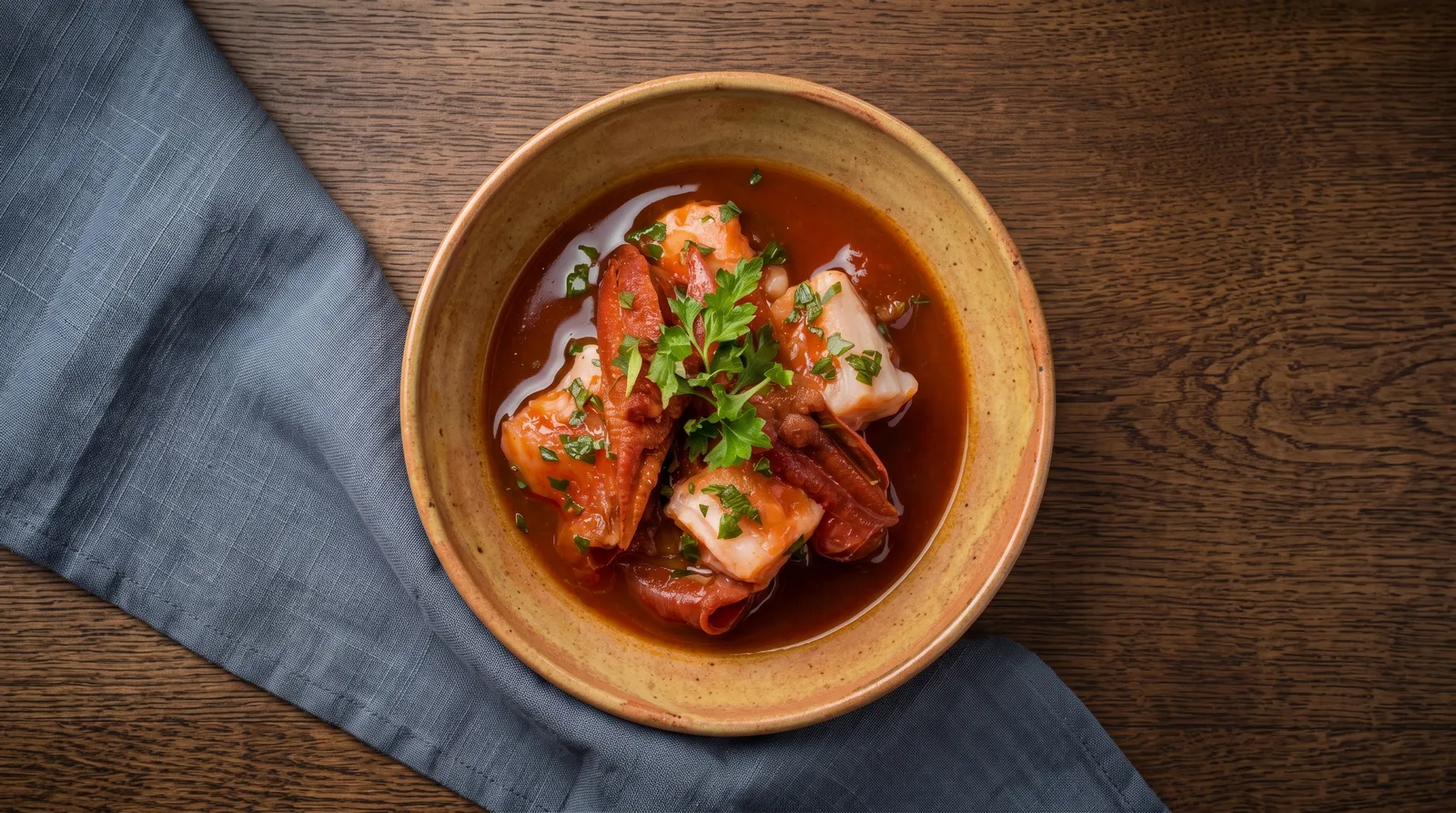
Cuttlefish is simmered until tender in a rust-coloured tomato and white-wine sauce, then finished off the heat with a pasteurised-yolk aïoli.

French National Dishes
Share
Rouille de seiche — served in a bowl
Prep time 30 minutes
Cook time 63 minutes
Total time 93 minutes
Yield about 1.7 kg finished cuttlefish and sauce
Introduction and overview

Rouille de seiche — Sétois cuttlefish in tomato, wine and aïoli

Rouille de seiche from the Sète and Hérault coast is a cuttlefish dish, not the orange garlic condiment served alongside bouillabaisse. Its colour comes from tomato concentrate cooked into the pan and from the long, reduced sauce around the seafood. White wine, onion, garlic, thyme and a little chilli build the savoury base; an aïoli made with pasteurised egg yolk is stirred in off the heat at the end, turning the sauce glossy and rounded without obscuring the cuttlefish.

Cuttlefish rewards a deliberate cooking curve. The pieces first go into a hot pan long enough to release and evaporate excess moisture. Onion and garlic are then softened, tomato concentrate is fried briefly to remove rawness, and white wine is reduced before water and herbs are added. The seafood must pass 63 °C for safety, but tenderness requires more than merely reaching that temperature. A low simmer of about 35 minutes gives the connective tissue time to relax; a short, hesitant cook can leave the cuttlefish rubbery.

The aïoli is made separately from pasteurised yolk, garlic, olive oil and lemon. It is never boiled into the sauce. Once the cuttlefish is tender, the pan comes off the heat and the aïoli is stirred in only long enough to bind the cooking liquid. That preserves the emulsion and keeps the garlic fresh rather than harsh. The wine contributes sulphites and the cuttlefish is a mollusc allergen; the pasteurised yolk adds egg. Keep the seafood chilled before cooking and refrigerate leftovers promptly.
Success points

Success points

  • Evaporate the cuttlefish's released water before the tomato and wine stages.
  • Let the wine reduce before adding the measured water.
  • Add the pasteurised aïoli only after the pan is off the heat.
Ingredients

Ingredients

Cuttlefish and tomato-wine sauce

  • 1000 g cleaned cuttlefish, commercially cleaned; cut into 3–4 cm pieces
  • 25 ml olive oil
  • 180 g onion, thinly sliced
  • 12 g garlic, finely chopped
  • 140 g double-concentrated tomato paste
  • 500 ml dry white wine
  • 400 ml water
  • 2 g fresh thyme leaves
  • 1 g bay leaf, 1 small leaf
  • 3 g fine salt
  • 1 g black pepper
  • 1 g bird's-eye chilli, finely chopped

Pasteurised aïoli liaison

  • 40 g pasteurised egg yolk, about 2 yolks
  • 15 g garlic, very finely grated
  • 160 ml olive oil
  • 15 ml lemon juice
  • 1 g fine salt
Method

Method

Build the stew

  1. Draw out the cuttlefish moisture. Heat 25 ml olive oil in a wide casserole, add the cuttlefish and cook for 8 minutes while it releases liquid. The cuttlefish should turn opaque and the pan should no longer hold a deep pool of released water.

  2. Soften the onion and garlic. Add the sliced onion and chopped garlic and cook for 7 minutes. The onion should be soft and lightly golden and the garlic should smell sweet rather than scorched.

  3. Fry the tomato concentrate. Stir in the tomato paste and cook for 3 minutes, scraping the base. The tomato paste should darken slightly and lose its raw metallic smell.

  4. Reduce the white wine. Pour in the white wine, bring to a lively simmer and cook for 10 minutes. The sharp raw-wine aroma should soften and the liquid should reduce visibly.

  5. Simmer until the cuttlefish is tender. Add the water, thyme, bay, salt, pepper and chilli. Simmer gently for 35 minutes, checking early in the simmer that the seafood has passed 63 °C, then continue until tender. A piece should cut easily with the side of a fork and the sauce should be medium-thick rather than watery.

Make and add the aïoli

  1. Make the pasteurised aïoli. Whisk the pasteurised yolk with the garlic, lemon juice and salt, then add 160 ml olive oil in a very thin stream over about 8 minutes. The aïoli should be thick, glossy and able to hold a soft ridge from the whisk.

  2. Bind the sauce off the heat. Remove the casserole from the heat. Whisk a ladle of sauce into the aïoli, then fold that mixture back through the cuttlefish for about 1 minute without returning it to the boil. The sauce should become smooth, rust-coloured and creamy without oily beads or curdling.

Serving

Practical

Serving

Serve hot with plain boiled potatoes or rice offered separately; neither accompaniment is included in the nutrition panel.

Storage and reheating

Refrigerate within 2 hours. Once the aïoli has been incorporated, keep up to 2 days and reheat very gently without boiling to avoid splitting.

Make-ahead and substitutions

The tomato-wine cuttlefish stew can be cooked to tenderness a day ahead; chill it before the aïoli is added, then reheat the stew gently and finish with freshly made pasteurised aïoli.

Substitution

Cleaned squid can replace cuttlefish. Effect: The dish remains a tomato-wine mollusc stew but loses the specific cuttlefish identity and may tenderise on a different schedule.

Troubleshooting

Troubleshooting

  • Cuttlefish is rubberyThe simmer stopped in the firm middle range. Continue a gentle simmer until the pieces cut easily rather than increasing the heat sharply.
  • Sauce splits after the aïoliThe sauce was boiling when the emulsion was added. Move off heat, temper the aïoli with a little sauce, then fold it in without boiling.
Nutrition per serving

Nutrition per serving

  • Serving sizeabout 285 g cuttlefish and sauce
  • Calories475 kcal
  • Carbohydrate15 g
  • Protein31 g
  • Fat28 g
  • Fibre2 g
  • Sodium760 mg
Allergens and food safety

Allergens and food safety

Allergens: Mollusc, Egg, Sulphites from white wine.

Keep cleaned cuttlefish refrigerated until cooking.

Cuttlefish must reach at least 63 °C; the stew then continues until tender.

Use pasteurised egg yolk for the aïoli because it is not fully cooked.

Refrigerate leftovers within 2 hours.

Handling warning: Do not return the pan to a boil after the aïoli is added; the emulsion can split. White wine contributes sulphites and some retained alcohol.

FAQ

FAQ

Is this the same rouille served with fish soup?

No. The name refers here to a Sétois cuttlefish preparation in a rust-coloured tomato and wine sauce, finished with aïoli.

Why not boil after adding the aïoli?

High heat can split the egg-and-oil emulsion. Stirring it in off the heat thickens and enriches the sauce more reliably.

Closing

Closing

  • Result: Tender cuttlefish is coated in a deep tomato-wine sauce with a final garlic-aïoli sheen.
  • Decisive technique: The decisive sequence is moisture evaporation, wine reduction, a patient low simmer and an off-heat aïoli finish.