French National Dishes

Galette aux pommes de terre berrichonne

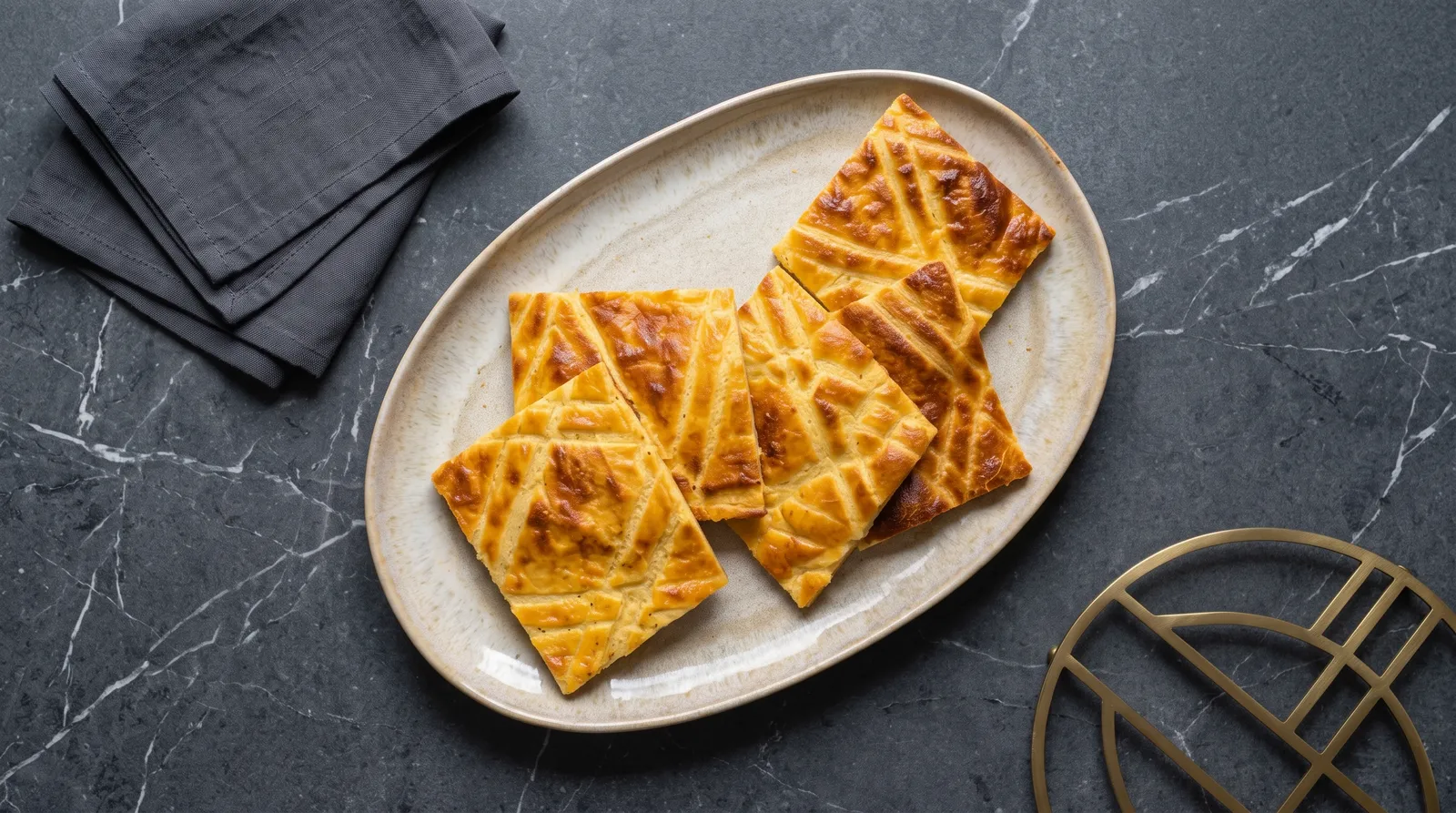
Ten layered Berry potato galettes made from dry cooled mash, wheat flour and goat faisselle, laminated with butter through six turns and baked until crisp.

French National Dishes
Share
Galette aux pommes de terre berrichonne — resting on a cooling rack
Prep 70 minutes
Cook 43 minutes
Total 328 minutes
Yield 10 rectangular galettes
Introduction and overview

Galette aux pommes de terre berrichonne: laminated Berry potato pastry

The Berrichon galette aux pommes de terre is a laminated pastry, not a grated-potato pancake. Dry mashed potato is worked with wheat flour, drained faisselle and egg yolk to form the base dough. A block of butter is then enclosed and the dough is rolled and folded repeatedly, building the layers that make the baked exterior crisp while the potato-enriched centre remains tender.

Moisture control starts before the dough exists. Floury potatoes are peeled, boiled until tender, drained thoroughly and mashed without milk or butter. The mash is spread out and cooled for 45 minutes until no steam remains. Mixing flour into hot, damp potato would make the dough sticky and would warm the lamination butter before the folds even begin.

The lamination uses six single turns arranged in three pairs, with a 30-minute refrigerator rest after each pair. The final sheet is rolled to 7–8 mm, cut into exactly 10 rectangles and brushed with a measured yolk wash. Clean cut edges matter: compressed or egg-smeared sides can seal layers that should lift in the 190 °C oven.
Success points

Success points

  • The mash must be dry and completely cool before flour and cheese are added.
  • Keep the butter cold but pliable through all six turns; chill between each pair of turns.
Ingredients

Ingredients

Potato dough

  • 420 g floury potatoes — purchased weight; peeled to about 360 g, boiled and drained to 300 g dry mash
  • 300 g plain wheat flour
  • 100 g goat-milk faisselle — well drained
  • 20 g egg yolk — for the dough
  • 9 g fine salt

Lamination and wash

  • 190 g unsalted butter — cold but pliable, shaped to about 20 × 12 cm
  • 20 g egg yolk — for wash
  • 10 ml water — for wash
Method

Method

Potatoes and dough

  1. Cook the potatoes. Peel the 420 g purchased potatoes to about 360 g, cut evenly and boil until completely tender, about 20 minutes. Drain very thoroughly and mash without milk or butter. The peeled potatoes are completely tender and steam-dry after draining, leaving about 300 g dry mash.

  2. Cool the mash completely. Spread the 300 g mash on a wide tray and leave it for 45 minutes. The 300 g mash is completely cool and dry to the touch, with no visible steam or condensation.

  3. Make the potato dough. Combine the cool mash with the 300 g flour, 100 g drained goat faisselle, 20 g yolk and 9 g salt. Mix just until uniform. The mash, flour, drained faisselle, 20 g yolk and salt form a soft uniform dough without wet pockets.

  4. Chill the dough. Flatten, cover and refrigerate the dough for 60 minutes at 4 °C. The dough is cold and firm enough to roll without sticking excessively.

Lamination

  1. Laminate the potato pastry. Shape the 190 g butter into a 20 × 12 cm rectangle. Roll the dough to about 25 × 50 cm, enclose the butter, and perform six single turns in three pairs. The butter remains in distinct flexible layers and the dough completes six even turns without ruptures or greasy patches.

  2. Rest between turn pairs. After each pair of turns, cover and refrigerate the dough for 30 minutes at 4 °C, for 90 minutes total. After each 30-minute rest, the dough is cold and relaxed enough to roll without springing or butter leakage.

  3. Cut ten portions. Roll the chilled pastry to an even 7–8 mm thickness and trim neatly into exactly 10 rectangles. The sheet is an even 7–8 mm thick and yields exactly 10 rectangles with minimal offcuts.

Bake

  1. Bake until layered and crisp. Mix the 20 g yolk with 10 ml water, brush the tops without flooding the cut edges, and bake at 190 °C for about 23 minutes. The exterior is crisp and deeply golden, visible layers have lifted, and the potato centre is fully baked rather than pasty.

  2. Cool briefly. Transfer the galettes to a rack and leave them for 20 minutes. The layers remain crisp and the centre is warm rather than steaming when cut.

Serving, storage and planning

Practical

Serving, storage and planning

Serve the galettes after 20 minutes on a rack, when the layers are still crisp but the centre is no longer releasing aggressive steam. They can be eaten warm or at room temperature; no salad, sauce or other accompaniment is included in the measured yield.

Serving, storage and planning

For make-ahead work, complete the lamination and keep the covered pastry at 4 °C until later the same day. Leftover baked pieces should be refrigerated within 2 hours. Reheat in a moderate oven to revive the layers; a microwave heats the centre but softens the laminated exterior.

Serving, storage and planning

Use a floury potato and genuinely drained faisselle. A waxy potato holds more moisture, while wet curd loosens the dough and makes the butter layers harder to maintain. Cow-milk faisselle can make a workable variation if equally well drained, but it does not preserve the exact goat-milk profile used here.

Troubleshooting

If butter smears through the surface while rolling, stop immediately and chill the dough. Continuing with soft butter merges the layers instead of laminating them.

Troubleshooting

Flat, dense layers usually mean the lamination was incomplete, too warm or sealed at the edges. Check that all six turns are completed, keep every rest cold and cut the final sheet cleanly without flooding the edges with egg wash.

Nutrition per serving

Nutrition per serving

  • Serving size1 of 10 galettes
  • Calories295 kcal
  • Carbohydrate39 g
  • Protein6 g
  • Fat13 g
  • Fibre2 g
  • Sodium380 mg
Allergens and food safety

Allergens and food safety

Allergen: Gluten from wheat.

Allergen: Milk from faisselle and butter.

Allergen: Egg from dough and egg wash.

Safety: Keep drained faisselle, yolks and laminated dough refrigerated at 4 °C during rests.

Safety: Cool the cooked mash completely before it contacts the lamination butter.

Safety: Refrigerate baked leftovers within 2 hours.

FAQ

FAQ

Is this the same as pâté berrichon aux pommes de terre?

No. That is an enclosed potato pie or tourte. This dish is a folded laminated pastry in which potato is incorporated into the dough itself.

Why cool the potatoes before mixing?

Cool, dry mash limits excess moisture and protects the butter layers that will be added later.

Closing

Closing

  • Result — ten golden potato pastries with a crisp laminated shell and a fully baked tender centre.
  • Decisive technique — start with completely cool dry mash and keep the six-turn butter lamination cold through every rest.