French National Dishes

Crêpes dentelle

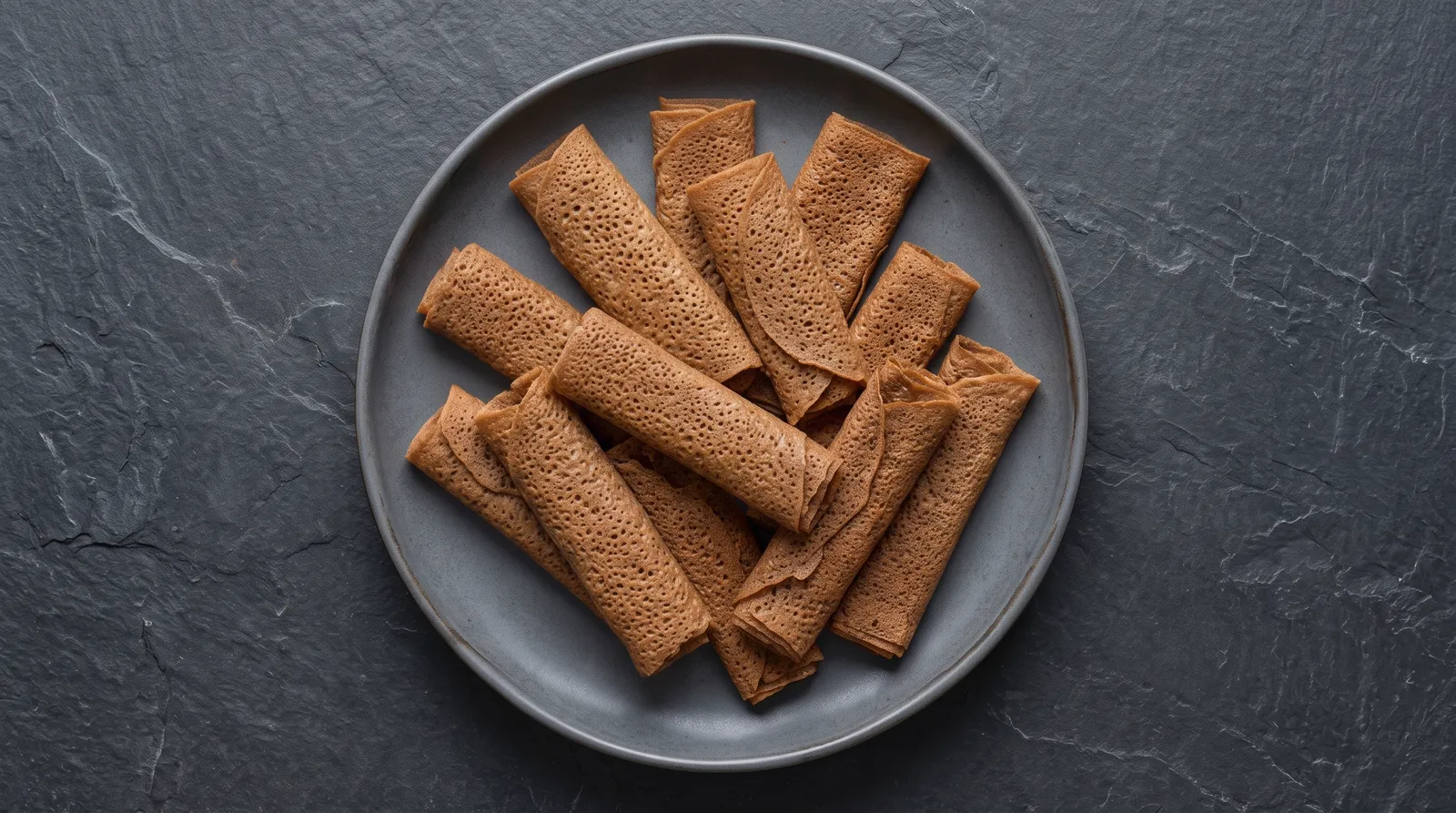
Exceptionally thin Breton crêpes cooked until dry and deep golden, folded or rolled into narrow layered pieces while hot, then cooled until brittle and crisp.

French National Dishes
Share
Crêpes dentelle — served on a plate
Prep 8 minutes
Cook 45 minutes
Total 103 minutes
Yield 20 crisp crêpes dentelle
Introduction and overview

Crêpes dentelle — thin Breton crisp crêpes folded hot

Crêpes dentelle are not miniature soft crêpes. Their defining character is an exceptionally thin layer that is cooked long enough to lose surface moisture, then folded or rolled rapidly while still hot. Once cool, the layered piece becomes brittle and audibly crisp. The familiar Breton style is associated with multiple turns; about eight layers give the narrow, delicate shape used here.

A household pan cannot reproduce every detail of commercial production, so the goal is the style rather than a claim of an exact factory clone. The batter is intentionally fluid and used in only 15 ml portions on a 24 cm smooth surface around 180 °C. Each piece dries more deeply than an ordinary crêpe before it is shaped.

Timing becomes a safety issue as well as a texture issue. The crêpe is too hot for bare fingers when it leaves the pan, yet it soon becomes too brittle to fold. A heatproof spatula or narrow turner does the shaping, and children should not perform that step. The final 20-minute cooling period is when the layered pieces lose their remaining steam and reach their crisp endpoint.
Success points

Success points

  • Use only about 15 ml batter per piece.
  • Dry deeply enough before folding; pale soft crêpes will not crisp.
  • Fold with a tool while hot, then cool completely before judging crispness.
Ingredients

Ingredients

Batter

  • 30 g unsalted butter, melted and cooled
  • 30 g plain wheat flour
  • 30 g icing sugar, sifted
  • 120 ml whole milk, cold
  • 50 g whole egg, about 1 large egg without shell
  • 0.5 g fine salt

Pan

  • 5 g unsalted butter, for wiping the pan
Method

Method

Batter and rest

  1. Mix the fluid batter. Whisk the flour, icing sugar and 0.5 g salt; add the egg and half the milk and whisk for 3 minutes until smooth, then whisk in the remaining milk and 30 g melted butter for 2 minutes. Tool or vessel: mixing bowl + whisk. Heat: none. Temperature: cool. Readiness: The batter is very fluid, smooth and free of flour lumps. Why it matters: A fluid batter is essential for a paper-thin layer. Safety: Do not taste raw flour or egg batter.

  2. Rest the batter cold. Cover and refrigerate for 30 minutes at 4 °C or below. Tool or vessel: covered bowl + refrigerator. Heat: none. Temperature: ≤4 °C. Readiness: The batter remains fluid after resting, with no thick dough-like body. Why it matters: Resting hydrates the small amount of flour. Safety: keep the raw batter cold.

Dry, fold and crisp

  1. Heat the smooth cooking surface. Heat a smooth 24 cm crêpe pan or billig for 5 minutes to about 180 °C and wipe with a minimal film from the 5 g butter. Tool or vessel: 24 cm crêpe pan or billig. Heat: medium-high. Temperature: about 180 °C surface. Readiness: A test drop sets at once without the butter smoking. Why it matters: A hot dry surface supports rapid spreading and drying.

  2. Dry each crêpe deeply. Working one at a time, pour about 15 ml batter and spread it exceptionally thin; cook on the first side for about 90 seconds until the surface is dry, the underside is deep golden and the edges are visibly dehydrated. Tool or vessel: same pan + offset or heatproof spatula. Heat: medium to medium-high. Temperature: about 175–185 °C surface. Readiness: Each crêpe is paper-thin, its surface is dry with no wet batter, and its underside is deep golden rather than pale and supple. Why it matters: The longer single-side drying distinguishes dentelle texture from ordinary crêpes. Safety: use a heatproof tool; the crêpe and pan are hot.

  3. Fold or roll while hot. While each crêpe is still hot and flexible, use a heatproof spatula to fold or roll it rapidly into a narrow strip with about eight turns/layers; transfer to a rack and repeat, allowing about 10 minutes total for the folding work across the batch. Tool or vessel: pan edge + heatproof spatula + cooling rack. Heat: off heat but crêpe hot. Temperature: hot. Readiness: Each piece holds a narrow layered shape before it cools and becomes brittle. Why it matters: The shape must be made while the crêpe is hot; cooling fixes the crisp layers. Safety: Do not use bare fingers on the hot crêpes; children should not perform this hot-folding step.

  4. Cool until brittle. Leave all finished pieces on the rack for 20 minutes to cool completely and crisp. Tool or vessel: cooling rack. Heat: none. Temperature: room temperature. Readiness: The cooled pieces are dry, brittle and audibly crisp rather than bendable. Why it matters: Final crispness develops after steam escapes during cooling.

Serving and practical guidance

Practical

Substitutions

- Cooking surface: A very smooth flat skillet may replace a billig if it can maintain about 180 °C and spread 15 ml batter thinly. A rough or undersized pan makes uniform ultra-thin spreading harder.

Troubleshooting

Troubleshooting

  • Problem 1Check the cause and correction. If the pieces stay soft after cooling, the crêpes were too thick or under-dried; use less batter and wait for a dry, deep-golden underside.
  • Problem 2Check the cause and correction. If they crack before folding, they cooled too long on the pan; begin folding as soon as the surface is dry and deeply coloured.
Nutrition per serving

Nutrition per serving

  • Serving size1 crisp crêpe dentelle
  • Calories31 kcal
  • Carbohydrate2.9 g
  • Protein0.7 g
  • Fat1.8 g
  • Fibre0.0 g
  • Sodium16 mg
Allergens and food safety

Allergens and food safety

Allergen: Gluten from wheat.

Allergen: Egg.

Allergen: Milk.

Safety: Do not taste raw flour-and-egg batter.

Safety: Keep resting batter at 4 °C or below.

Safety: Use a heatproof spatula for hot folding and keep children away from the hot pan and crêpes.

Closing

Closing

  • Result: Exceptionally thin Breton crêpes cooked until dry and deep golden, folded or rolled into narrow layered pieces while hot, then cooled until brittle and crisp.
  • Decisive technique: Use only about 15 ml batter per piece.