French National Dishes

Canelé de Bordeaux

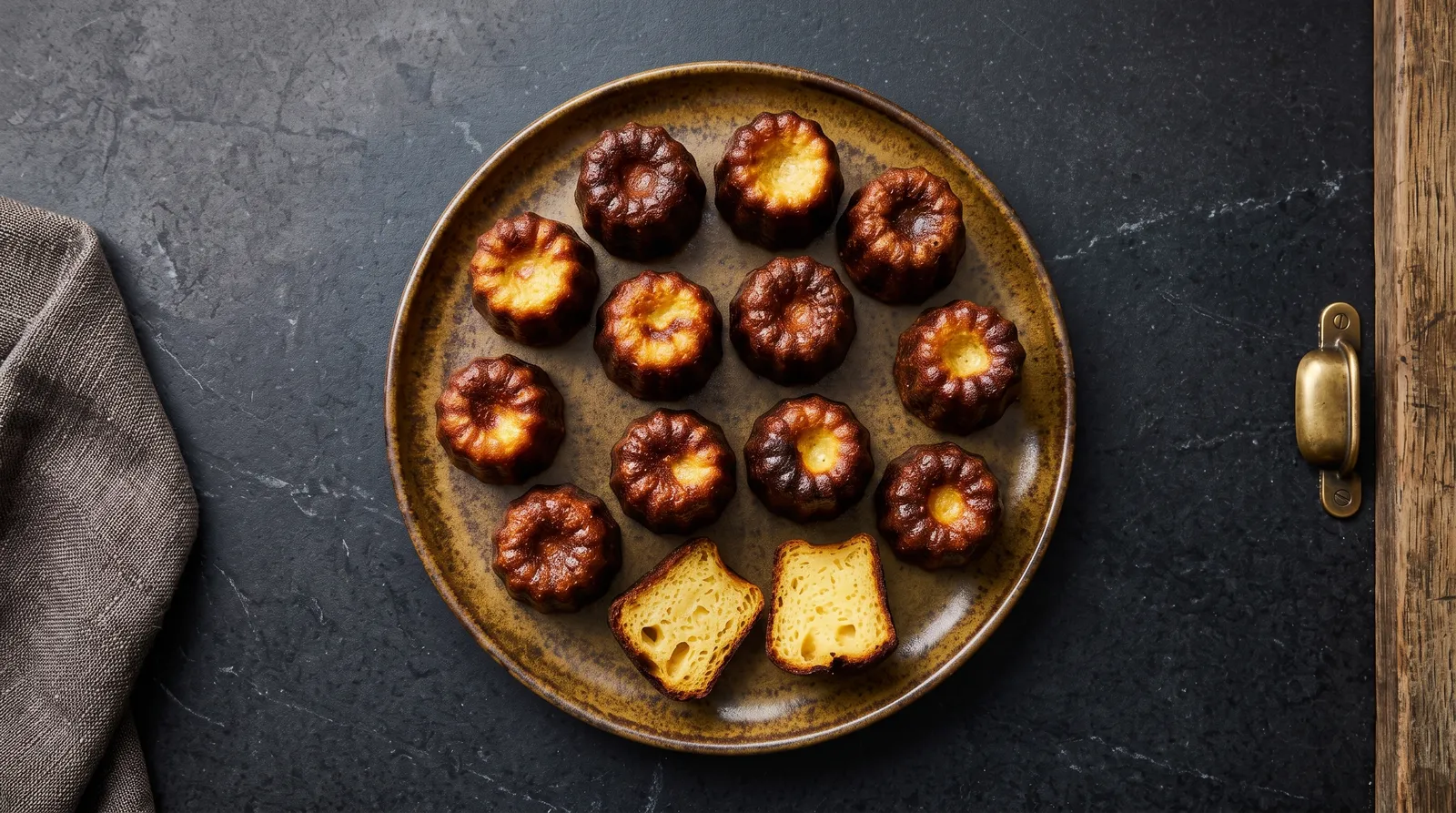
Eight large Bordeaux canelés made from a low-aeration vanilla-rum batter rested 24 hours, baked hot then lower for a deep mahogany shell and custardy centre.

French National Dishes
Share
Canelé de Bordeaux — shown with a cut section visible
Prep 30 minutes
Cook 65 minutes
Total 1595 minutes
Yield 8 large canelés in 55 mm moulds
Introduction and overview

Canelé de Bordeaux in 55 mm copper moulds

A Bordeaux canelé is defined by contrast: a deeply caramelised shell surrounds a tender, almost custardy centre scented with vanilla and rum. That texture cannot be rushed by treating the batter like cake mix. The mixture is unusually fluid, the flour needs time to hydrate, and excess whisking introduces bubbles that can distort the dense interior.

The batter starts with hot milk, butter and vanilla. Sugar and flour are combined before the eggs go in, then the hot milk is added gradually and the rum follows. Mix until smooth, not foamy, strain, and refrigerate for a full twenty-four hours. The rest is part of the schedule, not a hidden convenience step. Keep the batter at 4 °C or below because it contains raw egg and milk.

These proportions fill eight 55 mm copper moulds. Copper conducts heat rapidly enough to build the dark shell that makes the pastry distinctive. A thin butter coating helps release, but puddled fat can fry the exterior unevenly. Start at 240 °C, then lower to 180 °C without a long oven-door delay. Deep mahogany is the target colour. Unmould immediately and cool on a rack so steam does not soften the shell.
Success points

Success points

  • Mix for smoothness, not aeration.
  • Rest the batter for the full 24 hours under refrigeration.
  • Coat copper moulds very thinly.
  • Bake to deep mahogany and unmould while hot.
Ingredients

Ingredients

Batter

  • 500 ml whole milk.
  • 50 g unsalted butter, diced.
  • 5 g vanilla bean, 1 plump pod, split.
  • 250 g granulated sugar.
  • 125 g plain wheat flour, sifted.
  • 100 g whole egg, about 2 large eggs.
  • 36 g egg yolks, about 2 large yolks.
  • 50 ml dark rum.

Moulds

  • 20 g unsalted butter, melted, for a very thin mould coating.
Method

Method

Make and rest the batter

  1. Scald the vanilla milk. Heat the milk with the 50 g butter and split vanilla bean until steaming, then remove from the heat and infuse briefly. Target: about 85 °C. Time: 5 minutes. The milk is steaming and the butter has melted, with no vigorous boil. Scalding extracts vanilla and dissolves the butter without concentrating the milk.

  2. Mix without aerating. Whisk the sugar and flour together, then stir in the whole eggs and yolks just until smooth; gradually add the hot milk without whipping in foam, then stir in the rum. Time: 12 minutes. The batter is fluid and smooth with little or no foam on the surface. Minimal aeration supports the dense custardy centre rather than a cake-like crumb.

  3. Give the batter its cold rest. Strain the batter, cover and refrigerate before baking. Target: 4 °C or below. Time: 1440 minutes passive refrigeration. The rested batter is cold, fluid and free of flour lumps. A 24-hour rest hydrates the flour and develops the characteristic texture. Keep the egg-and-milk batter at 4 °C or below during the full rest.

Coat and bake

  1. Coat the copper moulds. Brush eight 55 mm copper canelé moulds with an extremely thin film of the 20 g melted butter and chill briefly until the coating is set. Time: 8 minutes. The mould interiors are evenly shiny with no puddles of butter. A thin coating promotes release without frying the sides.

  2. Start with high heat. Stir the cold batter gently, fill each mould to about 5 mm below the rim, place the moulds on a heavy baking tray and start the bake at high heat. Target: 240 °C. Time: 10 minutes. The batter rises toward the rim and the outer edge begins to colour quickly. The high-heat start drives strong crust formation in copper.

  3. Finish at lower heat. Lower the oven temperature without opening the door for long and continue baking until the shells are deep mahogany. Target: 180 °C. Time: 50 minutes. The exposed tops are deep mahogany-brown, not blond, and the centres feel set but still custardy rather than dry. The lower phase cooks the centre while the shell caramelises.

  4. Unmould and cool. Unmould immediately onto a wire rack and cool fully before serving. Time: 60 minutes passive cooling. The canelés stand upright with crisp dark shells and tender custardy centres. Prompt unmoulding prevents trapped steam from softening the crust.

Serving and storage

Practical

Serving and storage

Let the canelés cool completely before eating; the shell becomes crisp as steam escapes. They are best the day they are baked. Keep them loosely covered at cool room temperature for that day. For longer holding, refrigerate up to two days, accepting that the crust softens. Re-crisp for about five minutes at 200 °C, then cool for ten minutes before serving.

Make-ahead and mould choice

The batter is the make-ahead component and may remain refrigerated for up to forty-eight hours. Stir it gently before filling, without whipping. Silicone moulds can hold the batter, but they do not transfer heat like copper and generally produce a paler, softer crust; do not promise the same result from both materials.

Nutrition per serving

Nutrition per serving

  • Serving size1 large canelé
  • Calories310 kcal
  • Carbohydrate46 g
  • Protein6 g
  • Fat11 g
  • Fibre0.5 g
  • Sodium50 mg
Allergens and food safety

Allergens and food safety

Allergens: Milk; Egg; Wheat/gluten. Food safety: Keep the uncooked egg-and-milk batter refrigerated at 4 °C or below during its 24–48 hour rest. Bake until the structure is fully set; do not taste raw batter. Cool on a clean rack and refrigerate leftovers promptly if not eaten the same day.

FAQ

FAQ

Why is the batter rested so long?

The rest hydrates the flour and lets bubbles dissipate, helping the interior bake dense and custardy rather than cake-like.

Why unmould immediately?

Steam trapped in a hot mould softens the caramelised shell. Moving the canelé to a rack lets moisture escape.

Closing

Closing

  • Result: a dark mahogany, crisp shell around a vanilla-rum centre that stays tender and custardy.
  • Decisive technique: rest a minimally aerated batter for 24 hours and use a strong high-heat start in copper moulds.