French National Dishes

Canard à l’orange

A whole duck roasted to a safe 74 °C endpoint, rested and served with a bright orange sauce built from caramel, vinegar, stock and pan juices rather than a sweet glaze alone.

French National Dishes
Share
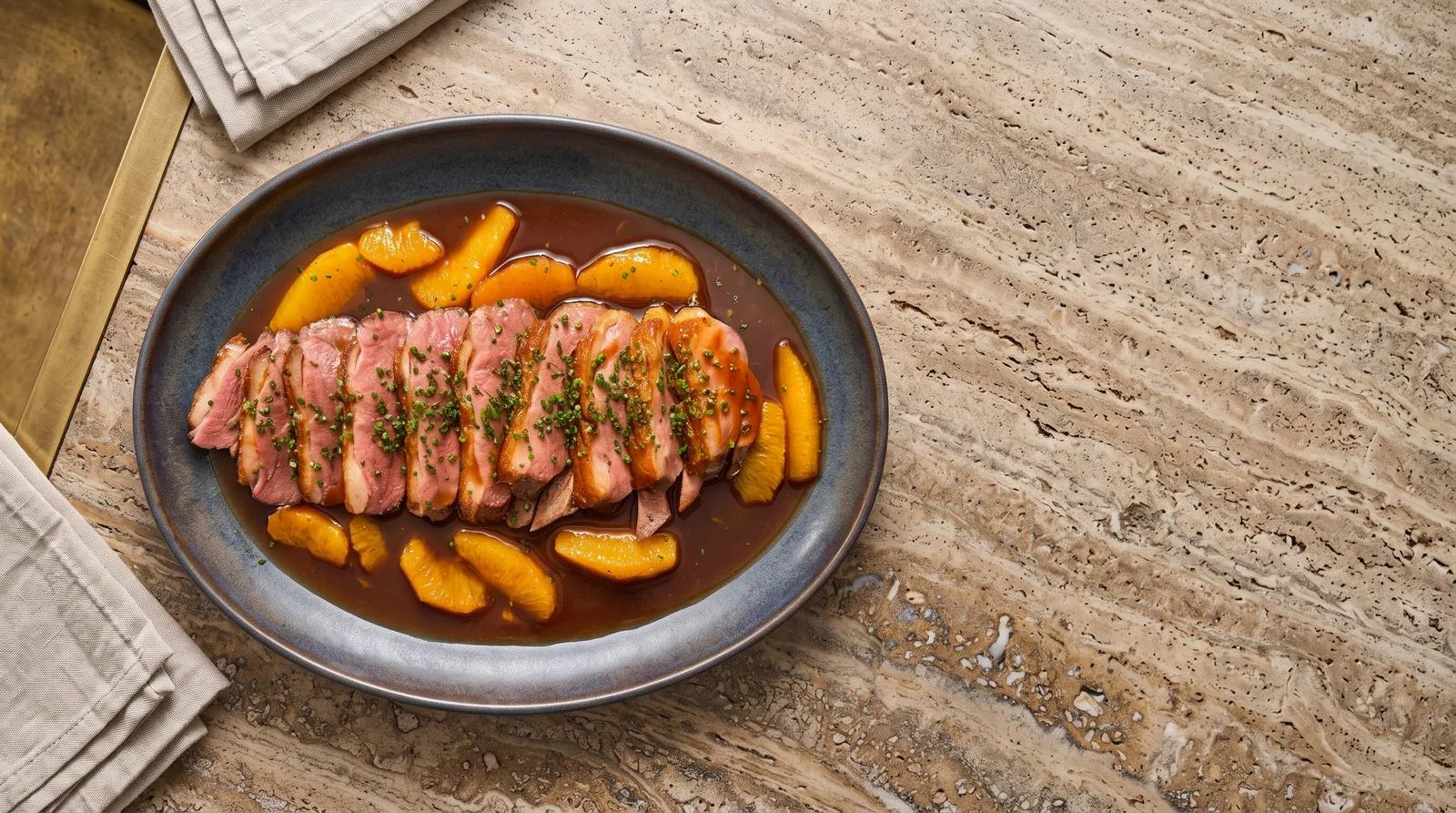
Canard à l’orange — arranged on a serving platter
Prep 35 minutes
Cook 115 minutes
Total 670 minutes
Yield 1 roast duck with sauce, 6 main-course servings
Introduction and overview

Whole roast canard à l’orange with a balanced orange gastrique sauce

Canard à l’orange works when the sauce cuts through duck fat instead of simply adding sweetness. A whole bird brings crisp skin, moist dark meat and enough roasting juices to give the sauce depth. Orange supplies zest and juice, but the classic French logic is broader: sugar is cooked to an amber caramel, vinegar sharpens it, and stock plus pan juices turn that sweet-acid base into a savoury sauce.

Dry skin is the first practical control. Season the duck and leave it uncovered in the refrigerator for eight hours so surface moisture can evaporate before roasting. The bird then starts in a hot oven to encourage rendering and colour before the temperature is lowered. Rendered fat is poured off safely rather than left to pool around the duck. Doneness is measured in the thickest part of the thigh, away from bone, and 74 °C is the safety endpoint; skin colour and juice colour are quality clues, not safety tests.

The sauce is made while the duck rests. Deep amber caramel gives a gentle bitter edge, red wine vinegar prevents cloying sweetness, and strained orange juice plus stock supply volume. A small cornstarch slurry gives predictable body, while cold butter rounds the finish. Spoon the sauce around the carved meat rather than covering every piece of skin so the crisp surface survives to the table.
Success points

Success points

  • Give the seasoned duck the full uncovered refrigerator dry.
  • Pour off rendered fat before it smokes or burns.
  • Measure 74 °C in the thickest thigh and rest before carving.
  • Keep the sauce balanced with acidity; it should be glossy, not jammy.
Ingredients

Ingredients

Duck

  • 2200 g whole oven-ready duck, neck and giblets removed, thoroughly chilled.
  • 10 g fine salt.
  • 2 g black pepper, freshly ground.

Orange sauce

  • 600 g oranges, about 3 medium; scrubbed, zest pared from 1 and juice strained.
  • 80 g granulated sugar.
  • 60 ml red wine vinegar.
  • 400 ml unsalted poultry stock, hot.
  • 30 g unsalted butter, cold, diced.
  • 10 g cornstarch.
  • 20 ml cold water.
Method

Method

Dry and roast the duck

  1. Dry-season the whole duck. Pat the duck completely dry, season inside and out with the salt and pepper, set it breast-side up on a rack and refrigerate uncovered. Target: 4 °C or below. Time: 480 minutes passive refrigeration. The skin feels dry and slightly tacky rather than wet. Air-drying promotes more even rendering and browning. Keep raw duck at 4 °C or below and prevent drips onto ready-to-eat foods.

  2. Prepare the skin for roasting. Bring the duck from the cold, prick only the fatty skin around the thighs without piercing meat, and let it lose the refrigerator chill. Time: 20 minutes. The surface remains dry and no liquid has pooled in the cavity. A short tempering period supports more even roasting without prolonged room-temperature holding.

  3. Start the roast hot. Roast the duck breast-side up, then carefully pour off rendered fat from the tray. Target: 220 °C. Time: 20 minutes. The skin has begun to bronze and a visible layer of fat has rendered into the tray. The initial high heat starts skin rendering and colour. Handle hot rendered fat cautiously and keep raw-duck utensils separate.

  4. Finish the roast safely. Continue roasting at the lower temperature until the thickest part of the thigh, away from bone, reaches the safety endpoint. Target: 180 °C. Time: 70 minutes. The skin is deep golden-brown and the thickest thigh registers 74 °C. The lower phase cooks the bird through while limiting scorching. 74 °C in the thickest thigh is the mandatory safety endpoint; colour or clear juices alone are not sufficient.

  5. Rest before carving. Transfer the duck to a clean board and rest loosely tented. Time: 20 minutes passive resting. The duck remains hot and the juices settle before carving. Resting reduces juice loss during carving.

Build the sauce and serve

  1. Build the gastrique. While the duck rests, caramelise the sugar in a clean saucepan to a deep amber, then remove briefly from the heat and add the vinegar in a thin stream. Target: 170 °C. Time: 8 minutes. The caramel is deep amber, not black, and the sharp vinegar has loosened the sugar without hard lumps. The gastrique supplies bitterness, sweetness and acidity. Stand back from steam and splatter when adding vinegar to hot caramel.

  2. Reduce with orange and stock. Add the orange juice, pared zest, hot stock and defatted roasting juices; simmer until the sauce is reduced by roughly one third. Time: 12 minutes. The sauce tastes balanced rather than syrupy and lightly coats a spoon. Reduction concentrates orange and roast-duck flavour.

  3. Give the sauce its body. Stir the cornstarch into the 20 ml cold water, whisk it into the simmering sauce, cook briefly, then remove the zest and whisk in the cold butter. Time: 5 minutes. The finished sauce is glossy and lightly nappant, with no raw starch taste. A small starch addition stabilises body without turning the sauce into a glaze.

  4. Carve and sauce. Carve the duck on a clean board, portion the meat and spoon the sauce around rather than over all the crisp skin. Time: 10 minutes. Each serving includes moist duck, crisp skin and a bright orange sauce with a distinct acidic edge. Keeping some skin above the sauce preserves its crispness.

Serving, cooling and reheating

Practical

Serving, cooling and reheating

Carve just before serving and give each plate a mix of breast or leg meat, crisp skin and orange sauce. Cool leftovers promptly and refrigerate within two hours at 4 °C or below. Keep cooked duck for three to four days. Reheat meat with a little sauce until it reaches 74 °C; skin can be re-crisped separately in a hot oven so the sauce does not make it leathery.

Make-ahead and substitutions

The caramel-vinegar base can be made earlier in the day. Finish it with orange juice, stock and pan juices while the duck rests, then whisk in butter at the end. White wine vinegar can replace red wine vinegar in the same volume; the sauce will be paler and a little sharper, but the sweet-acid structure remains intact.

Nutrition per serving

Nutrition per serving

  • Serving sizeabout 180 g carved cooked duck with 80 g sauce
  • Calories740 kcal
  • Carbohydrate20 g
  • Protein36 g
  • Fat56 g
  • Fibre0.2 g
  • Sodium780 mg
Allergens and food safety

Allergens and food safety

Allergens: Milk (butter). Food safety: Keep raw duck at 4 °C or below before roasting and avoid cross-contamination. Cook whole duck until the thickest thigh reaches 74 °C measured away from bone. Refrigerate cooked duck within 2 hours and use refrigerated leftovers within 3–4 days; reheat leftovers to 74 °C.

FAQ

FAQ

Can the duck be judged by clear juices?

No. The safety decision comes from a thermometer reading of 74 °C in the thickest part of the thigh, away from bone.

Why rest the duck before carving?

The rest lets the internal juices redistribute and gives enough time to reduce and finish the sauce without rushing the carve.

Closing

Closing

  • Result: crisp-skinned roast duck with a savoury orange sauce that is sweet, acidic and lightly bitter rather than sticky.
  • Decisive technique: dry the bird before roasting and use a thermometer, then finish the sauce during the rest.