French National Dishes

Calissons d’Aix

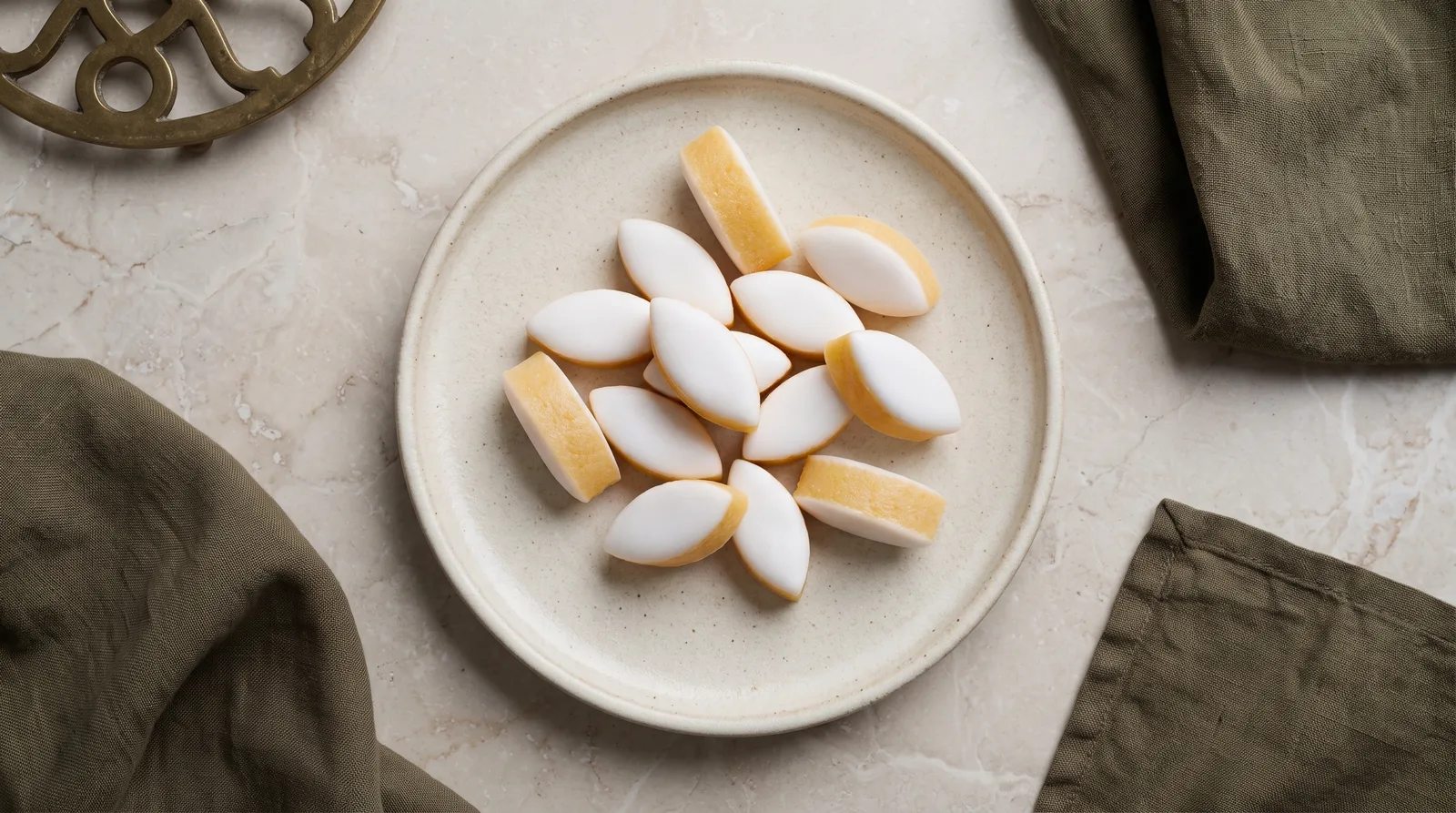
A home-scale Aix-style calisson with a fine almond-and-candied-melon centre, thin wafer base and matte royal icing, dried gently so the surface is neat while the middle stays soft.

French National Dishes
Share
Calissons d’Aix — served on a plate
Prep 55 minutes
Cook 25 minutes
Total 860 minutes
Yield 40 calissons
Introduction and overview

Calissons d’Aix with candied melon, almond and royal icing

Calissons d’Aix are small Provençal confections built from three contrasting layers: a soft, finely ground almond-and-candied-fruit paste, a paper-thin wafer underneath, and a white royal icing on top. The characteristic shape is an elongated lozenge or navette rather than a square sweet. Candied melon is not a decorative extra here; it is one of the ingredients that gives the Aix confection its supple, fruit-led centre, with orange peel supplying a brighter citrus note.

The most important texture decision happens before the sweets are cut. The fruit and almond mixture needs enough moisture to stay tender, but not so much that it drags under the cutter or bleeds into the wafer. A short, very gentle pan-drying phase is followed by a long uncovered rest. That combination gives the paste a dry surface for clean shaping without turning the centre into marzipan-like candy. Process the almonds only as long as necessary because over-processing can release oil and make the paste greasy.

The icing is deliberately made with pasteurized egg white. It is set at only 100 °C, a low treatment chosen to dry the surface rather than to validate raw egg safety. Once cooled, a good calisson should have a matte white top, a wafer that stays attached, and a centre that is soft, slightly grainy and aromatic rather than sticky. The professional name and manufacturing standards around Aix should not be confused with certification of a home batch; this method aims for the recognised composition and shape without making a commercial-status claim.
Success points

Success points

  • Keep the paste fine but do not grind so long that the almonds release visible oil.
  • Dry the slab before cutting; a wet top tears and drags under the cutter.
  • Spread only a thin icing layer so it sets matte rather than staying gummy.
Ingredients

Ingredients

Fruit-almond paste

  • 250 g blanched ground almonds, finely ground.
  • 220 g candied melon, diced.
  • 60 g candied orange peel, diced.
  • 170 g icing sugar.
  • 15 ml orange blossom water.

Base and royal icing

  • 35 g potato-starch wafer sheets, enough for a 30 × 30 cm area; Use wafer/host paper whose ingredient list is gluten-free if that claim matters.
  • 30 g pasteurized egg white, about 1 large egg white.
  • 120 g icing sugar.
  • 5 ml lemon juice.
Method

Method

Make and dry the paste

  1. Grind the candied fruit. Pulse the candied melon and orange peel to a smooth, dense fruit paste. Time: 8 minutes. The fruit paste is smooth with no pieces larger than a few millimetres. Fine fruit particles give the calisson centre its characteristic even bite.

  2. Bring the paste together. Add the ground almonds, 170 g icing sugar and orange blossom water; process only until an even paste forms. Time: 7 minutes. The paste is fine, firm and slightly tacky rather than wet. Avoiding prolonged processing limits oil release from the almonds.

  3. Dry the paste gently. Warm the paste in a wide non-stick saucepan, stirring continuously to drive off excess moisture. Target: about 70 °C. Time: 8 minutes. The paste pulls cleanly from the pan and no longer smears wetly on a cool plate. Gentle drying gives a cuttable centre without browning the fruit.

  4. Roll the wafer-backed slab. Press the warm paste onto the wafer to an even 8 mm thickness and smooth the surface. Time: 12 minutes. The slab is an even 8 mm thick with no exposed gaps in the wafer. Uniform thickness gives predictable drying and piece size.

  5. Give the slab its dry rest. Leave the slab uncovered in a cool dry room until the top is dry enough to cut cleanly. Time: 600 minutes passive drying. The surface feels dry, while the centre remains soft when pressed at an edge. The long dry rest firms the paste without baking away its soft centre.

Cut, ice and set

  1. Cut the lozenges. Cut 40 lozenges about 5 cm long and 2.5 cm wide, cutting through the wafer with each piece. Time: 18 minutes. The cut edges are neat and the wafer remains attached to the underside. The elongated lozenge is part of the recognisable Aix form.

  2. Mix a dense royal icing. Stir the pasteurized egg white, 120 g icing sugar and lemon juice into a thick, smooth royal icing without whipping in excess air. Time: 5 minutes. The icing falls slowly from the spatula and levels without running down the sides. A dense glaze gives a smooth white shell.

  3. Set the icing gently. Coat the tops thinly with royal icing and set the calissons in a low oven. Target: 100 °C. Time: 15 minutes. The icing is matte and dry to the touch but has not browned. Low heat sets the surface while protecting the soft centre. Use pasteurized egg white because the icing receives only a low setting treatment.

  4. Finish the cooling. Cool completely on a rack before packing airtight. Time: 180 minutes passive cooling. The surface is dry and firm, while the centre remains soft and slightly grainy. Complete cooling prevents condensation in storage.

Serving and storage

Practical

Serving and storage

Serve calissons at cool room temperature, where the almond and candied-fruit centre is softest. Two pieces make a useful tasting portion. Once the icing has fully dried and the sweets are completely cool, layer them between baking paper in an airtight tin. Keep the tin in a cool, dry cupboard for up to two weeks. Refrigeration is usually unnecessary and can introduce condensation that softens the icing and wafer.

Make-ahead and substitutions

The uncut paste slab can complete its first drying period overnight, which makes this confection easier to divide over two days. The paste itself should stay built around almond and candied melon. Candied lemon peel can replace some orange peel if a deliberate citrus variation is wanted, but that changes the aroma; it should not be presented as identical to the orange-led batch. Reheating is not appropriate.

Nutrition per serving

Nutrition per serving

  • Serving size2 calissons (about 43 g)
  • Calories185 kcal
  • Carbohydrate29 g
  • Protein3 g
  • Fat6 g
  • Fibre1.5 g
  • Sodium10 mg
Allergens and food safety

Allergens and food safety

Allergens: Tree nuts (almond); Egg; Check wafer composition for wheat/gluten if using a wheat-based wafer rather than the specified potato-starch wafer. Food safety: Use pasteurized egg white for the royal icing because the 100 °C oven stage is a setting/drying step, not a validated pasteurization process. Keep pasteurized egg white refrigerated at 4 °C or below until use. Discard sweets showing moisture condensation, off odour or mould rather than extending the stated dry-storage period.

FAQ

FAQ

Why use pasteurized egg white?

The royal icing is only dried at low heat. Pasteurized egg white removes the avoidable raw-egg risk without changing the basic icing structure.

Why not refrigerate the finished sweets?

A cool dry cupboard better protects the dry icing and wafer. Refrigeration can create surface condensation when the tin is opened.

Closing

Closing

  • Result: a dry white shell and wafer base around a soft, fine almond-and-candied-melon centre.
  • Decisive technique: dry the paste and icing gently rather than baking the confection hard.