French National Dishes

Cabri massalé

A Réunion-style goat preparation with massalé spice, turmeric, ginger, chilli and caloupilé, browned first and simmered slowly to fork tenderness in a shallow spice-rich sauce.

French National Dishes
Share
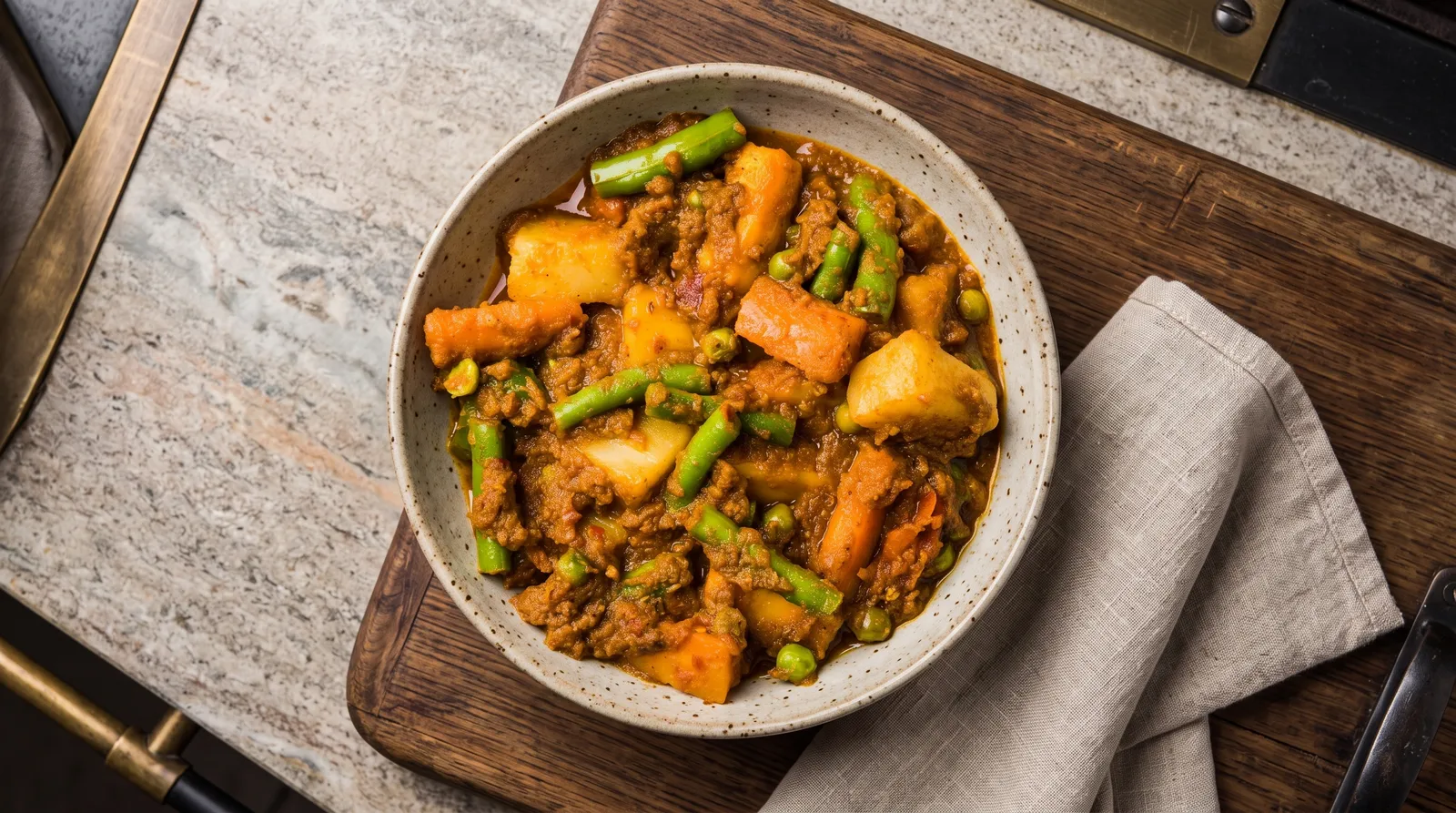
Cabri massalé — served in a bowl
Cook 135 minutes after 30 minutes of active preparation
Passive 0 minutes, in addition to 135 minutes of cooking
Calories per serving 296 kcal; total elapsed time 165 minutes
Yield 6 main-course portions
Introduction and overview

Réunionnais Cabri Massalé

Cabri massalé belongs to the cooking of Réunion and should not be flattened into a generic goat curry. The name signals the importance of massalé seasoning, while ginger, garlic, turmeric, chilli and caloupilé reinforce the island's aromatic profile. In this preparation the goat is not wine-marinated and the sauce does not follow an Antillean ragoût structure, keeping it clearly separate from cabri en sauce.

Boneless goat shoulder is browned first so the meat contributes roasted depth before any water is added. The onions, garlic and ginger are softened in the same pot, then the massalé and turmeric are heated briefly in the fat. This stage must be restrained: ground spices need enough heat to release aroma, but once scorched they become harsh and bitter. Water goes in as soon as the spice mixture smells fragrant.

The long quiet simmer does the remaining work. Small bubbles are enough; a rolling boil is unnecessary and can reduce the liquid before the shoulder has softened. After roughly 100 minutes the meat should yield readily to a fork and the liquid should have tightened into a shallow sauce that clings to the cubes. A final five-minute uncovered reduction is only for body, not for continued frying of the spice paste.
Success points

Success points

  • Brown the goat before the liquid stage.
  • Fry massalé and turmeric gently and briefly, stopping before any spice powder blackens.
  • Let the shoulder become fork-tender at a quiet simmer rather than forcing a rapid boil.
Ingredients

Ingredients

Cabri massalé

  • 1200 g goat shoulder, boneless, cut into 4 cm pieces
  • 220 g red onion, thinly sliced
  • 20 g garlic, crushed
  • 20 g fresh ginger, grated
  • 30 g Réunion-style massalé spice blend, unsalted
  • 6 g ground turmeric
  • 5 g fresh curry leaves (caloupilé)
  • 5 g bird's-eye chilli, finely chopped
  • 30 ml neutral oil
  • 700 ml water
  • 12 g fine salt
  • 2 g black pepper
  • 30 g spring onion, thinly sliced, to finish
Method

Method

Brown and season

  1. Brown the goat. Pat the goat dry and brown it in the oil in batches, transferring browned pieces to a bowl. Continue for about 15 minutes. The goat has browned edges while the pot fond is dark brown rather than burnt. Dry meat and small batches promote browning.

  2. Bloom the Réunion spices. Lower the heat and soften the onion, garlic and ginger, then stir in the massalé, turmeric, curry leaves and chilli just long enough to smell toasted spice without scorching it. Continue for about 10 minutes. The onion is soft and the spice mixture smells fragrant without blackened powder on the pan base. Ground spices need brief fat contact but become bitter if burned.

Simmer

  1. Bring the braise to a quiet simmer. Return the goat, add the water and salt, bring to a gentle simmer and partly cover. Continue for about 5 minutes. Temperature target: 95 °C. The liquid reaches a quiet simmer with small bubbles rather than a hard rolling boil. Gentle heat starts the braise without toughening the exterior.

  2. Cook until fork-tender. Simmer slowly until the goat is fork-tender and the liquid has reduced to a shallow, spice-rich sauce. Continue for about 100 minutes. Temperature target: 95 °C. A fork enters the meat easily and the cubes yield without springing back. The sauce clings lightly to the goat and is no longer watery. Long moist heat tenderizes shoulder while concentrating the spice base. The stew cooks well beyond the 63 °C minimum for whole cuts of goat.

  3. Reduce and finish. Uncover and reduce briefly if needed, then remove from the heat and scatter over the spring onion. Continue for about 5 minutes. The finished sauce coats the meat without a greasy pool and the curry leaves remain aromatic rather than burnt. The last reduction adjusts body without prolonged spice frying.

Practical guidance

Practical

Practical guidance

Serve with plain rice and, if desired, a simple lentil or bean accompaniment. The quiet starches let the massalé and caloupilé remain the dominant aromas.

Practical guidance

The stew can be cooked one day ahead. Cool it promptly, refrigerate at 4 °C or below and bring it back to 74 °C when reheating.

Practical guidance

If the refrigerated sauce sets firmly, loosen it with only a small amount of water during reheating. Excess water dilutes the spice concentration and creates a soup rather than a coating sauce.

Practical guidance

Bone-in goat shoulder is a reasonable structural alternative when the edible meat quantity is kept similar. It can need extra time and will give the cooking liquid more gelatin and bone flavour.

Troubleshooting

Troubleshooting

  • The sauce tastes harsh and bitter.The ground spice scorched during frying. Keep the heat medium-low and add the liquid as soon as the spices smell fragrant.
  • The goat is tender but the sauce is watery.Too little evaporation occurred near the end. Uncover and reduce for a few minutes while stirring so the spice solids do not catch.
Nutrition per serving

Nutrition per serving

  • Serving size1 of 6 portions
  • Calories296 kcal
  • Carbohydrate7 g
  • Protein43 g
  • Fat10 g
  • Fibre2 g
  • Sodium946 mg
Allergens and food safety

Allergens and food safety

Allergen note: Check the ingredient label of any commercial massalé blend for undeclared or cross-contact allergens; none is assumed beyond the listed formula.

Safety: Keep raw goat at 4 °C or below before cooking and avoid cross-contact.

Safety: Whole-cut goat has a minimum 63 °C safety endpoint with a rest, while this long simmer goes beyond it for tenderness.

Safety: Reheat leftovers to 74 °C.

Frequently asked questions

Frequently asked questions

Is cabri massalé the same as a generic curry?

No. The Réunionnais name points to a specific massalé seasoning context and island cooking tradition; a random curry powder does not preserve the same profile.

Why does massalé taste bitter?

Ground spice is likely scorched. Use medium-low heat, stir continuously and add the liquid once the spice smells fragrant.

Closing

Closing

  • Result — tender goat in a concentrated Réunionnais spice sauce with massalé, turmeric, ginger and caloupilé.
  • Decisive technique — brown first, toast the spice gently without scorching and give shoulder enough low simmering time to soften.