French National Dishes

Bottereaux

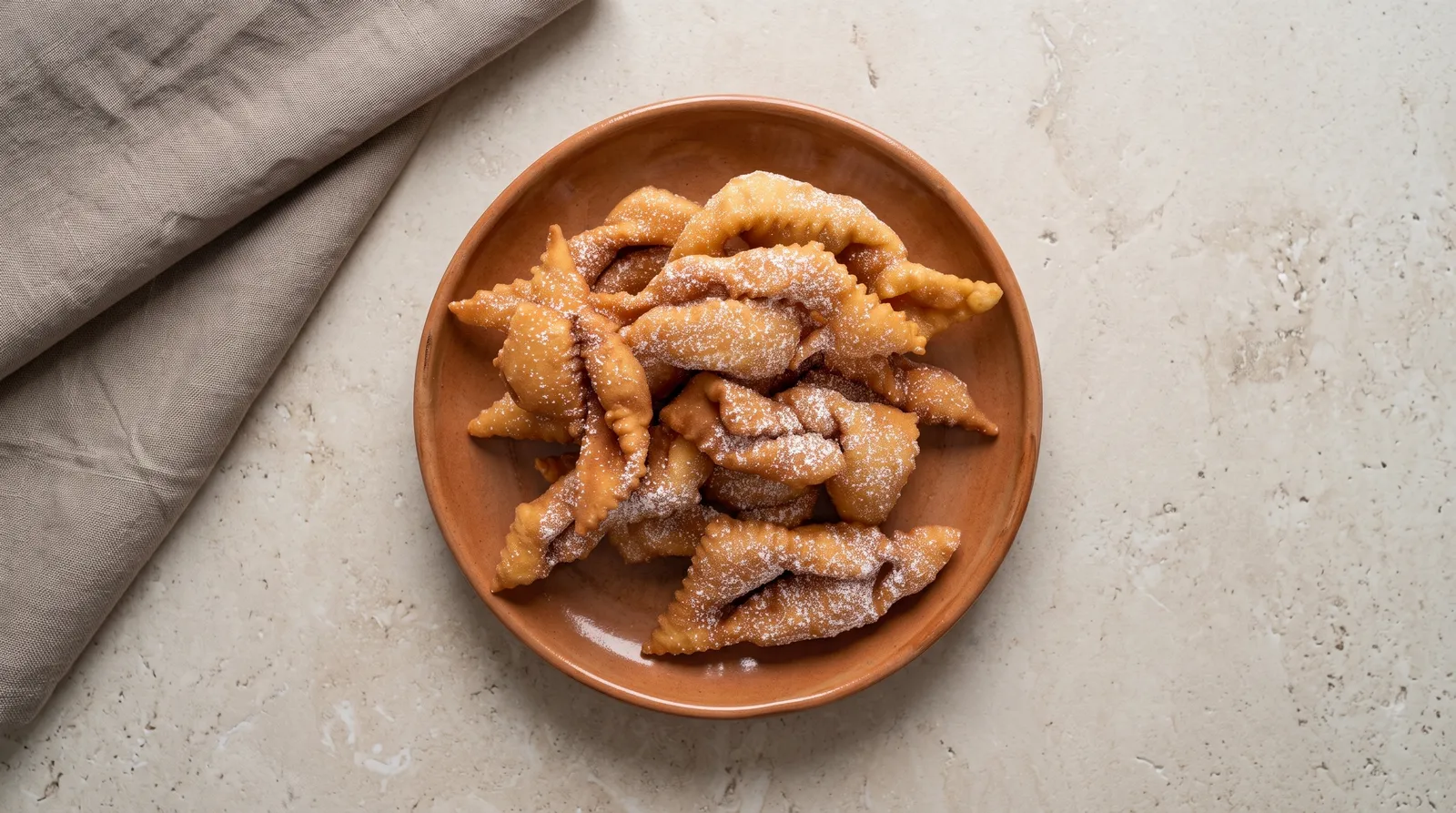
Small Anjou-style yeast fritters made from an enriched orange-blossom dough, rested for one hour, rolled to a controlled thickness, cut into diamonds and fried until puffed and golden.

French National Dishes
Share
Bottereaux — served in a bowl
Prep 30 minutes
Cook 15 minutes
Total 120 minutes
Yield About 30 small fritters
About this dish

Anjou-style bottereaux — orange-blossom carnival fritters

Bottereaux belong to the broad family of western French carnival fritters, but that does not make every regional beignet or merveille the same pastry. This recipe follows an Anjou-style path: a rich dough with eggs and butter, baker’s yeast, sugar and orange-blossom water. The one-hour rest lets the dough relax and gain a little volume before it is rolled, giving a lighter centre than an un-rested scrap of dough would produce.

Thickness is a practical identity control. Roll the dough between 5 and 10 mm, then cut pieces about 4–5 cm across. Pieces much thicker than that can brown before the centre cooks; pieces that are too thin become brittle rather than softly frittered inside. The shape can be diamond-like or rectangular, but the batch should remain similar in size so each load spends roughly the same time in the oil.

As with bokit, the frying medium is not the same as the amount of oil actually eaten. One litre gives safe depth and thermal stability, while the nutrition estimate counts about 80 g retained across the whole batch. Fry in three short batches at 175 °C, drain on a rack, and include the 15-minute cooling period in the total time. Icing sugar goes on only after that cooling step so it stays powdery rather than dissolving into surface steam.
Success points

Success points

  • Rest the enriched dough for the full hour.
  • Keep the rolled dough within 5–10 mm thickness.
  • Cut similar 4–5 cm pieces.
  • Return the frying oil to 175 °C before each batch.
Ingredients

Ingredients

  • 500 g wheat flour
  • 7 g instant dry baker’s yeast
  • 125 g caster sugar
  • 150 g whole egg, about 3 large eggs, beaten
  • 150 g unsalted butter, melted and cooled
  • 75 ml water, warm
  • 40 ml orange-blossom water
  • 2 g fine salt
  • 1000 ml sunflower oil, for frying; estimated retained oil 80 g across the batch
  • 30 g icing sugar, for finishing
Method

Method

Make and rest the dough

  1. Mix the enriched dough. Dissolve the yeast in the warm water, then mix with flour, sugar, beaten egg, melted butter, orange-blossom water and salt to form a soft enriched dough. Time: 12 minutes. Continue until the dough is soft, cohesive and evenly moistened with no dry flour.

  2. Rest for fermentation. Cover and let the dough rest and rise at warm room temperature. Time: 1 hour resting. Continue until the dough is slightly puffed and relaxed enough to roll without springing back strongly.

  3. Roll and cut. Roll the dough 5–10 mm thick and cut into diamonds or rectangles about 4–5 cm across. Time: 15 minutes. Continue until the pieces are evenly thick and close in size so they fry at the same rate.

Fry and cool

  1. Fry the first batch. Fry the first third of the dough pieces, turning as needed. Maintain 175 °C. Time: 5 minutes. Continue until the first batch is puffed, crisp at the edges and golden on both sides.

  2. Fry the second batch. Fry the second third after the oil returns to temperature. Maintain 175 °C. Time: 5 minutes. Continue until the second batch is puffed, crisp at the edges and golden on both sides.

  3. Fry the final batch. Fry the final third, then drain all fritters on a rack. Maintain 175 °C. Time: 5 minutes. Continue until the final batch is puffed and golden and the surfaces are no longer visibly wet with oil.

  4. Cool before dusting. Cool the fritters before dusting with icing sugar. Time: 15 minutes passive cooling. Continue until the fritters are cool enough that the icing sugar remains powdery instead of melting.

Practical guidance

Practical

Serving

Dust with icing sugar only after the fritters have cooled enough to keep the sugar dry. Serve the same day for the crispest edges.

Make-ahead

The dough can be mixed shortly before the planned one-hour rest, but the fritters are best fried and cooled on the day they are eaten.

Storage and reheating

Once fully cool, keep airtight at cool room temperature for up to 1 day. Refrigeration is not preferred because it softens fried dough.

Valid substitutions

- orange-blossom water: A small amount of rum or eau-de-vie appears in some regional formulas. The aromatic profile changes and alcohol would need to be stated; this formula keeps orange blossom only.

Troubleshooting

Troubleshooting

  • Heavy frittersthe oil was too cool; restore 175 °C before continuing.
  • Raw centrethe dough was rolled too thick or pieces were oversized; keep the 5–10 mm and 4–5 cm dimensions.
  • Sugar turns wetthe fritters were dusted hot; cool them fully enough for the surface steam to dissipate.
Nutrition per serving

Nutrition per serving

  • Serving sizeAbout 3 fritters
  • Calories445 kcal
  • Carbohydrate54 g
  • Protein7 g
  • Fat22 g
  • Fibre2 g
  • Sodium105 mg
Allergens and food safety

Allergens and food safety

Allergens: Wheat/gluten, Egg, Milk.

Keep water away from the hot frying oil and use a deep stable pot.

Maintain frying oil near 175 °C and never leave it unattended.

Cool completely before airtight storage to avoid trapped condensation.

FAQ

FAQ

Are bottereaux the same as every French carnival fritter?

No. Related names and styles overlap, but this recipe stays with an Anjou-style yeast-raised form instead of treating all regional fritters as interchangeable.

Why wait before adding icing sugar?

Steam from hot fritters melts the sugar. Cooling first keeps the finish dry and visible.

Closing

Closing

  • Result: Puffed, golden fritters with crisp edges, a tender enriched centre and a light orange-blossom perfume.
  • Decisive technique: The decisive controls are the one-hour rest, 5–10 mm rolling thickness and a steady 175 °C frying temperature.